Parmentiera aculeata
(Kunth) Seem.
Food candle tree
iNaturalist· cc-by-nc
(с) Aurelio Molina Hernández., некоторые права защищены (CC BY-NC), загрузил Aurelio Molina Hernández.
iNaturalist· cc-by-nc-sa
(с) Carlos Christian Garcia Cruz, некоторые права защищены (CC BY-NC-SA), загрузил Carlos Christian Garcia Cruz
iNaturalist· cc-by-nc
(с) Luis Humberto Vicente-Rivera, некоторые права защищены (CC BY-NC), загрузил Luis Humberto Vicente-Rivera
Summary
Source: WikipediaParmentiera aculeata (synonym Parmentiera edulis), commonly known as cow okra, cuajilote, guajilote, huachilote, or pepino kat, is a species of flowering tree in the family Bignoniaceae. It is native to Mexico and Central America and is known primarily for its edible fruit and medicinal properties.
Description
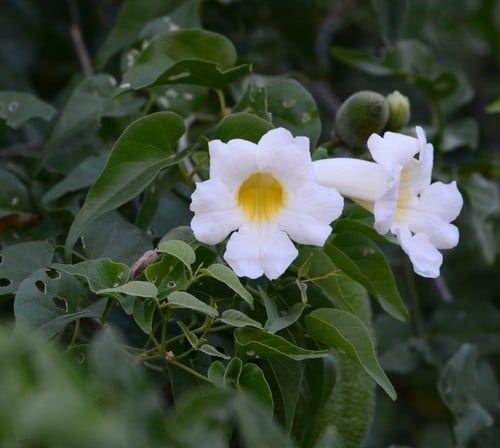
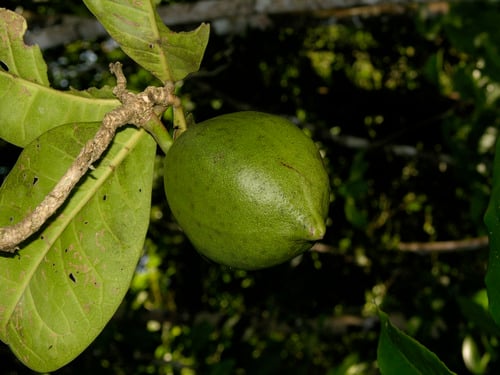
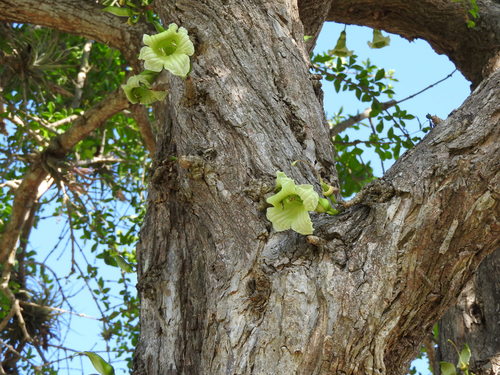
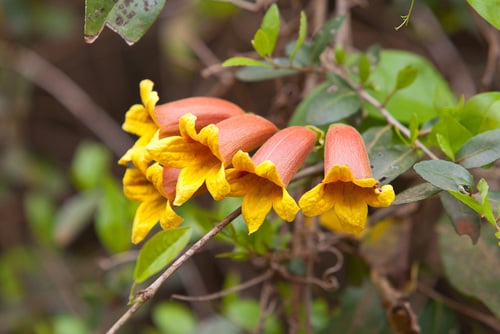
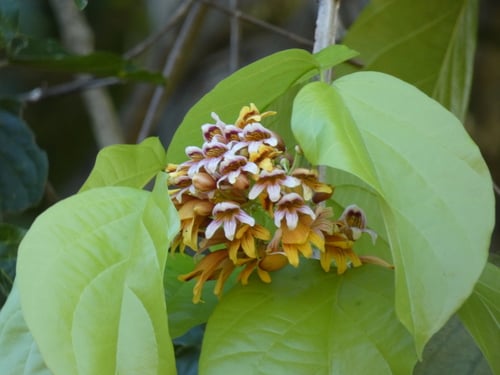
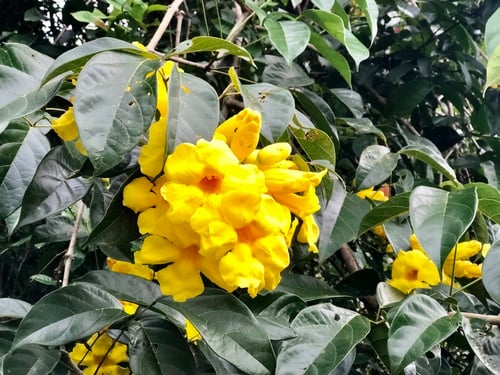
A small evergreen tree. It grows 5-10 m high. It has a spreading crown. The trunk can be 8 cm across. The leaf stalks have narrow wings. The leaves are in rings on short spiny twigs. The leaves have 1-4 leaflets. They are 5 cm long. The flowers and fruit grow from the trunk or singly at the ends of branches. The flowers are large and irregular and bell shaped. They are up to 6 cm long. They usually occur . The tube shaped flowers are yellowish green with purple stripes. The fruit are pointed and yellowish green. The fruit are candle shaped and 12 cm long by 7 cm wide. The fruit is waxy. They are dull yellow and short and plump with ridges like okra. It has many angles and grooves.
Edible Uses
The ripe fruits are eaten raw, cooked by boiling, roasted, preserved, or pickled. The fruits can also be chewed like sugarcane. They are a staple food in some Central American countries.
Traditional Uses
The ripe fruit are eaten raw, cooked by boiling or roasted, and preserved or pickled. They are chewed like sugarcane.
This uses section is brief — help expand it
Medicinal Uses
P. aculeata is planted as an ornamental, shade tree and live fence throughout its native range. Its fruits are edible and are eaten either raw or cooked, and are sometimes pickled or made into preserves. Its flavor is reportedly similar to sugarcane. They are also used as cattle fodder in southern Mexico. The plant is commonly used in traditional medicine. The fruit is used to treat common colds, diabetes, asthma, headaches, diarrhea, and gallstones, while the roots are used as a diuretic.
Distribution
A tropical plant. It grows in the humid lowlands. It is native to Central America. It needs a frost free site. It needs reasonable drainage. In tropical Queensland it grows from sea level to 750 m altitude. It suits hardiness zones 11-12. In Rockhampton Botanical gardens.
Where It Grows
Asia, Australia, Belize, Brazil, Central America*, Colombia, Cuba, Dominican Republic, El Salvador, Guatemala, Haiti, Hawaii, Hispaniola, Honduras, Indonesia, Jamaica, Mexico*, North America, Pacific, Panama, Puerto Rico, SE Asia, South America, St Lucia, USA, Venezuela, West Indies,
Cultivation
Plants grow easily from seed. They can also be grown by cuttings.
Other Uses
The wood is used for fuel.
Production
Trees fruit in about 5 years. It flowers all year round.
Other Information
They are a staple food in some Central American countries. It is cultivated.
Notes
There are 9 Parmentiera species. They are trees from tropical America.
Nutrition
| Part | Moisture | kJ | kcal | Protein | Vit A | Vit C | Iron | Zinc |
|---|---|---|---|---|---|---|---|---|
| Fruit | 87.6 | 184 | 44 | 1.4 | 10 | 5 | 3.2 | — |
Synonyms
Also Known As
Bananinha, Chayote, Chote, Cow okra, Cuachilote, Cuajilote, Cucumber tree, Guachilote, Panama candle tree, Pepino de arbol, Yellowtaper candletree
References (38)
- Altschul, S.V.R., 1973, Drugs and Foods from Little-known Plants. Notes in Harvard University Herbaria. Harvard Univ. Press. Massachusetts. no. 4097 (As Parmentiera edulis)
- Arellanes, Y., et al, 2013, Influence of traditional markets on plant management in the Tehuacan Valley. Journal of Ethnobiology and Ethnomedicine 9:38 (As Parmentiera edulis)
- Arriaga, M. R. et al, 2014, Catalogue of fruit species in the southeast of the State of Mexico, Mexico. Revista Mexicana de Ciencias Agricolas Vol. 5 Num. 8. pp 1509-1517
- Barwick, M., 2004, Tropical and Subtropical Trees. A Worldwide Encyclopedic Guide. Thames and Hudson p 313
- Bot. voy. Herald 183. 1854
Show all 38 references Hide references
- Casas, A., et al, 1996, Plant Management Among the Nahua and the Mixtec in the Balsas River Basin, Mexico: An Ethnobotanical Approach to the Study of Plant Domestication. Human Ecology, Vol. 24, No. 4 pp. 455-478 (As Parementiera edulis)
- Cooper, W. and Cooper, W., 2004, Fruits of the Australian Tropical Rainforest. Nokomis Editions, Victoria, Australia. p 90
- Coronel, R.E., 1982, Fruit Collections in the Philippines. IBPGR Newsletter p 10 (As Parmentaria edulis)
- Cruz, I. M., et al, 2015, Edible fruits and seeds in the State of Mexico. Revista Mexicana de Ciencias Agricolas. Vol. 6. Num. 2 pp 331-346
- Cundall, P., (ed.), 2004, Gardening Australia: flora: the gardener's bible. ABC Books. p 987
- Etherington, K., & Imwold, D., (Eds), 2001, Botanica's Trees & Shrubs. The illustrated A-Z of over 8500 trees and shrubs. Random House, Australia. p 511 (Also as Parmentiera edulis)
- Facciola, S., 1998, Cornucopia 2: a Source Book of Edible Plants. Kampong Publications, p 49
- Gentry, A. H., 1980, Bignoniaceae: Part I (Crescentieae and Tourrettieae): Flora Neotropica, Vol. 25, No. 1, Bignoniaceae: Part I (Crescentieae and Tourrettieae), pp. 1-130
- Grandtner, M. M., 2008, World Dictionary of Trees. Wood and Forest Science Department. Laval University, Quebec, Qc Canada. (Internet database http://www.wdt.qc.ca)
- Grandtner, M. M. & Chevrette, J., 2013, Dictionary of Trees, Volume 2: South America: Nomenclature, Taxonomy and Ecology. Academic Press p 483
- Hedrick, U.P., 1919, (Ed.), Sturtevant's edible plants of the world. p 465 (As Parmentaria edulis)
- Hermandez Bermejo, J.E., and Leon, J. (Eds.), 1994, Neglected Crops. 1492 from a different perspective. FAO Plant Production and Protection Series No 26. FAO, Rome. p14
- Hibbert, M., 2002, The Aussie Plant Finder 2002, Florilegium. p 219
- http://research.famsi.org/botanyworking_plant_list.php (As Parmentiera edulis)
- Jackes, B.R., 2001, Plants of the Tropics. Rainforest to Heath. An Identification Guide. James Cook University. p 44
- Kermath, B. M., et al, 2014, Food Plants in the Americas: A survey of the domesticated, cultivated and wild plants used for Human food in North, Central and South America and the Caribbean. On line draft. p 608
- Kiple, K.F. & Ornelas, K.C., (eds), 2000, The Cambridge World History of Food. CUP p 1765 (As Parmentiera edulis)
- Little, E. L., et al, 1974, Trees of Puerto Rico and the Virgin Islands. USDA Handbook 449. Forestry Service. p 900 (As Parmentiera edulis)
- Llamas, K.A., 2003, Tropical Flowering Plants. Timber Press. p 141
- Lorenzi, H., Bacher, L., Lacerda, M. & Sartori, S., 2006, Brazilian Fruits & Cultivated Exotics. Sao Paulo, Instituto Plantarum de Estuados da Flora Ltda. p 367
- Martin, F. W., et al, 1987, Perennial Edible Fruits of the Tropics. USDA Handbook 642 p 19 (As Parmentiera edulis)
- Miguel, E., et al, 1989, A checklist of the cultivated plants of Cuba. Kulturpflanze 37. 1989, 211-357
- Piedra-Malagón, E. M. et al, 2022, Edible native plants of the Gulf of Mexico Province. Biodiversity Data Journal 10: e80565 p 14
- Plants of Haiti Smithsonian Institute http://botany.si.edu
- Purseglove, J.W., 1968, Tropical Crops Dicotyledons, Longmans. p 628 (As Parmentiera edulis)
- Rivero, J. A., y Brunner, B. R., 2007, Arborels frutales exoticas y poco conocidos en Puerto Rico. Universidad de Puerto Rico. p 36
- Roa, J. A. G. & Boada, D. S. G., 2018, Fundación para el Fortalecimiento de la Fruticultura y Plantas Alimenticias no Convencionales en Colombia.
- Segura, S. et al, 2018, The edible fruit species in Mexico. Genet Resour Crop Evol (2018) 65:1767–1793
- Standley, P. C. & Record, S. J., 1936, The Forests and Flora of British Honduras. (Belize). p 326 (As Parmentiera edulis)
- Staples, G.W. and Herbst, D.R., 2005, A tropical Garden Flora. Bishop Museum Press, Honolulu, Hawaii. p 191
- Sukarya, D. G., (Ed.) 2013, 3,500 Plant Species of the Botanic Gardens of Indonesia. LIPI p 434
- USDA, ARS, National Genetic Resources Program. Germplasm Resources Information Network - (GRIN). [Online Database] National Germplasm Resources Laboratory, Beltsville, Maryland. Available: www.ars-grin.gov/cgi-bin/npgs/html/econ.pl (10 April 2000)
- World Checklist of Useful Plant Species 2020. Royal Botanic Gardens, Kew