Parmentiera cereifera
Seemann
Panama candle tree
iNaturalist· cc-by-nc
(c) Steve Maldonado Silvestrini, some rights reserved (CC BY-NC), uploaded by Steve Maldonado Silvestrini
iNaturalist· cc-by-nc
(c) Steve Maldonado Silvestrini, some rights reserved (CC BY-NC), uploaded by Steve Maldonado Silvestrini
iNaturalist· cc-by-nc
(c) Steve Maldonado Silvestrini, some rights reserved (CC BY-NC), uploaded by Steve Maldonado Silvestrini
Summary
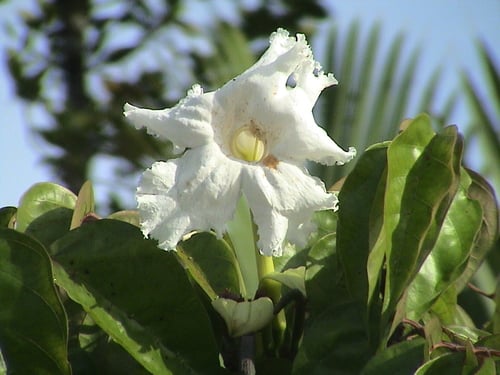
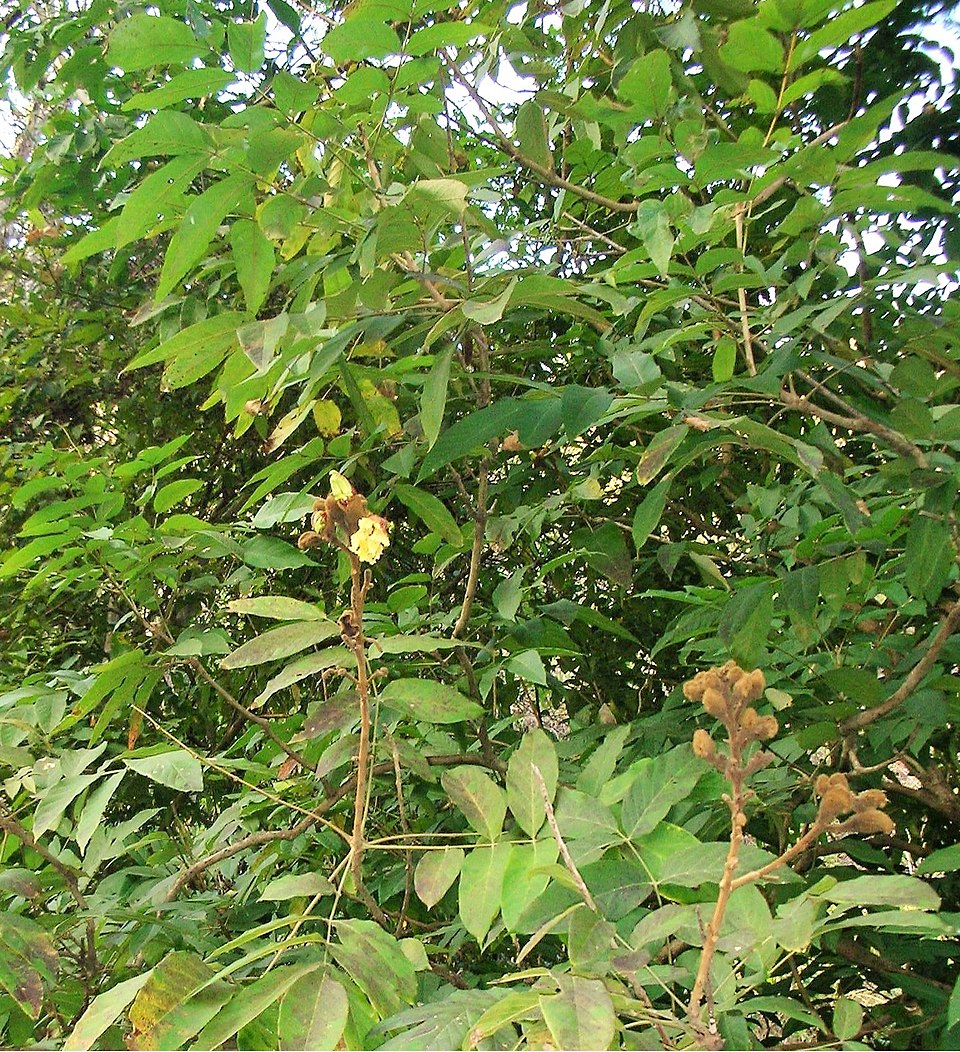
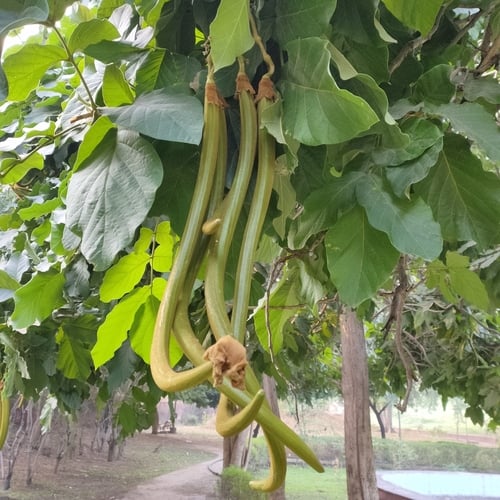
Source: WikipediaParmentiera cereifera, the candle tree, is a species of tree in the family Bignoniaceae. It is endemic to Panama, but it is also a commonly cultivated specimen in botanical gardens. This tree grows up to 6 m tall. The leaves are arranged oppositely, each made up of three leaflets. They are borne on winged petioles up to 5 cm long. The flower is solitary or borne in a cluster of up to four. The five-lobed corolla is greenish white. The fruit is a taper-shaped berry up to 60 cm long. The record is 120 cm long while only 2.5 cm wide. It is green, ripening yellow, and waxy in texture. The fleshy fruit is edible.
Description
A small evergreen tree. It grows 7 m tall. It develops branches from near the base of the trunk. The limbs spread and arch in an untidy manner. The leaves have 3 leaflets and are light green. The leaflets are 6.5 cm long. The leaf stalks have wings. The flowers are showy and greenish-white. They are 5 cm long. They are bell-shaped and have frilly lips. They are produced on the stems and trunk. The fruit is a capsule 54 cm long. It is a dull yellow and hangs from the trunk and branches.
Edible Uses
Fruit - raw or cooked. The waxy, white to yellow, candle-shaped fruit can be 39 - 54cm long and 10 - 24mm wide.
Traditional Uses
The fruit are eaten.
This uses section is brief — help expand it
Medicinal Uses
Both the bark and the roots have medicinal properties.
Distribution
A tropical plant. It is native to Panama. It grows on limestone formations. It can tolerate some drought. It is best in full sun or bright shade. It needs well drained soil. It suits hardiness zones 10-12. In XTBG Yunnan.
Where It Grows
Africa, Asia, Australia, Brazil, Central America*, China, Colombia, Costa Rica, Dominican Republic, East Africa, Haiti, Hawaii, Hispaniola, India, Mexico*, Mozambique, North America, Pacific, Panama*, Puerto Rico, South America, Sri Lanka, Trinidad, USA, Venezuela, West Africa, West Indies,
Cultivation
Plants are grown from seed.
Production
It is slow growing.
Other Information
It is a cultivated food plant.
Synonyms
Also Known As
Cuachilote, Palo de velas, Pato de vela
References (18)
- Ambasta, S.P. (Ed.), 2000, The Useful Plants of India. CSIR India. p 431
- Barwick, M., 2004, Tropical and Subtropical Trees. A Worldwide Encyclopedic Guide. Thames and Hudson p 313
- Burkill, H. M., 1985, The useful plants of west tropical Africa, Vol. 1. Kew.
- Condit, R., et al, 2011, Trees of Panama and Costa Rica. Princeton Field Guides. p 90
- Cundall, P., (ed.), 2004, Gardening Australia: flora: the gardener's bible. ABC Books. p 987
Show all 18 references Hide references
- Etherington, K., & Imwold, D., (Eds), 2001, Botanica's Trees & Shrubs. The illustrated A-Z of over 8500 trees and shrubs. Random House, Australia. p 511
- Facciola, S., 1998, Cornucopia 2: a Source Book of Edible Plants. Kampong Publications, p 49
- Grandtner, M. M., 2008, World Dictionary of Trees. Wood and Forest Science Department. Laval University, Quebec, Qc Canada. (Internet database http://www.wdt.qc.ca)
- Heywood, V.H., Brummitt, R.K., Culham, A., and Seberg, O. 2007, Flowering Plant Families of the World. Royal Botanical Gardens, Kew. p 63
- J. Bot. (Hooker) 3:302. 1841 (B. Seemann, Bot. voy. Herald 182, t. 32. 1854)
- Llamas, K.A., 2003, Tropical Flowering Plants. Timber Press. p 141
- Mabberley, D.J. 1990. The plant-book: a portable dictionary of the higher plants. Cambridge University Press. NY.
- Menninger, E.A., 1977, Edible Nuts of the World. Horticultural Books. Florida p 79
- Purseglove, J.W., 1968, Tropical Crops Dicotyledons, Longmans. p 629
- Roa, J. A. G. & Boada, D. S. G., 2018, Fundación para el Fortalecimiento de la Fruticultura y Plantas Alimenticias no Convencionales en Colombia.
- Staples, G.W. and Herbst, D.R., 2005, A tropical Garden Flora. Bishop Museum Press, Honolulu, Hawaii. p 191
- Wickens, G.E., 1995, Edible Nuts. FAO Non-wood forest products. FAO, Rome. p 109
- World Checklist of Useful Plant Species 2020. Royal Botanic Gardens, Kew