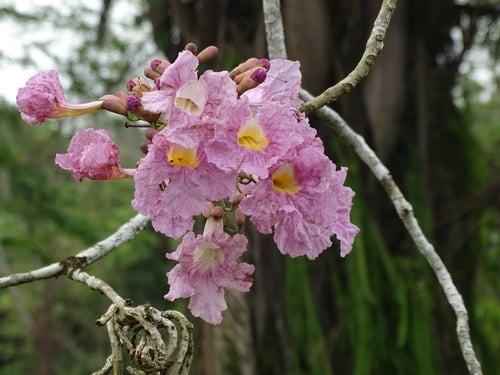
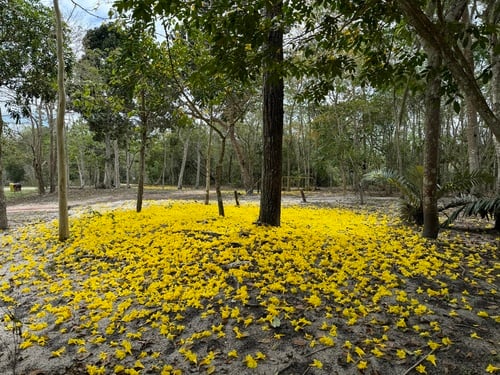
Mayodendron igneum
(Kurz) Kurz
Tree jasmine
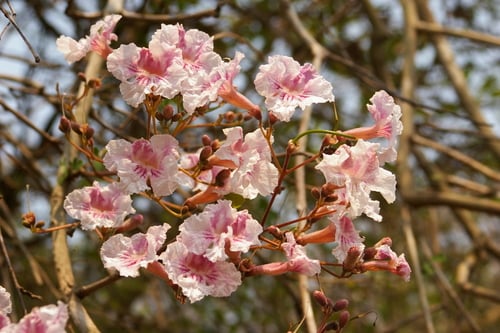
iNaturalist· cc-by-nc
(c) onidiras-iNaturalist, some rights reserved (CC BY-NC), uploaded by onidiras-iNaturalist
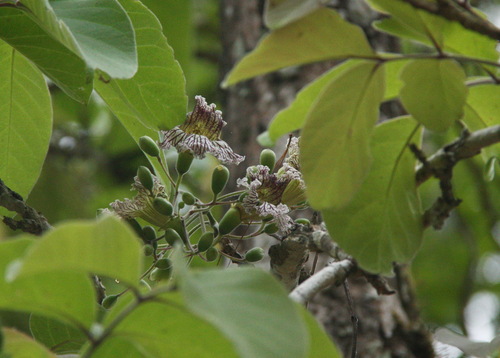
iNaturalist· cc-by-nc
(c) onidiras-iNaturalist, some rights reserved (CC BY-NC), uploaded by onidiras-iNaturalist
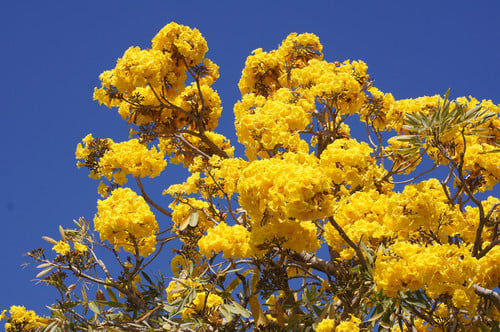
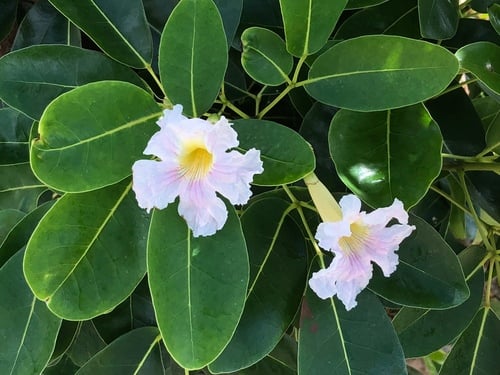
iNaturalist· cc-by-nc-nd
(c) Cerlin Ng, some rights reserved (CC BY-NC-ND)
Description
A tree. It grows up to 20 m tall. The bark is smooth. The leaves are compound. They are twice divided. They are 60 cm long. There are side leaflets then small leaflet stalks about 5 mm long with a leaflet at the end. The flowers are on old stems. There are 5-13 flowers in a group. The fruit is a capsule up to 45 cm long and it is twisted. It splits and opens. There are many flat seeds. They have wings at both ends.
Edible Uses
The flowers are cooked and eaten as a vegetable, used in stir-fried dishes, and added to curries. Leaves are also edible.
Traditional Uses
The flowers are cooked and eaten as a vegetable. They are also used in stir-fried dishes. They are added to curries.
This uses section is brief — help expand it
Distribution
It is a tropical plant. In Borneo it grows between 100-1,900 m above sea level. In XTBG Yunnan.
Where It Grows
Asia, China, Indochina, Laos, Malaysia, Myanmar, SE Asia, Taiwan, Thailand, Vietnam,
Other Information
It is a cultivated food plant. It is sold in local markets.
Synonyms
Also Known As
A ci ma ha nen, Agayit-ni, Guo te guo me a ye, Hpun-hpawk, Huo shao hua, Lao bie, Luobi, Jie tong, Ledoulebo, Mai-pyit, Nia long fan, Ntoo paj lab, Sumhtung, Sumtungh-kyeng
References (10)
- Anderson, E. F., 1993, Plants and people of the Golden Triangle. Dioscorides Press. p 219
- Cao, Y., et al, 2020, Ethnobotanical study on wild edible plants used by three trans-boundary ethnic groups in Jiangcheng County, Pu’er, Southwest China. Journal of Ethnobiology and Ethnomedicine (2020) 16:66
- Ghorbani, A., et al, 2012, A comparison of the wild food plant use knowledge of ethnic minorities in Naban River Watershed Nature Reserve, Yunnan, SW China. Journal of Ethnobiology and Ethnomedicine; 8:17
- Liu, Yi-tao, & Long, Chun-Lin, 2002, Studies on Edible Flowers Consumed by Ethnic Groups in Yunnan. Acta Botanica Yunnanica. 24(1):41-56
- Luo, B., et al, 2019, Wild edible plants collected by Hani from terraced rice paddy agroecosystem in Honghe Prefecture, Yunnan, China. Journal of Ethnobiology and Ethnomedicine 15:56
Show all 10 references Hide references
- Slik, F., www.asianplant.net
- Thitiprasert, W., et al, 2007, Country report on the State of Plant Genetic Resources for Food and Agriculture in Thailand (1997-2004). FAO p 95 (As Radermachera ignea)
- Whitney, C. W., et al, 2014, Conservation and Ethnobotanical Knowledge of a Hmong Community in Long Lan, Luang Prabang, Lao People’s Democratic Republic. Ethnobotany Research and Applications 12:643-658 (As Radermachera ignea)
- www.pang-soong-lodge.com website (As Radermachera ignea)
- Xu, You-Kai, et al, 2004, Wild Vegetable Resources and Market Survey in Xishuangbanna, Southwest China. Economic Botany. 58(4): 647-667.