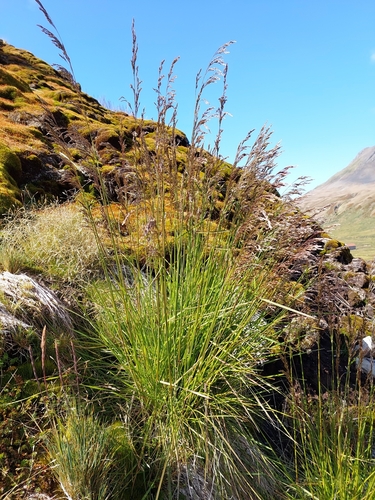
Chimonobambusa marmorea
(Mitford) Makino
Marble sheath bamboo, Winter shooting bamboo
iNaturalist· cc-by-sa
(c) harum.koh, some rights reserved (CC BY-SA), uploaded by harum.koh
iNaturalist· cc-by-nc
(c) Colin Ogle, some rights reserved (CC BY-NC)
Summary
An evergreen bamboo reaching 1.5 m tall with fast growth rate. Hardy to UK zone 6. Year-round foliage; wind-pollinated hermaphrodite. Tolerates light sandy, medium loamy, and heavy clay soils. Grows in mildly acid, neutral, or basic soils. Adapts to semi-shade or full sun with preference for moist soil.
Description
A bushy bamboo. It grows 2-3 m high. The stems are slender and black. They are 1-2 cm across. The young shoots are creamy purple. The leaves are 6-15 cm long by 8-12 mm wide. They do not have hairs.
Edible Uses
The young shoots are edible cooked. The seed can be used as a cereal, though it is neither regularly nor abundantly produced.
Traditional Uses
The young shoots are eaten.
This uses section is brief — help expand it
Medicinal Uses
None known
Distribution
It is a temperate plant. It needs to be in moist soil. It can tolerate temperatures down to -9°C. It grows in hills and low mountains between 200-1,500 m above sea level in central China. It suits hardiness zones 7-10.
Where It Grows
Asia, Australia, China, Europe, Indonesia, Japan*, SE Asia,
Cultivation
Plants can be grown by division.
Propagation
Surface sow seed as soon as it is ripe in a greenhouse at about 20°c, keeping the compost consistently moist. Germination usually occurs fairly quickly with good-quality seed, though it can take 3–6 months. Grow seedlings on in a lightly shaded greenhouse position until large enough to plant out. Seed is rarely available. Divide in spring as new growth begins, taking divisions with at least three canes and disturbing the main plant's roots as little as possible. Grow divisions in light shade in a greenhouse in pots of high-fertility sandy medium, misting the foliage regularly until established. Plant out when a good root system has developed, which can take a year or more. Basal cane cuttings can also be used.
Other Uses
Hedge Hedge The plant is useful for low screens, clumps and hedges. Special Uses Hedge Hedge
Other Information
It is cultivated.
Notes
There are about 10-40 Chimonobambusa species.
Synonyms
Also Known As
Bambu kelereng, Han zhu, Kan-chiku, Marbled bamboo
References (11)
- Bot. Mag. (Tokyo) 28:154. 1914
- Crouzet, I., Starosta, P., 1998, Bamboos. Evergreen. p 22
- Cundall, P., (ed.), 2004, Gardening Australia: flora: the gardener's bible. ABC Books. p 371
- Hibbert, M., 2002, The Aussie Plant Finder 2002, Florilegium. p 66
- http://www.plantnames.unimelb.edu.au/sorting/Bamboos_Edible.html
Show all 11 references Hide references
- Levy-Yamamori, R., & Taaffe, G., 2004, Garden Plants of Japan. Timber Press. p 366
- Plants for a Future database, The Field, Penpol, Lostwithiel, Cornwall, PL22 0NG, UK. http://www.scs.leeds.ac.uk/pfaf/
- Ryan, S., 2008, Dicksonia. Rare Plants Manual. Hyland House. p 83
- Sukarya, D. G., (Ed.) 2013, 3,500 Plant Species of the Botanic Gardens of Indonesia. LIPI p 839
- Wiersema, J. H. & Leon, B., 2013, World Economic Plants. A Standard Reference CRC Press. 2nd Ed. p 169
- World Checklist of Useful Plant Species 2020. Royal Botanic Gardens, Kew