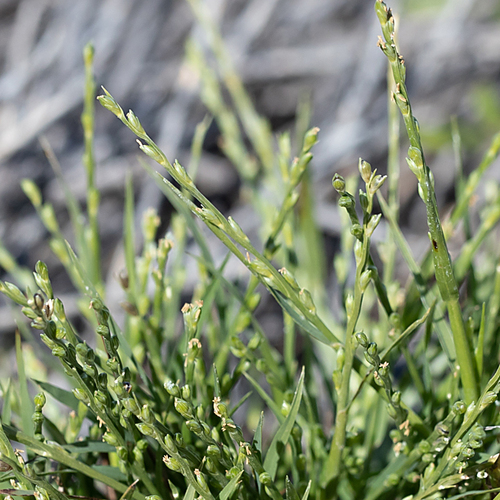
Schizostachyum latifolium
Gamble
iNaturalist· cc-by-nc-sa
(c) Smithsonian Institution, National Museum of Natural History, Department of Botany, some rights reserved (CC BY-NC-SA)
Description
A bamboo. It grows 3-5 m tall. The stems are 2-3 cm across. The tips arch over. The inter-nodes are 35-80 cm long. They are whitish below the nodes. There are branches at the nodes. The sheath is 10-16 cm long by 4-5 cm wide. It is light green.
Edible Uses
The shoots are eaten, though probably only occasionally.
Distribution
It is a tropical plant. It grows in the edges of forests near rivers. It grows up to 1,000 m above sea level.
Where It Grows
Asia, Indochina, Malaysia, SE Asia, Thailand,
Cultivation
Bamboos have an interesting method of growth. Each plant produces a number of new stems annually - these stems grow to their maximum height in their first year of growth, subsequent growth in the stem being limited to the production of new side branches and leaves. In the case of some mature tropical species the new stem could be as much as 30 metres tall, with daily increases in height of 30cm or more during their peak growth time. This makes them some of the fastest-growing species in the world. Bamboos in general are usually monocarpic, living for many years before flowering, then flowering and seeding profusely for a period of 1 - 3 years before usually dying.
Other Uses
The culms are used to make fine woven baskets ('seraung') and in Sarawak to make blowpipes, tobacco containers (part of internode, carved in low relief), baskets and other ornamental woven objects such as mats. Culms of Schizostachyum latifolium however, can be split into fine strips which are suitable to be woven into very fine baskets.
Other Information
The shoots are probably only occasionally eaten.
Synonyms
References (1)
- Hoare, A., 2003, Food use of the Lundayeh SW Sabah. Borneo Research Council.