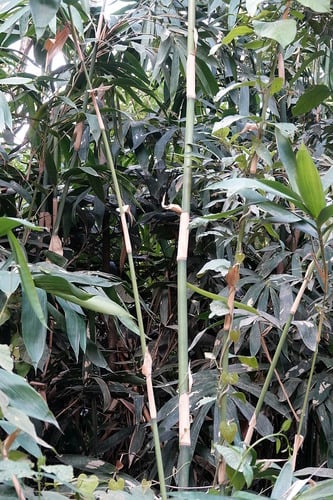
Schizostachyum grande
Ridl.
gbif· cc-by
Royal Botanic Gardens, Kew
gbif· cc-by
Royal Botanic Gardens, Kew
gbif· cc-by
Royal Botanic Gardens, Kew
Description
A bamboo. It grows 12-20 m tall. The stems are 7-12 cm long. The internodes are 90 cm long. The sheaths are 35 cm long. They are pale green. The leaf blade is 60 cm long by 10 cm wide.
Edible Uses
The shoots are eaten.
Distribution
It is a tropical plant. It grows in mountain valleys up to 1,000 m above sea level in Malaysia.
Where It Grows
Asia, Indochina, Laos, Malaysia, SE Asia, Thailand,
Cultivation
The plant is regarded as a weed of overlogged forests in Peninsular Malaysia, where it occurs abundantly, together with Gigantochloa scortechinii and Dendrocalamus pendulus. Efforts used to be directed towards eradication of the plants, but at present, the exploitation of these weedy bamboos as material for local cottage industries is being promoted - more successfully for Gigantochloa scortechinii and Dendrocalamus pendulus than for Schizostachyum grande. More research is needed on how to reclaim land in certain areas occupied by Schizostachyum grande. A mature clump of Schizostachyum grande contains on average 10 - 25 culms, exceptionally to 60 culms. Young shoots and inflorescences are produced all the year round. Bamboos have an interesting method of growth. Each plant produces a number of new stems annually - these stems grow to their maximum height in their first year of growth, subsequent growth in the stem being limited to the production of new side branches and leaves. In the case of some mature tropical species the new stem could be as much as 30 metres tall, with daily increases in height of 30cm or more during their peak growth time. This makes them some of the fastest-growing species in the world. Bamboos in general are usually monocarpic, living for many years before flowering, then flowering and seeding profusely for a period of 1 - 3 years before usually dying.
Other Uses
The culms are used as frames, for plaiting dish covers and winnowing trays, and as containers to cook glutinous rice ('lemang'). As a thin-walled bamboo, the culms could be used to make baskets and other handicrafts. The leaves are used as wrappers for a Chinese glutinous rice dumpling.
Also Known As
Buloh semeliang, Mai poung chin, Phai miang, Phai ta kwang
References (1)
- A Rapid Participatory Biodiversity Assessment. 2007, Southern Lao PDR. IUCN p 104