Schizostachyum lumampao
(Blanco) Merr.
Buho
wikimedia· cc-by-sa
Wikimedia Commons - JFVelasquez Floro
gbif· cc0
President and Fellows of Harvard College
gbif· cc0
President and Fellows of Harvard College
Description
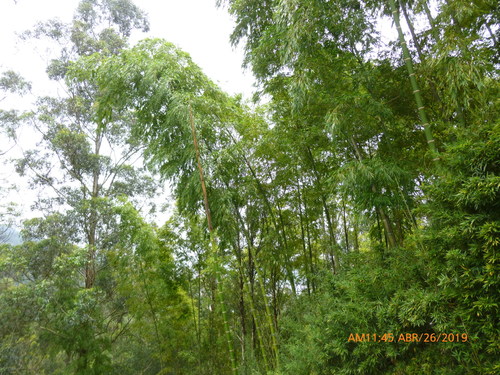
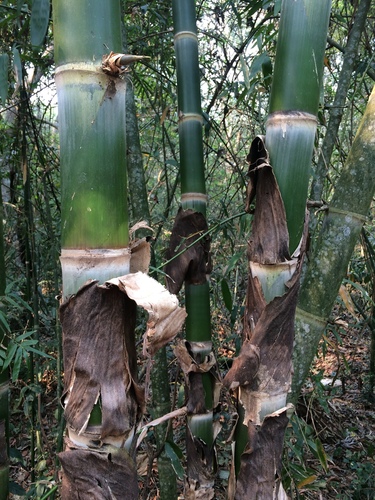
A thin walled erect bamboo. It usually is about 10 m high and large clumps often occupy an area excluding other plants. The stems are about 7,5 to 9 cm across, green and without spines. The internodes are 30 to 50 cm long. The nodes are at an angle and the angle is opposite for each node. It does not form roots from the nodes and does not branch from the fifth node.
Edible Uses
The young shoots are cooked and eaten.
Traditional Uses
The young shoots are cooked and eaten.
This uses section is brief — help expand it
Distribution
A tropical plant. It is widely scattered in the Philippines especially in Bataan and Zambales.
Where It Grows
Asia, Australia, Pacific, Philippines, SE Asia,
Cultivation
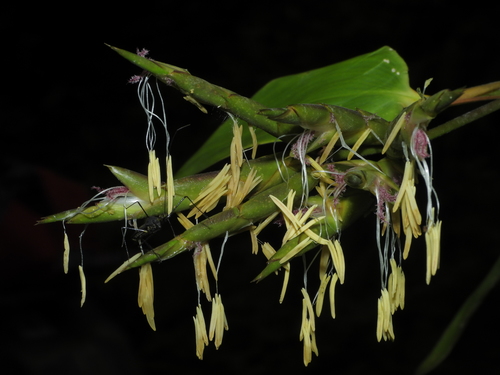
A plant of the moist, tropical lowlands, where it can also be found at elevations up to 1,500 metres. It grows best at an average temperature of 28 - 32°c with an annual rainfall around 1,900 mm. It grows best on a well-drained sandy loam or clay loam, often found growing found on forested hills with a pH of 5.0 - 6.5. Young shoots emerge during the rainy season and develop to their full height in 4 - 6 months. The culms become mature in 1 - 2 years; they reach their maximum diameter at 5 metres height. A healthy clump produces several young shoots annually, up to about 10% of the number of mature culms. The number of culms per hectare in natural stands averages about 9,000, but can be as high as 25,000 in dense stands. The dry weight rate of the above ground parts of a culm is approximately 89% for the culm, 7% for the branches, 4% for the leaves. The culms can best be harvested in the dry season. In a newly established plantation, harvesting may start 5 years after planting. Most harvesting, however, is done from natural stands. It is recommended to harvest only culms 3 years old or older in a 2-year-felling cycle, leaving about 40% of the standing mature culms evenly spaced in the clump. It has been estimated that dense natural stands of Schizostachyum lumampao can yield 2,500 culms per hectare each year, which is 15 tonnes on a dry-weight basis. The total dry weight of an average standing crop in natural stands is estimated at 59 - 73 tonnes per hectare. To produce 50 tonnes of pulp (for paper) per day, it is estimated that about a minimum of 4,000 hectares planted with Schizostachyum lumampao is necessary; pulp yield is on average about 43% of the culm yield. Traditionally, harvested culms are air dried in the sun or in the shade for about 1 month. Kiln drying takes about 9 days. The culms are classified in the Philippines as moderately resistant to deterioration. Traditional methods are often used to preserve culms. These include soaking, curing, smoking and whitewashing. For industrial use, several chemical preservation methods are possible. Bamboos have an interesting method of growth. Each plant produces a number of new stems annually - these stems grow to their maximum height in their first year of growth, subsequent growth in the stem being limited to the production of new side branches and leaves. In the case of some mature tropical species the new stem could be as much as 30 metres tall, with daily increases in height of 30cm or more during their peak growth time. This makes them some of the fastest-growing species in the world. Bamboos in general are usually monocarpic, living for many years before flowering, then flowering and seeding profusely for a period of 1 - 3 years before usually dying.
Propagation
Seed - when available, it should be sown immediately. Sow in a moderately shaded position in containers, only just covering the seed. The seedlings can be transplanted after 5 - 6 months when they are 30 - 60 cm tall. Rhizome cuttings (part of clump with roots, rhizome part and culm part) survive better than culm cuttings. Culm cuttings (2-node portions) can be taken from 6 - 24 month-old culms, kept in the nursery for 3 - 5 months and planted out in the field in the rainy season.
Other Uses
The culms are widely used in making bamboo matting known as 'sawali', a material woven from thin strips, which is variously used in rural areas. They are also commonly used to make baskets, fences, spears, fish pens, flutes, handicrafts and for many other purposes, including constructions, ply bamboo panels and paper pulp.
Other Information
It is cultivated.
References (4)
- Amer. J. Bot. 3:65. 1916
- Hibbert, M., 2002, The Aussie Plant Finder 2002, Florilegium. p 288
- Monsalud, M.R., Tongacan, A.L., Lopez, F.R., & Lagrimas, M.Q., 1966, Edible Wild Plants in Philippine Forests. Philippine Journal of Science. p 475
- Zeven, A. C. & de West, J. M. J., 1982, Dictionary of cultivated plants and their regions of diversity. Wageningen. p 55