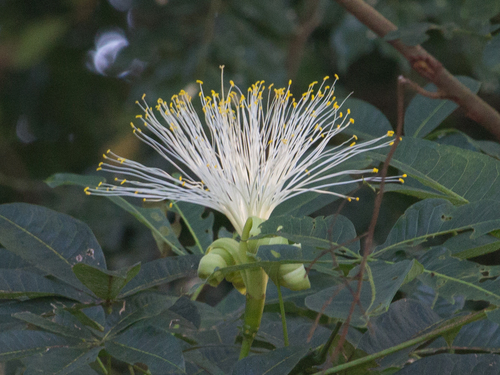
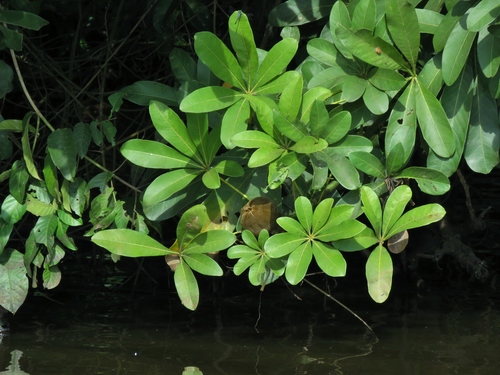
Cola lateritia
K. Schum.
Monkey kola (red), Bush cola
iNaturalist· cc-by-nc
(c) Carel Jongkind, some rights reserved (CC BY-NC)
iNaturalist· cc-by-nc
(c) Carel Jongkind, some rights reserved (CC BY-NC)
Description
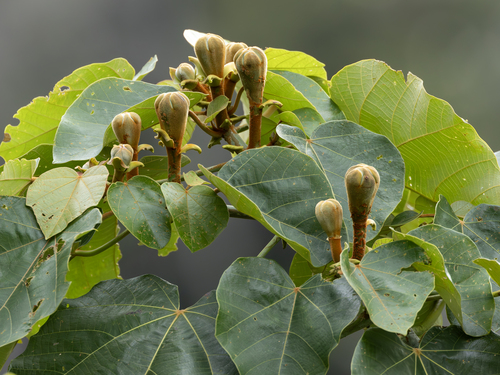
A tree. It grows 25-50 m tall. It loses its leaves during the year. The trunk is straight for about 30 m and 1-2 m wide at the base. The fruit are red.
Edible Uses
Fruit. The pulp is eaten. The red or pink fruit consists of usually 4 indehiscent follicles, on a robust, 7 - 10cm long pedicel; the follicles are ovoid to globose, up to 65mm long, with a short and slender beak. The seed is chewed in the same way as that of the true kola (mainly Cola acuminata and Cola nitida). The seed is rich in caffeine and is chewed to give energy and increase endurance. Leaf buds and young leaves - cooked and eaten as a vegetable. They are much appreciated during feasts and initiation ceremonies.
Traditional Uses
The pulp of the fruit is eaten. The seed is chewed. The young leaves are eaten as a vegetable.
This uses section is brief — help expand it
Medicinal Uses
Sun-dried plant parts are smoked in a pipe for treatment of tuberculosis. A preparation of the inner bark is drunk as a remedy for coughs. A bark decoction is drunk as a treatment for intercostal pain. A bark-decoction is applied as a vaginal douche in a treatment against sterility. Eruptions, especially on the nostrils, are treated with an ointment of the inner bark pounded with clay, and by bathing the afflicted parts in a leaf decoction.
Distribution
It is a tropical plant.
Where It Grows
Africa, Angola, Cameroon, Cape Verde, Central Africa, Central African Republic, CAR, Congo DR, Gabon, Guinea, Guinée, Liberia, Sierra Leone, West Africa,
Propagation
Seed - best sown as soon as it is ripe. Germination rates are usually high, with the seed sprouting within 6 - 21 days.
Other Uses
Fibre from the bark is made into cordage. The heartwood is pinkish brown, sometimes figured; the sapwood is grey-white. The grain is mostly straight, texture coarse. The wood is tough, strong and flexible, bending without breaking, but is not durable. It is difficult to work and does not give a smooth finish; it splits easily. The wood is used in local carpentry and for making casks and bows. The wood of the buttresses is considered good for making pails and tubs for household use, and clappers made from the wood are attached to hunting-dogs.
Production
In Central African Republic flowers have been recorded January to March.
Other Information
The fruit are sold in local markets.
Synonyms
Also Known As
Amoreira, Toko
References (10)
- Awodoyin, R.O., Olubode, O.S., Ogbu, J.U., Balogun, R.B., Nwawuisi, J.U. and Orji, K.O., 2015, Indigenous Fruit Trees of Tropical Africa: Status, Opportunity for Development and Biodiversity Management. Agricultural Sciences, 6, 31-41Mon
- Duarte, M. C., et al, 2022, Diversity of Useful Plants in Cabo Verde Islands: A Biogeographic and Conservation Perspective. Plants 2022, 11, 1313 p 14
- Ferns, Useful Tropical Plants.
- Hawthorne, W.& Marshall, C., 2013, Nimba Western Area Iron Ore Concentrator Mining Project Environmental and Social Impact Assessment. AcelorMittel Liberia. p 469
- Hwang, L. C., et al, 2020, Traditional Botanical Uses of Non-Timber Forest Products (NTFP) in Seven Counties in Liberia. ACS Symposium Series; American Chemical Society: Washington, DC, 2020.
Show all 10 references Hide references
- INFOODSUpdatedFGU-list.xls
- Jusu, A. & Cuni-Sanchez, A., 2017, Priority indigenous fruit trees in the African rainforest zone: insights from Sierra Leone. Genet Resour Crop Evol (2017) 64:745–760
- Tanno, T., 1981, Plant Utilization of the Mbuti Pygmies: With Special reference to their Material Culture and Use of Wild Vegetable Foods. Kyoto University Research. African Study Monographs 1:1-53
- Voorhoeve, A. G., 1965, Liberian high forest trees. Pudoc p
- World Checklist of Useful Plant Species 2020. Royal Botanic Gardens, Kew