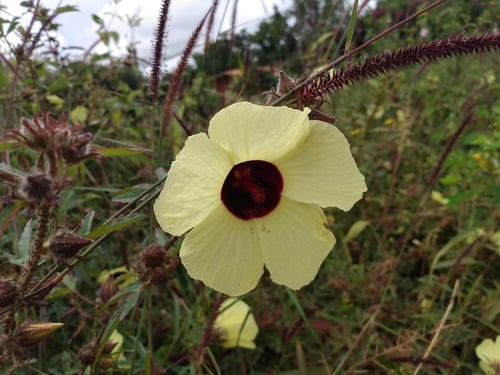
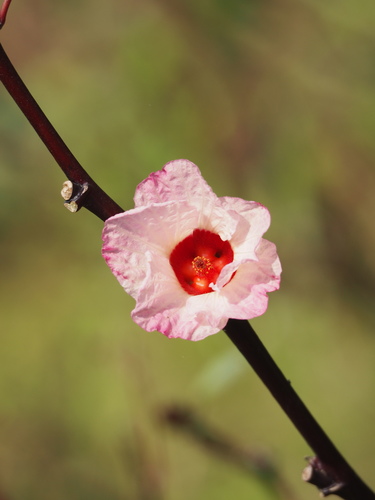
Brachychiton rupestris
(Mitchell ex Lindley) K. Schum.
Bottle tree, Narrow-leaved bottle tree, Queensland Bottle Tree, Barrel tree
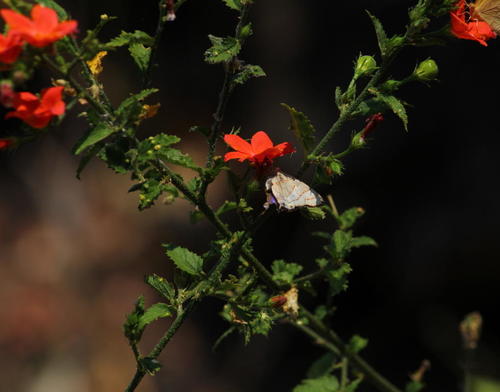
iNaturalist· cc-by-nc
(c) Matthieu Gauvain, some rights reserved (CC BY-NC), uploaded by Matthieu Gauvain
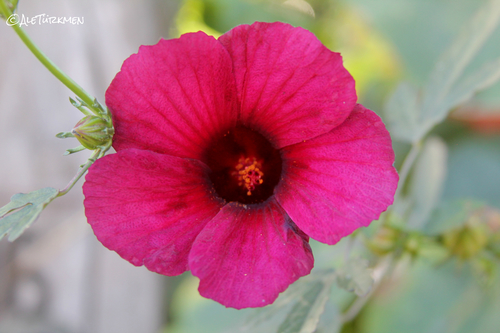
iNaturalist· cc-by-nc
(c) Mick Drews, some rights reserved (CC BY-NC), uploaded by Mick Drews
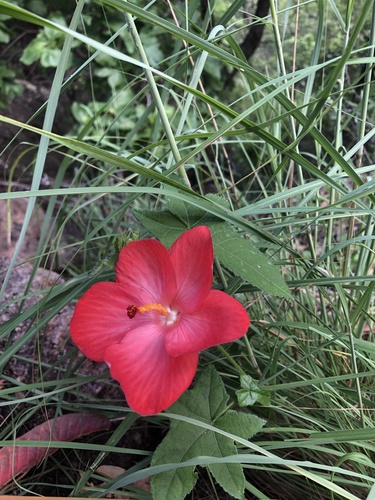
iNaturalist· cc-by-nc
(c) Pete Woodall, some rights reserved (CC BY-NC), uploaded by Pete Woodall
Summary
Source: WikipediaBrachychiton rupestris (commonly known as the narrow-leaved bottle tree or Queensland bottle tree) is a tree in the family Malvaceae, endemic to the Australian state of Queensland. Described by Sir Thomas Mitchell and John Lindley in 1848, it earned its name from its bulbous trunk, which can be up to 3.5 metres (11 ft) in diameter at breast height (DBH). Reaching around 10–25 m (33–82 ft) high, the Queensland bottle tree is deciduous, losing its leaves seasonally, between September and December. The leaves are simple or divided, with one or more narrow leaf blades up to 11 centimetres (4 in) long and 2 cm (0.8 in) wide. Cream-coloured flowers appear from September to November, and are followed by woody, boat-shaped follicles that ripen from November to May. No subspecies are recognised. As a drought deciduous and succulent tree, much like the baobab (Adansonia) of Madagascar, B. rupestris adapts readily to cultivation, and is quite tolerant of a range of soils and temperatures. It is a key component and emergent tree in the endangered central semi-evergreen vine thickets (also known as bottletree scrub) of the Queensland Brigalow Belt. Remnant trees are often left by farmers on cleared land for their value as shade and fodder trees, and as homes for various birds and animals.
Description
A medium sized tree. It can be 8-10 m tall. It develops a large bottle-shaped trunk. This can be 2 m across. The plant can spread 5-6 m wide. It loses many leaves during the year. Young leaves have deep lobes but adult leaves are undivided. They are 5-10 cm long by 7-8 mm wide, and bright green. Flowers are bell-shaped. They are 1.2 cm across. They occur in small clusters near the ends of branches. The fruit are boat-shaped follicles. They are dark brown and leathery. They are 2-3 cm long.
Edible Uses
Aboriginal people made use of the trees through eating the roots of young plants and by consuming secretions from the trunk that were induced by wounds. Fibre obtained from the species was used to make nets. The leaves have also been used for fodder, and Queensland farmers often leave bottle trees as a potential food source when land is cleared. During drought conditions, whole trees have been felled to feed stock. The soft edible pulp inside the trunk is exposed by removing the bark. The pulp is energy-rich but protein-poor, and occasional cases of nitrate poisoning have led to cattle deaths.
Traditional Uses
The young leaves are used as a salad vegetable. The gum is edible. The young roots of seedling trees are boiled and eaten.
This uses section is brief — help expand it
Known Hazards
The seeds are surrounded in the seed capsule by irritant hairs and are best collected using gloves. The tree is sometimes used as a fodder, especially in times of drought, though there are occasional cases of cattle dying as a result of nitrate poisoning.
Distribution
A tropical plant. It grows in drier regions. It cannot tolerate heavy frosts. It is very drought tolerant. It needs an acid pH. It grows in areas with an annual rainfall between 460-890 mm. It can grow in arid places. Melbourne Botanical gardens. National Arboretum Canberra. It suits hardiness zones 9-11.
Where It Grows
Africa, Asia, Australia*, Indonesia, SE Asia, Sudan,
Cultivation
Plants can be grown from seed. Young plants transplant easily.
Propagation
Seed - fresh seed is relatively easy to germinate without the need for any pre-treatment. If dried seed is soaked in warm water for 12 - 24 hours prior to sowing it then germinates easily.
Other Uses
The fibrous inner bark is used to make twine or rope and can be woven together to make nets. A gum resembling gum tragacanth (Astragalus spp.) in appearance is obtained from the trunk. This gum, however, does not thicken water, except to an almost inappreciable extent, and, therefore, could not have the same economic uses to which the very viscid tragacanth is put.
Production
It is very slow growing.
Notes
There are about 38 Brachychiton species. Most are in Australia. Also put in the family Sterculiaceae.
Synonyms
Also Known As
Binkey, Pohon botol australia, Pohon kepel australia
References (28)
- Anderson, M., 2002, The World Encyclopedia of Cacti and Succulents. Hermes House, New York. p 136
- Bailey, F. M., 1913, Comprehensive Catalogue of Queensland Plants. Queensland Government. p 62
- Barwick, M., 2004, Tropical and Subtropical Trees. A Worldwide Encyclopedic Guide. Thames and Hudson p 56
- Bircher, A. G. & Bircher, W. H., 2000, Encyclopedia of Fruit Trees and Edible Flowering Plants in Egypt and the Subtropics. AUC Press. p 63
- Bodkin, F., 1991, Encyclopedia Botanica. Cornstalk publishing, p 164
Show all 28 references Hide references
- Cooper, W. and Cooper, W., 2004, Fruits of the Australian Tropical Rainforest. Nokomis Editions, Victoria, Australia. p 530
- Cribb, A.B. & J.W., 1976, Wild Food in Australia, Fontana. p 105, 138, 185
- Elliot, W.R., & Jones, D.L., 1982, Encyclopedia of Australian Plants suitable for cultivation. Vol 2. Lothian. p 367
- H. G. A. Engler & K. A. E. Prantl, Nat. Pflanzenfam. 3(6):96. 1893
- Etherington, K., & Imwold, D., (Eds), 2001, Botanica's Trees & Shrubs. The illustrated A-Z of over 8500 trees and shrubs. Random House, Australia. p 139
- Greig, D., 1996, Flowering Natives for Home Gardens. Angus & Robertson. p 87
- Hedrick, U.P., 1919, (Ed.), Sturtevant's edible plants of the world. p 635 (As Sterculia rupestris)
- Hibbert, M., 2002, The Aussie Plant Finder 2002, Florilegium. p 45
- Lazarides, M. & Hince, B., 1993, Handbook of Economic Plants of Australia, CSIRO. p 36
- Lim, T. K., 2015, Edible Medicinal and Non Medicinal Plants. Volume 9, Modified Stems, Roots, Bulbs. Springer p 17
- Llamas, K.A., 2003, Tropical Flowering Plants. Timber Press. p 266
- Lord, E.E., & Willis, J.H., 1999, Shrubs and Trees for Australian gardens. Lothian. p 13
- Low, T., 1991, Wild Food Plants of Australia. Australian Nature FieldGuide, Angus & Robertson. p 183
- Menninger, E.A., 1977, Edible Nuts of the World. Horticultural Books. Florida p 43 (As Sterculia rupestris)
- Molyneux, B & Forrester, S., 1997, The Austraflora A-Z of Australian Plants. Reed. p 57
- Ratcliffe D & P., 1987, Australian Native Plants for Indoors. Little Hills press. p 64
- Recher, P, 2001, Fruit Spirit Botanical Gardens Plant Index. www.nrg.com.au/~recher/ seedlist.html p 1, 5
- Royal Botanic Gardens, Kew (1999). Survey of Economic Plants for Arid and Semi-Arid Lands (SEPASAL) database. Published on the Internet; http://www.rbgkew.org.uk/ceb/sepasal/internet [Accessed 11th June 2011]
- Sukarya, D. G., (Ed.) 2013, 3,500 Plant Species of the Botanic Gardens of Indonesia. LIPI p 523
- Townsend, K., 1994, Across the Top. Gardening with Australian Plants in the tropics. Society for Growing Australian Plants, Townsville Branch Inc. p 105
- Wickens, G.E., 1995, Edible Nuts. FAO Non-wood forest products. FAO, Rome. p156 (As Sterculia rupestris)
- Williams, J.B., Harden, G.J., and McDonald, W.J.F., 1984, Trees and shrubs in rainforests of New South Wales and Southern Queensland. Univ. of New England, Armidale. p 35, 62, 98
- World Checklist of Useful Plant Species 2020. Royal Botanic Gardens, Kew