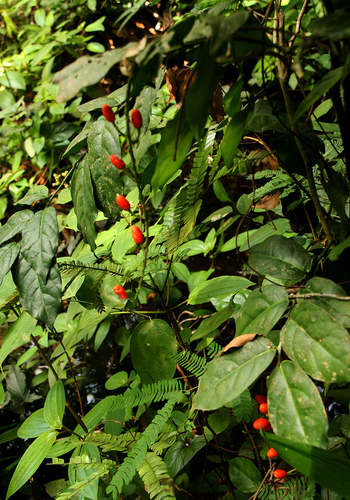
Lepionurus sylvestris
Blume
Chemperai
iNaturalist· cc-by-nc-sa
(c) Smithsonian Institution, National Museum of Natural History, Department of Botany, some rights reserved (CC BY-NC-SA)
iNaturalist· cc-by-nc
(c) Gavin, some rights reserved (CC BY-NC)
Description
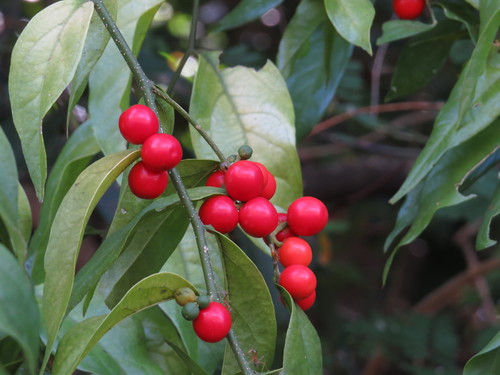
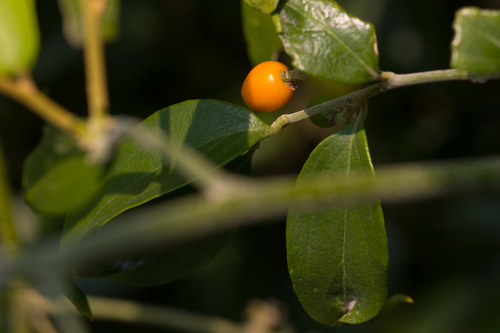
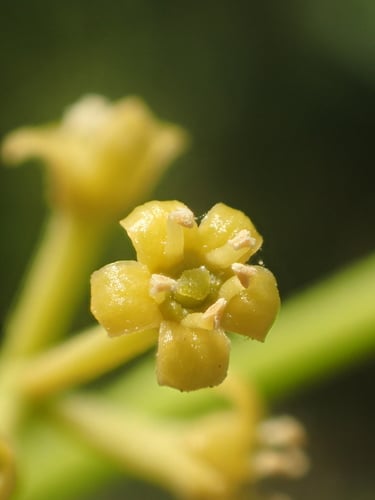
A shrub. It grows 1.5 m tall. The leaves vary in shape. They can be sword shaped or oblong. They are 8-17 cm long by 2-4 cm wide. The base is wedge shaped and it tapers to the tip. The flowers are on tubercles. The fruit is oval, fleshy and orange. They are 1.8 cm long by 1 cm wide. They are on a thickened disk.
Edible Uses
The leaves are cooked with dry fish.
Traditional Uses
The leaves are cooked with dry fish.
This uses section is brief — help expand it
Medicinal Uses
The roots are used as a remedy against fever. A poultice of the plant, or of the root, is used as a treatment for headache.
Distribution
It is a tropical plant. It grows between 300-1,000 m above sea level in southern China. In Yunnan.
Where It Grows
Asia, Bhutan, China, Himalayas, India, Indochina, Indonesia, Laos, Malaysia, Myanmar, Nepal, Northeastern India, New Guinea, Northeastern India, SE Asia, Sikkim, Thailand, Vietnam,
Cultivation
Plants can be grown from seeds.
Synonyms
Also Known As
Anapangthuam, Anmang, Cemperai, Lin wei mu
References (6)
- Flora of China @ efloras.org Volume 5
- Gangte, H. E., et al, 2013, Wild Edible Plants used by the Zou Tribe in Manipur, India. International Journal of Scientific and Research Publications, Volume 3, Issue 5
- Guite, C., 2016, A study of wild edible plants associated with the Paite tribe of Manipur, India, International Journal of Current Research. Vol. 8, Issue, 11, pp. 40927-40932
- Kar, A., et al, 2013, Wild Edible Plant Resources used by the Mizos of Mizoram, India. Kathmandu University Journal of Science, Engineering and Technology. Vol. 9, No. 1, July, 2013, 106-126
- Lalfakzuala, R., 2007, Ethnobotanical usages of plants in western Mizoram. Indian Journal of Traditional Knowledge. Vol 6(3) pp 480-493
Show all 6 references Hide references
- Sukarya, D. G., (Ed.) 2013, 3,500 Plant Species of the Botanic Gardens of Indonesia. LIPI p 660