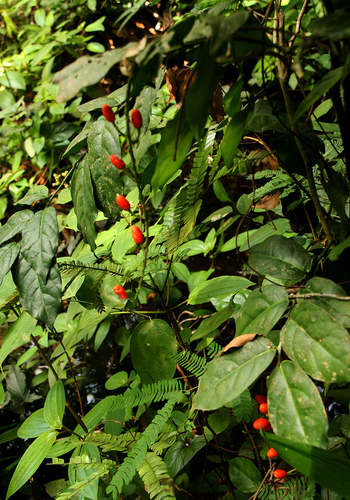
Opilia campestris
Engl.
wikimedia· cc-by-sa
Wikimedia Commons - SAplants
wikimedia· cc-by-sa
Wikimedia Commons - SAplants
Description
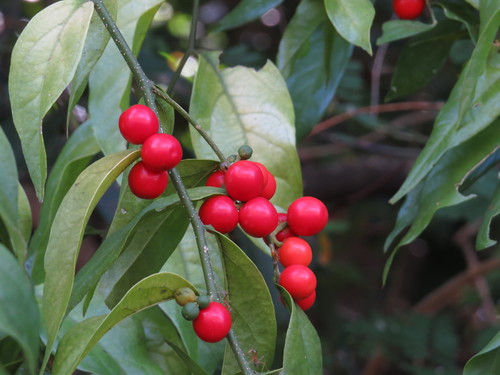
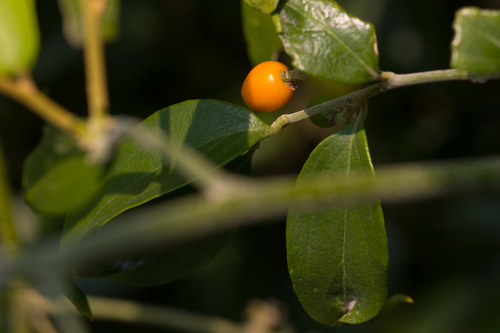
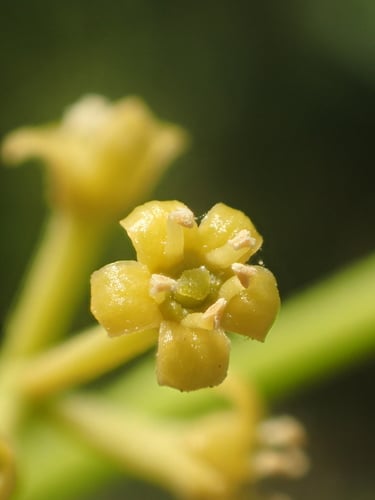
A shrub or small tree. It loses many leaves during the year. It grows 1-5 m high. The younger branches are olive green and have short hairs. The leaves are small and simple. They are alternate in 2 rows. They are olive green and hairy. The flowers have a scent.
Edible Uses
The ripe fruit are eaten raw or fermented into alcoholic drinks. The leaves are used as flavouring in relishes and chutneys. The roots serve as a fermenting agent for alcoholic drinks.
Traditional Uses
The ripe fruit are eaten raw. They are also used for alcoholic drinks. The leaves are used in relishes and chutneys. The roots are used as a fermenting agent for alcoholic drinks.
Distribution
It is a tropical plant. It grows between 60-1,450 m above sea level. It is often over limestone parent material. It grows in areas with an annual rainfall or 150-500 mm. It can grow in arid places.
Where It Grows
Africa, Angola, Central Africa, East Africa, Ethiopia, Kenya, Namibia, Somalia, South Africa, Southern Africa, Tanzania,
Cultivation
Requires a sunny position. Many species in this genus are root parasites on other species.
Also Known As
Afgub, Ipokeni, Kiburuburu, Lekkervreet, Mi-thumaigoro, Mubrubru, Omudize
References (11)
- Hiepko, P. 2008, Opiliaceae. Flora of the World. Species Plantarum No. 12 p 40
- Ichikawa, M., 1980, The Utilization of Wild Food Plants by the Suiei Dorobo in Northern Kenya. J. Anthrop. Soc. Nippon. 88(1): 25-48
- Malan & Owen-Smith, 1974,
- Mutie, F. G., 2020, Conservation of Wild Food Plants and Their Potential for Combatting Food Insecurity in Kenya as Exemplified by the Drylands of Kitui County. Plants 2020, 9, 1017
- Mutie, F. M., et al, 2023, Important Medicinal and Food Taxa (Orders and Families) in Kenya, Based on Three Quantitative Approaches. Plants 2023, 12, 1145
Show all 11 references Hide references
- Newman, 1970,
- Peters, C. R., O'Brien, E. M., and Drummond, R.B., 1992, Edible Wild plants of Sub-saharan Africa. Kew. p 158
- Royal Botanic Gardens, Kew (1999). Survey of Economic Plants for Arid and Semi-Arid Lands (SEPASAL) database. Published on the Internet; http://www.rbgkew.org.uk/ceb/sepasal/internet [Accessed 5th May 2011]
- Ruiters-Welcome, A. K., 2019, Food plants of southern Africa. Ph.D. thesis. Univ. of Johannesburg p 83
- Welcome, A. K. & Van Wyk, B.-E., 2019, An inventory and analysis of the food plants of southern Africa. South African Journal of Botany 122 (2019) 136–179
- World Checklist of Useful Plant Species 2020. Royal Botanic Gardens, Kew