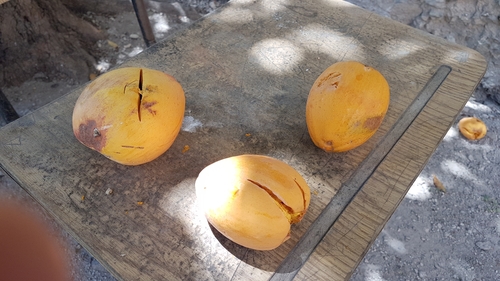
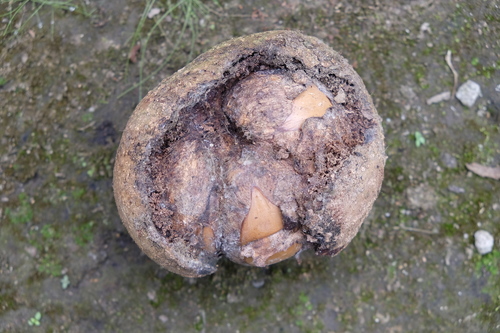
Pouteria coriacea
(Pierre) Pierre
Haimara eye
wikimedia· cc-by-sa
Wikimedia Commons - Tomás Acosta Escalas
Description
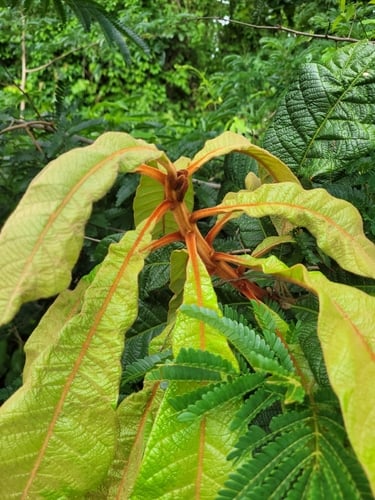
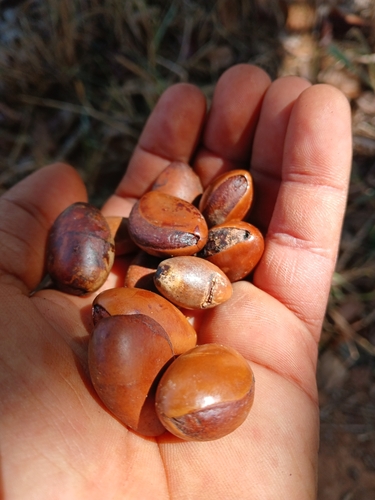
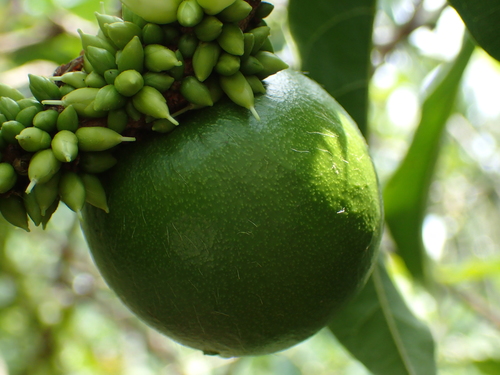
A tree. It grows 15-30 m tall. The trunk is 40 cm across. It has small buttresses. The outer bark is smooth and brown. The inner bark is red. Young shoots have fine hairs. The leaves are spaced out and arranged in spirals. They are 7-15 cm long by 3-5 cm wide. They are narrowly oval. The flowers are in groups or 3-10 in the axils of the leaves. They are pale green. The flowers contain both sexes. The fruit are 2-4 cm long and narrowly oval. The ripe fruit are yellow. There is one seed.
Traditional Uses
The fruit are sweet and eaten.
This uses section is brief — help expand it
Distribution
It is a tropical plant. It grows in mixed rainforest. It grows from sea level to 700 m above sea level.
Where It Grows
Amazon, America, Brazil, Colombia, Guiana, Guianas, Guyana, South America, Suriname, Trinidad, Venezuela,
Other Information
The fruit are much esteemed.
Synonyms
Also Known As
Auomora kushi, Caimitillo colorado, Coco macaque, Kudihuschi, Laurier-kersen, Mal balata, Mora-balli, Timon
References (3)
- Roa, J. A. G. & Boada, D. S. G., 2018, Fundación para el Fortalecimiento de la Fruticultura y Plantas Alimenticias no Convencionales en Colombia.
- van Andel, T., 2000, Useful plants of Guyana. Non-timber forest products of the North-West District of Guyana. Part 2. A Field Guide. Tropenbos-Guyana Programme. p 305
- Van Roosmalen, M.G.M., & Garcia, O. M., 2000, Fruits of the Amazonian Forest. Part 2: Sapotaceae. Acta Amazonica 30(2): 187-290