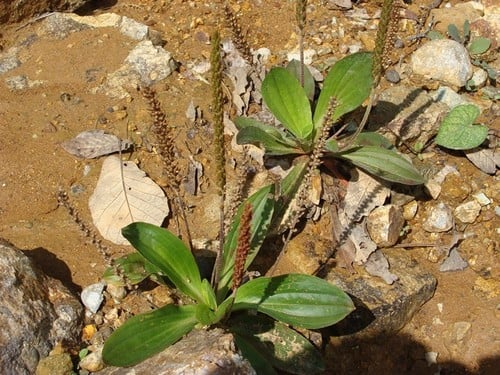
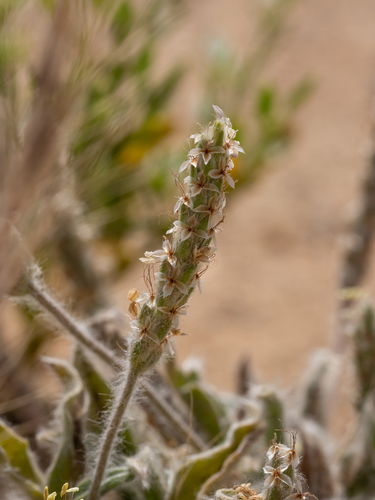
Plantago macrocarpa
Cham. & Schlecht.
Seashore plantain
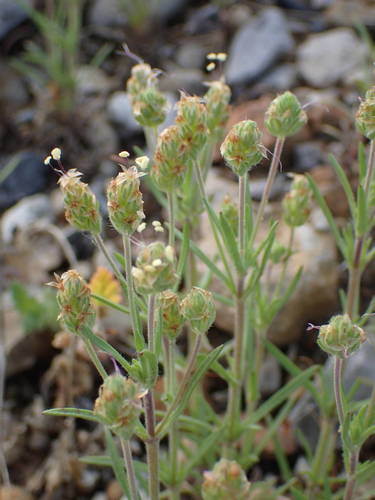
iNaturalist· cc-by-nc-sa
(c) M. Goff, some rights reserved (CC BY-NC-SA), uploaded by M. Goff
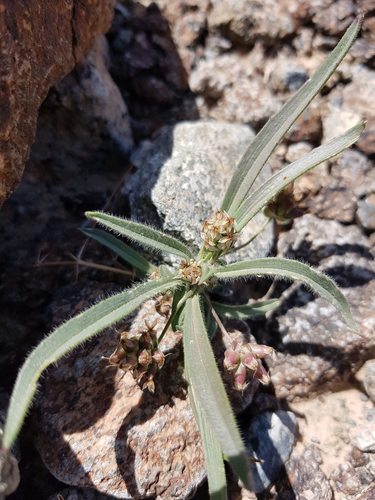
iNaturalist· cc-by-nc
(c) M. Torre Jorgenson, some rights reserved (CC BY-NC), uploaded by M. Torre Jorgenson
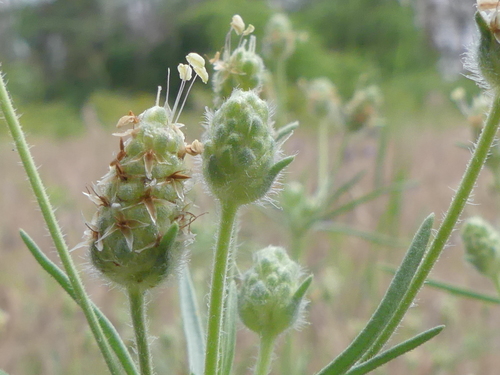
iNaturalist· cc-by-nc
(c) Ian Cruickshank, some rights reserved (CC BY-NC), uploaded by Ian Cruickshank
Description
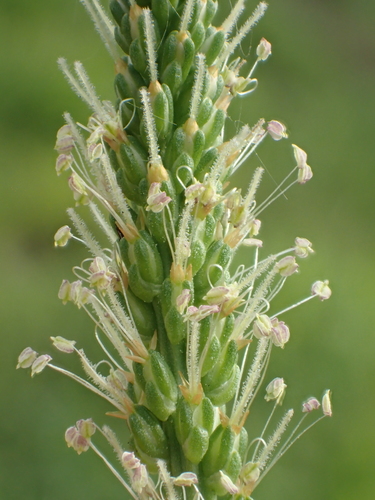
A herb. The leaves are long and arrow and rise from the root crown. They are 25 cm long and 2.5 cm wide. The flowers are very small. They are in dense heads crowded into a spike at the top of leafless stalks.
Edible Uses
The young tender leaves are eaten raw in salads or cooked as a spinach.
Traditional Uses
The young tender leaves are used raw in salads and also cooked as a spinach.
This uses section is brief — help expand it
Known Hazards
Plantain has been consumed as human food since prehistory. For example, archaeological recovery along California's Central Coast has demonstrated use of this species as a food since the Millingstone Horizon. The broad-leaved varieties are sometimes used as a leaf vegetable for salads, green sauce, and so on. Tender young plantain leaves can be eaten raw and older leaves can be cooked. The seeds can be cooked like rice. Plantago species have been used since prehistoric times as herbal remedies. The herb is astringent, anti-toxic, antimicrobial, anti-inflammatory, anti-histamine, as well as demulcent, expectorant, styptic and diuretic. Externally, a poultice of the leaves is useful for insect bites, poison-ivy rashes, minor sores, and boils. In folklore it is even claimed to be able to cure snakebite and was used by the Dakota tribe of North America for this. Internally, it is used for coughs and bronchitis, as a tea, tincture, or syrup. Tea made from the leaves may help cure diarrhea. Plantain seed husks expand and become mucilaginous when wet, especially those of P. psyllium, which is used in common over-the-counter bulk laxative and fiber supplement products such as Metamucil. P. psyllium seed is useful for constipation, irritable bowel syndrome, dietary fiber supplementation, and diverticular disease. Mucilage from desert indianwheat (P. ovata) is obtained by grinding off the husk. This mucilage, also known as psyllium, is commonly sold as Isabgol, a laxative which is used to control irregular bowel syndrome and constipation. It has been used as an indigenous Ayurvedic and Unani medicine for a whole range of bowel problems. Psyllium supplements are typically used in powder form, along with adequate amounts of fluids. A dose of at least 7 grams daily taken with adequate amounts of fluid (water, juice) is used by some for management of elevated cholesterol. There are a number of psyllium products used for constipation. The usual dose is about 3.5 grams twice a day. Psyllium is also a component of several ready-to-eat cereals. In Serbia, Romania, Bulgaria and Russia, leaves from Plantago major are used as a folk remedy to preventing infection on cuts and scratches because of its antiseptic properties. In Slovenia and other Central European regions, the leaves were traditionally used topically as a cure for blisters resulting from friction (such as caused by tight shoes etc.). There may also be a use for plantains in the abatement of enteric methane from ruminants, as the natural compounds present (e.g. condensed tannins; ~14 g/kg DM), affect the acetate-propionate ratio in the rumen, which is a primary mechanism by which methanogenesis is restricted. Currently this is not a viable option in any significant scale due to agronomic difficulties.
Distribution
It is a temperate plant. It grows along the coast just behind the tide mark.
Where It Grows
Alaska, North America, USA,
References (2)
- Heller, C. A., 1962, Wild Edible and Poisonous Plants of Alaska. Univ. of Alaska Extension Service. p 21
- Moerman, D. F., 2010, Native American Ethnobotany. Timber Press. p 416