Carpobrotus edulis
(L.) N. E. Br.
Hottentot Fig, Ice-plant
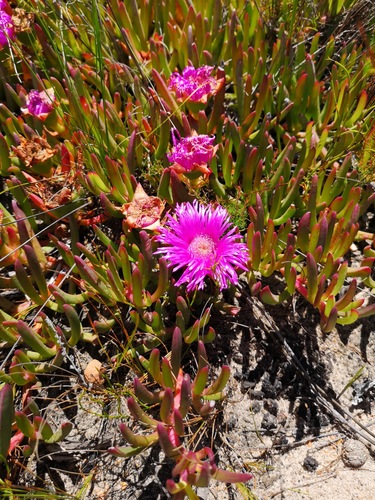
iNaturalist· cc-by-nc
(c) Cida Werneck, some rights reserved (CC BY-NC), uploaded by Cida Werneck
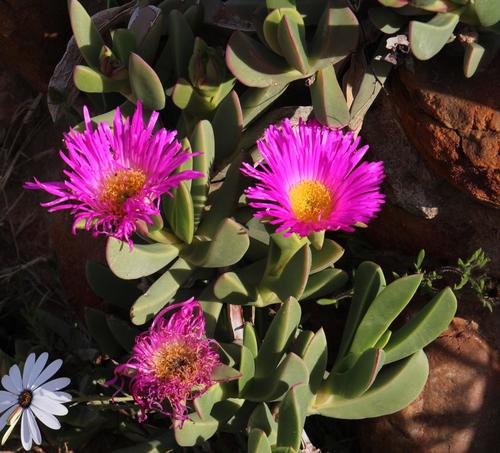
iNaturalist· cc-by-nc
(c) Valerio Lazzeri, some rights reserved (CC BY-NC), uploaded by Valerio Lazzeri
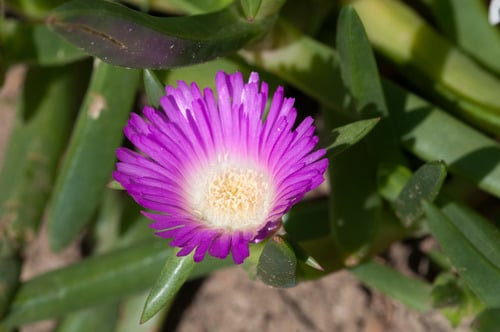
iNaturalist· cc-by-sa
(c) Alvesgaspar, some rights reserved (CC BY-SA)
Summary
Source: WikipediaCarpobrotus edulis is a creeping plant with succulent leaves in the genus Carpobrotus, native to South Africa. Its common names include hottentot-fig, sour fig, ice plant, highway ice plant, or vygie.
Description
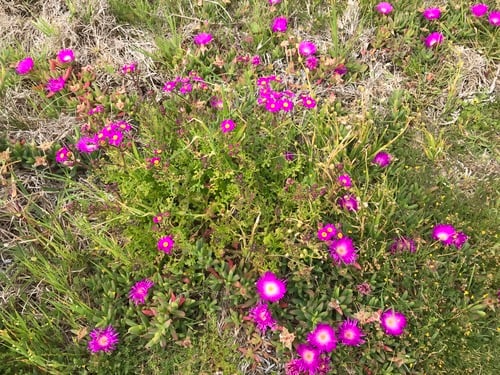
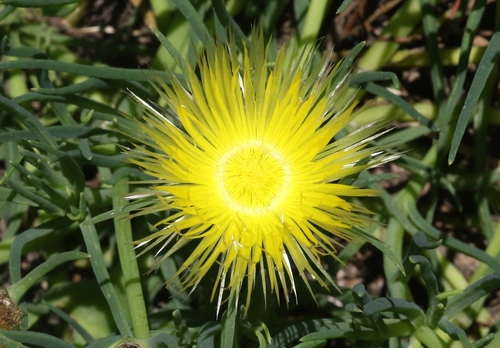
A succulent small shrub. It is a creeper. It grows 10-15 cm high and spreads 100-150 cm wide. The branches are long and have 2 edges. They branch extensively. They lie along the ground. The leaves are flattened and fleshy. They are 11 cm long. They are 3 angled and bent. The flowers are 9-12 cm across. They are light yellow or pink and occur singly. The fruit are shaped like a top. They have a red tint. They are edible.
Edible Uses
The fruit can be eaten raw, cooked, dried for later use, or made into pickles, chutney, and similar preserves. There is very little flesh and it must be fully ripe, as unripe fruit is very astringent; ripe fruit is mucilaginous and sweetly acid. The succulent leaves can be eaten raw in salads or cooked, and also work as a substitute for pickled cucumber, though they are notably mucilaginous.
Traditional Uses
The leaves are pickled and used as a substitute for pickled cucumbers in salads. The fruit are eaten fresh by chewing off the narrow end and sucking out the slimy sweet-sour contents. They can be dried, cooked, pickled or made into chutneys and preserves. They can be used for jam.
Medicinal Uses
Used as a traditional medicinal plant, methanolic extracts have shown some anti-cancer properties, and the plant has also demonstrated anti-bacterial activity.
Distribution
It is a temperate plant. It is native to South Africa. It requires moisture in hot weather and can be dry in cooler weather. It often grows in rocky dry soils in an open sunny position. It is drought resistant but frost tender. It can grow in arid places. It suits hardiness zones 8-10. Tasmania Herbarium.
Where It Grows
Africa, Angola, Argentina, Australia*, Botswana, Britain, Canada, Central Africa, Chile, East Africa, Egypt, Europe, France, Greece, Hawaii, Ireland, Mediterranean, Mexico, Mozambique, New Zealand, North Africa, North America, Pacific, South Africa*, Southern Africa, South America, St Helena, Tasmania, Uruguay, USA,
Cultivation
They can be grown from seeds or cuttings.
Propagation
Surface sow seed from March to June in a greenhouse, with lower night-time temperatures being beneficial. Seed typically germinates in 7–10 days at 23°C. Prick seedlings out into individual pots once large enough to handle and grow on in a greenhouse for at least their first winter. Plant out into permanent positions in late spring or early summer, after the last expected frosts. Cuttings can be taken at any point during the growing season — allow the cutting to dry in the sun for a day or two, then pot up in a very sandy mix. Very easy to propagate this way.
Other Uses
Planted in maritime areas to stabilise sandy soils, the plants form a dense carpet suited to ground cover. Can be grown as a fire barrier in areas subject to forest fires, as it is moderately fire-retardant. Dried leaves contain approximately 19.4% tannin and dry stems around 14.2% tannin; yields of 1,700 kilos per hectare have been achieved from cultivated plants.
Other Information
It is an important food for children. The fruit are sold. It is cultivated.
Notes
There are about 25 Carpobrotus species. Also put in the family Mesembryanthemaceae. This one can become invasive.
Nutrition
| Part | Moisture | kJ | kcal | Protein | Vit A | Vit C | Iron | Zinc |
|---|---|---|---|---|---|---|---|---|
| Fruit | 69.2 | 454 | 109 | 2.1 | — | 0.8 | 1.1 | 0.5 |
Synonyms
Also Known As
Balsamo, Doca, Frutilla de mar, Ghoena, Higo marino, Igcukuma, Ityum'tyum', Kaffir fig, Sour fig, Round-leaved Pigface, Suurvy
References (51)
- Andersohn, G., 1983, Cacti and Succulents. EP Publishing. p 288
- Barkhuizen, 1978,
- Bircher, A. G. & Bircher, W. H., 2000, Encyclopedia of Fruit Trees and Edible Flowering Plants in Egypt and the Subtropics. AUC Press. p 85
- Blamey, M and Grey-Wilson, C., 2005, Wild flowers of the Mediterranean. A & C Black London. p 42
- Bodkin, F., 1991, Encyclopedia Botanica. Cornstalk publishing, p 217
Show all 51 references Hide references
- H. M. L. Bolus, Fl. Pl. South Africa 7: sub t. 247. 1927 (N. E. Brown in Phillips, Gen. S. Afr. fl. pl. 249. 1926, nom. inval.)
- Brickell, C. (Ed.), 1999, The Royal Horticultural Society A-Z Encyclopedia of Garden Plants. Convent Garden Books. p 232
- Cordero, S. E., Abello, L. A., & Galvez, F. L., 2017, Plantas silvestres comestibles y medicinales de Chile y otras partes del mundo. CORMA p 156
- Courtenay-Latimer, M., et al, 1967, The Flowering Plants of the Tsitsikama Forest and Coastal National Park. National Parks Board. Republic of South Africa. Plate 31:1
- Crowe, A., 1997, A Field Guide to the Native Edible Plants of New Zealand. Penguin. p 82
- Cundall, P., (ed.), 2004, Gardening Australia: flora: the gardener's bible. ABC Books. p 333
- Curtis, W.M., 1963, The Students Flora of Tasmania Vol 2 p 238
- De Vynk, J. C., et al, 2016, Indigenous edible plant use by contemporary Khoe-San descendants of South Africa's Cape South Coast. South African Journal of Botany. 102 (2016) 60-69
- Facciola, S., 1998, Cornucopia 2: a Source Book of Edible Plants. Kampong Publications, p 150
- Flora of Australia, Volume 4, Phytolaccaceae to Chenopodiaceae, Australian Government Publishing Service, Canberra (1984) p 26, 35
- Food Composition Tables for use in Africa FAO http://www.fao.org/infoods/directory No. 944
- Flowerdew, B., 2000, Complete Fruit Book. Kyle Cathie Ltd., London. p 188
- Fox, F. W. & Young, M. E. N., 1982, Food from the Veld. Delta Books. p 267
- Hedrick, U.P., 1919, (Ed.), Sturtevant's edible plants of the world. p 412 (As Mesembryanthemum edule)
- Heywood, V.H., Brummitt, R.K., Culham, A., and Seberg, O. 2007, Flowering Plant Families of the World. Royal Botanical Gardens, Kew. p 215
- Hussey, B.M.J., Keighery, G.J., Cousens, R.D., Dodd, J., Lloyd, S.G., 1997, Western Weeds. A guide to the weeds of Western Australia. Plant Protection Society of Western Australia. p 76
- INFOODS:FAO/INFOODS Databases
- Irving, M., 2009, The Forager Handbook, A Guide to the Edible Plants of Britain. Ebury Press p 166
- Jardin, C., 1970, List of Foods Used In Africa, FAO Nutrition Information Document Series No 2.p 125
- Joffe, P., 2007, Creative Gardening with Indigenous Plants. A South African Guide. Briza. p 269
- John, L., & Stevenson, V., 1979, The Complete Book of Fruit. Angus & Robertson p 286 (As Mesembryanthemum edule)
- Lazarides, M. & Hince, B., 1993, Handbook of Economic Plants of Australia, CSIRO. p 49
- Llamas, K.A., 2003, Tropical Flowering Plants. Timber Press. p 49
- Lyle, S., 2006, Discovering fruit and nuts. Land Links. p 108
- Mabey, R., 1973, Food for Free. A Guide to the edible wild plants of Britain, Collins. p 179
- Marinelli, J. (Ed), 2004, Plant. DK. p 447
- Menninger, E.A., 1977, Edible Nuts of the World. Horticultural Books. Florida p 118 (As Mesembryanthemum edule)
- Omoruyi, B. E., et al, 2012, Antioxidant and phytochemical properties of Carpobrotus edulis (L.) Bolus leaf used for the management of common infections in HIV/AIDS patients in Eastern Cape Province. BMC Complementary and Alternative Medicine. 12:215
- Perry, F., and Hay, R., 1982, Guide to Tropical and Subtropical Plants. Sun Books p 98
- Peters, C. R., O'Brien, E. M., and Drummond, R.B., 1992, Edible Wild plants of Sub-saharan Africa. Kew. p 46
- Petersen, L. M., et al, 2012, Development of a Compendium of Local, Wild-Harvested Species Used in the Informal Economy Trade, Cape Town, South Africa. Ecology and Society 17(2):26
- Plants for a Future database, The Field, Penpol, Lostwithiel, Cornwall, PL22 0NG, UK. http://www.scs.leeds.ac.uk/pfaf/
- Plowes, N. J. & Taylor, F. W., 1997, The Processing of Indigenous Fruits and other Wildfoods of Southern Africa. in Smartt, L. & Haq. (Eds) Domestication, Production and Utilization of New Crops. ICUC p 187
- Royal Botanic Gardens, Kew (1999). Survey of Economic Plants for Arid and Semi-Arid Lands (SEPASAL) database. Published on the Internet; http://www.rbgkew.org.uk/ceb/sepasal/internet [Accessed 24th March 2011]
- Ruiters-Welcome, A. K., 2019, Food plants of southern Africa. Ph.D. thesis. Univ. of Johannesburg p 7
- Shava, S., 2000, The Use of Indigenous Plants as Food by a Rural Community in the Eastern Cape: an Educational Exploration. Masters Thesis Rhodes University. p 63
- Staples, G.W. and Herbst, D.R., 2005, A tropical Garden Flora. Bishop Museum Press, Honolulu, Hawaii. p 97 (Drawing)
- USDA, ARS, National Genetic Resources Program. Germplasm Resources Information Network - (GRIN). [Online Database] National Germplasm Resources Laboratory, Beltsville, Maryland. Available: www.ars-grin.gov/cgi-bin/npgs/html/econ.pl (10 April 2000)
- van Wyk, B., 2005, Food Plants of the World. An illustrated guide. Timber press. p 119
- van Wyk, Be, & Gericke, N., 2007, People's plants. A Guide to Useful Plants of Southern Africa. Briza. p 36
- van Wyk, B-E., 2011, The potential of South African plants in the development of new food and beverage products. South African Journal of Botany 77 (2011) 857–868
- Wehmeyer, A. S, 1986, Edible Wild Plants of Southern Africa. Data on the Nutrient Contents of over 300 species
- Welcome, A. K. & Van Wyk, B.-E., 2019, An inventory and analysis of the food plants of southern Africa. South African Journal of Botany 122 (2019) 136–179
- Wiersema, J. H. & Leon, B., 2013, World Economic Plants. A Standard Reference CRC Press. 2nd Ed. p 146
- World Checklist of Useful Plant Species 2020. Royal Botanic Gardens, Kew
- Zeven, A. C. & de West, J. M. J., 1982, Dictionary of cultivated plants and their regions of diversity. Wageningen. p 122