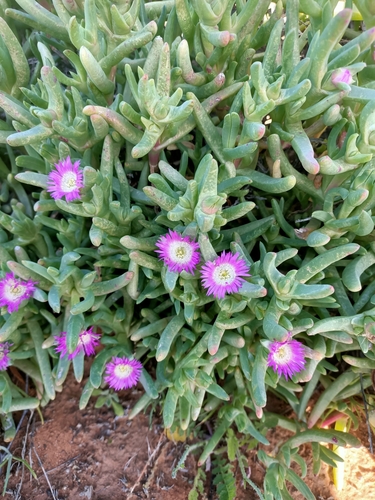
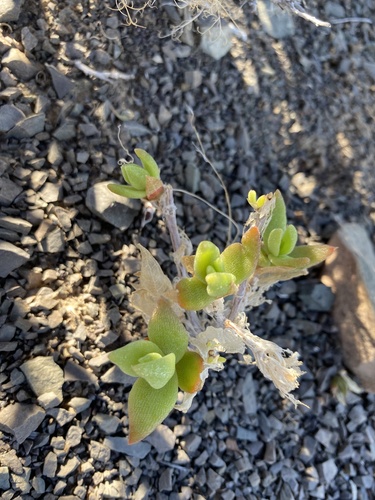
Sesuvium sesuvioides
(Fenzl) Verdc.
iNaturalist· cc-by-nc-nd
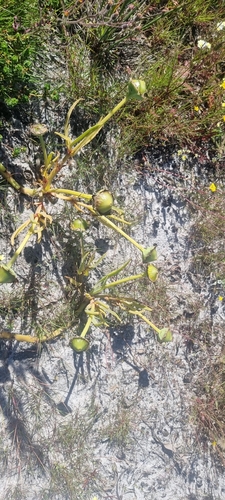
(c) Barbara Schneider, some rights reserved (CC BY-NC-ND), uploaded by Barbara Schneider
iNaturalist· cc-by-nc
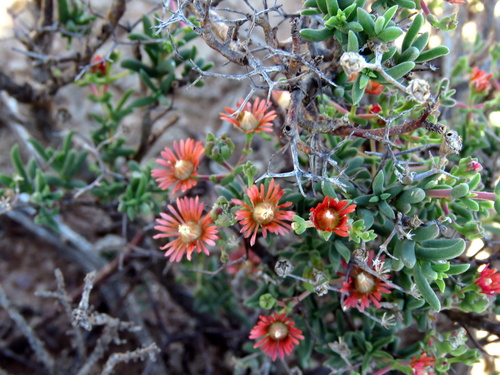
(c) Peter Erb, some rights reserved (CC BY-NC)
iNaturalist· cc-by-sa
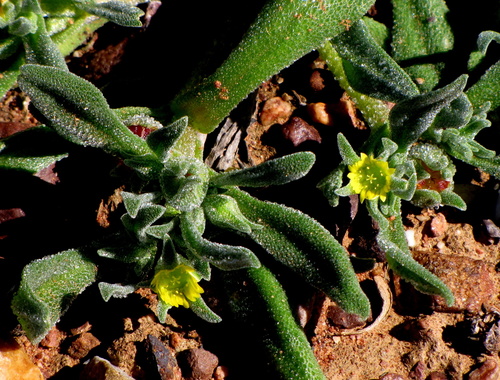
(c) leandra-k_89, some rights reserved (CC BY-SA)
Description
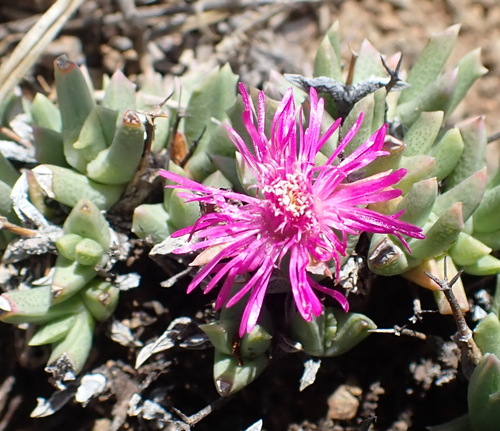
A herb. The stems lie along the ground. It can grow each year from seeds or keep growing for a few years. The leaves are 6-15 mm long and 3-6 mm wide. They are narrowly oval. The flowers occur singly in the axils of leaves. The fruit is a capsule with a lid on top. This is 5.5 mm long. There are 13-20 seeds. The seeds are black and 1 mm long.
Edible Uses
The leaves are eaten as a green vegetable, typically prepared as a pot-herb. They are often mixed with other leaves such as Cleome to increase sliminess.
Traditional Uses
The leaves are eaten as a green vegetable. It is eaten as a pot-herb. It is mixed with other leaves such as Cleome to make them more slimy.
This uses section is brief — help expand it
Distribution
A tropical plant. Rajasthan. It suits a salty soil. It needs a rainfall above 520 mm per year. It can grow in dry sandy areas. It grows up to about 100-700 m above sea level. It cannot tolerate frost. It can grow with temperatures between 2-41°C. It needs a water table close to the surface. It can grow in arid places.
Where It Grows
Africa, Angola, Asia, Botswana, Cape Verde, Central Africa, Chad, Congo, East Africa, India, Kenya, Malawi, Mali, Mozambique, Namibia, Niger, Pakistan, South Africa, Southern Africa, Sudan, Tanzania, West Africa, Zambia, Zimbabwe,
Notes
There are 8 Sesuvium species. They grow in tropical and subtropical salty locations.
Synonyms
Also Known As
Kailatsilabe, Lario, Lunio, Omundjulu
References (9)
- Ambasta, S.P. (Ed.), 2000, The Useful Plants of India. CSIR India. p 647 (As Trianthema hydaspica)
- Peters, C. R., O'Brien, E. M., and Drummond, R.B., 1992, Edible Wild plants of Sub-saharan Africa. Kew. p 46
- Rodin, 1985,
- Royal Botanic Gardens, Kew (1999). Survey of Economic Plants for Arid and Semi-Arid Lands (SEPASAL) database. Published on the Internet; http://www.rbgkew.org.uk/ceb/sepasal/internet [Accessed 24th March 2011]
- Ruiters-Welcome, A. K., 2019, Food plants of southern Africa. Ph.D. thesis. Univ. of Johannesburg p 8
Show all 9 references Hide references
- SAXENA,
- Shekhawat, G.S. & Anand, S., 1984, An Ethnobotanical Profile of Indian Desert. J. Econ. Tax. Bot. Vol.5 No.3 pp 591-598
- Welcome, A. K. & Van Wyk, B.-E., 2019, An inventory and analysis of the food plants of southern Africa. South African Journal of Botany 122 (2019) 136–179
- World Checklist of Useful Plant Species 2020. Royal Botanic Gardens, Kew