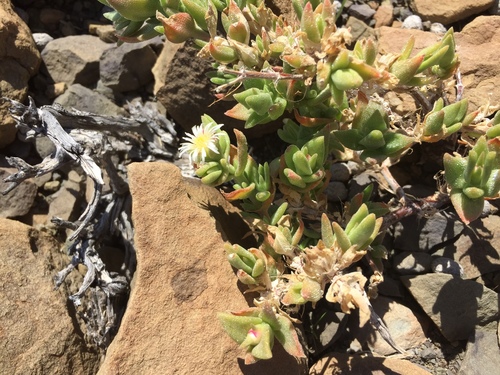
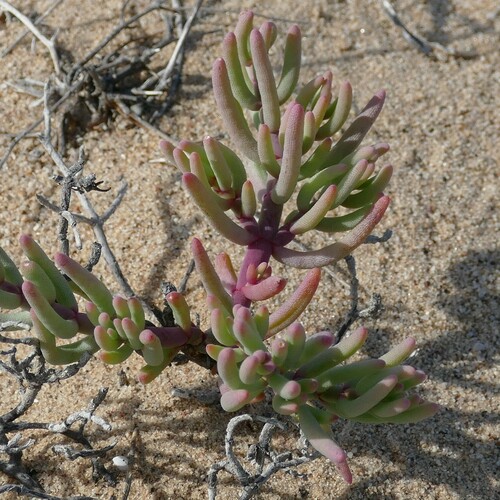
Tetragonia decumbens
Miller
South African sea spinach, Sea spinach, Dune spinach
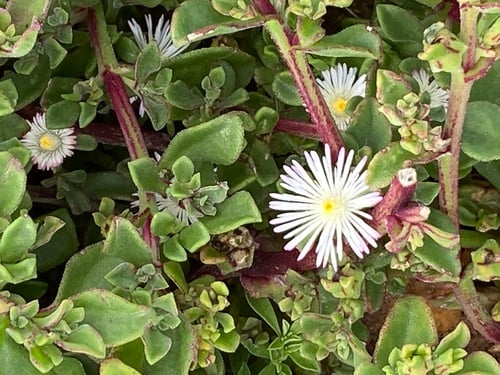
iNaturalist· cc-by-sa
(c) Nicola van Berkel, some rights reserved (CC BY-SA), uploaded by Nicola van Berkel
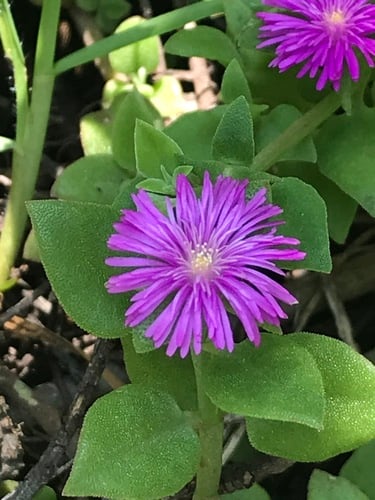
iNaturalist· cc-by-nc
(c) Felix Riegel, some rights reserved (CC BY-NC), uploaded by Felix Riegel
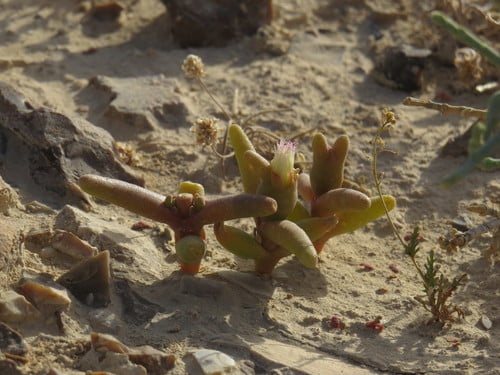
iNaturalist· cc-by-nc
(c) Felix Riegel, some rights reserved (CC BY-NC), uploaded by Felix Riegel
Summary
Source: WikipediaTetragonia decumbens (dune spinach or sea spinach) is a coastal shrub, native to southern Africa.
Description
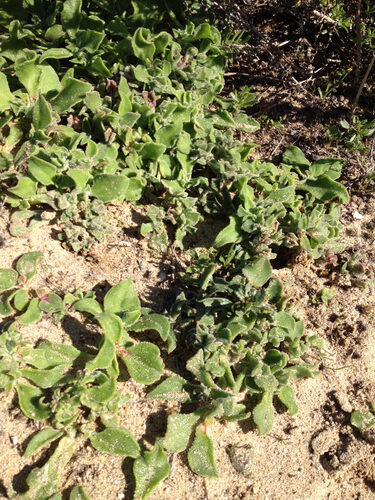
A trailing herb or shrub. It grows 10-30 cm high. It can spread 2 m wide. The leaves are dark green. They are broad and succulent. The flowers are yellow. The fruit have 4 wings.
Edible Uses
The leaves are cooked and used as a substitute for spinach; flavour is improved by adding butter or Oxalis leaves.
Traditional Uses
The leaves are cooked and used as a substitute for spinach. Adding butter or Oxalis leaves improves the flavour.
This uses section is brief — help expand it
Distribution
It is a subtropical plant. It grows on coastal sand and sand dunes. It suits hot arid, sandy places. It is a subtropical plant. In Southern Africa it grows from near sea level to 700 m above sea level.
Where It Grows
Africa, Australia, Namibia, South Africa, Southern Africa,
Cultivation
It can be grown from the winged fruit.
Propagation
Seed - Division of the running stems, making sure each section has some roots.
Other Uses
An early colonizer of moist sand dunes, it is an extremely valuable plant for stabilizing moving sand. It acts as a seed-trap and also provides organic matter that enables other species to grow on the dunes. The accumulation of plant matter such as that of Tetragonia decumbens, and the subsequent establishment of other plants, enable dunes to develop from fore-dunes to rear dunes that are stabilized by increasing plant growth.
Notes
There are about 50-60 Tetragonia species.
Synonyms
References (13)
- Dashorst, G.R.M., and Jessop, J.P., 1998, Plants of the Adelaide Plains & Hills. Botanic Gardens of Adelaide and State Herbarium. p 54
- Facciola, S., 1998, Cornucopia 2: a Source Book of Edible Plants. Kampong Publications, p 241
- Flora of Australia, Volume 4, Phytolaccaceae to Chenopodiaceae, Australian Government Publishing Service, Canberra (1984) p 38, 39
- Hussey, B.M.J., Keighery, G.J., Cousens, R.D., Dodd, J., Lloyd, S.G., 1997, Western Weeds. A guide to the weeds of Western Australia. Plant Protection Society of Western Australia. p 76
- Jardin, C., 1970, List of Foods Used In Africa, FAO Nutrition Information Document Series No 2.p 106
Show all 13 references Hide references
- Lazarides, M. & Hince, B., 1993, Handbook of Economic Plants of Australia, CSIRO. p 235
- Low, T., 1992, Bush Tucker. Australia’s Wild Food Harvest. Angus & Robertson. p 135
- Martin, F.W. & Ruberte, R.M., 1979, Edible Leaves of the Tropics. Antillian College Press, Mayaguez, Puerto Rico. p 172
- Paczkowska, G. & Chapman, A.R., 2000, The Western Australian Flora. A Descriptive Catalogue. Western Australian Herbarium. p 135
- Ruiters-Welcome, A. K., 2019, Food plants of southern Africa. Ph.D. thesis. Univ. of Johannesburg p 8
- van Wyk, Be., & Gericke, N., 2007, People's plants. A Guide to Useful Plants of Southern Africa. Briza. p 76
- van Wyk, B-E., 2011, The potential of South African plants in the development of new food and beverage products. South African Journal of Botany 77 (2011) 857–868
- Welcome, A. K. & Van Wyk, B.-E., 2019, An inventory and analysis of the food plants of southern Africa. South African Journal of Botany 122 (2019) 136–179