Sesuvium portulacastrum
(L.) L.
Seaside purslane, Shoreline purslane
iNaturalist· cc-by
(c) Nick Block, some rights reserved (CC BY), uploaded by Nick Block
iNaturalist· cc-by-nc
(c) ekcobrien, some rights reserved (CC BY-NC)
Summary
Source: WikipediaSesuvium portulacastrum is a sprawling perennial herb in the family Aizoaceae that grows in coastal and mangrove areas throughout much of the world. It grows in sandy clay, coastal limestone and sandstone, tidal flats and salt marshes, throughout much of the world. It is native to Africa, Asia, Australia, Hawai`i, North America and South America, and has naturalised in many places where it is not indigenous. It is commonly known as shoreline purslane or (ambiguously) "sea purslane," in English, dampalit in Tagalog and 海马齿 hǎimǎchǐ in Chinese.
Description
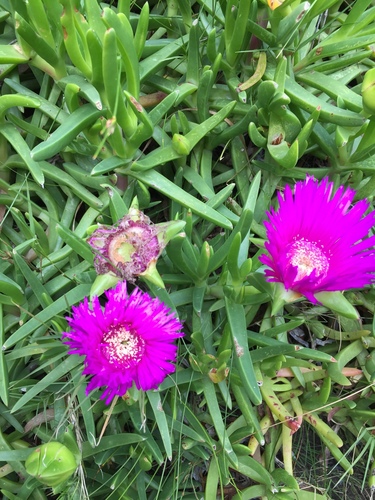
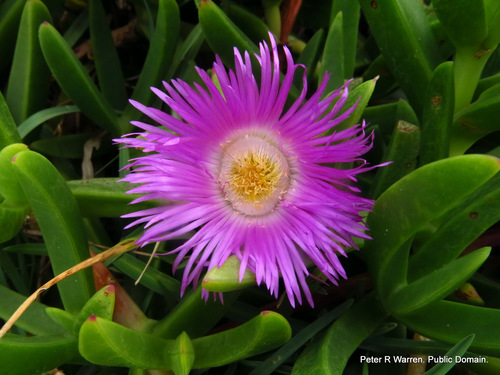
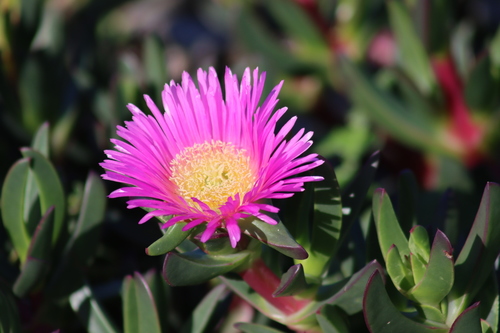
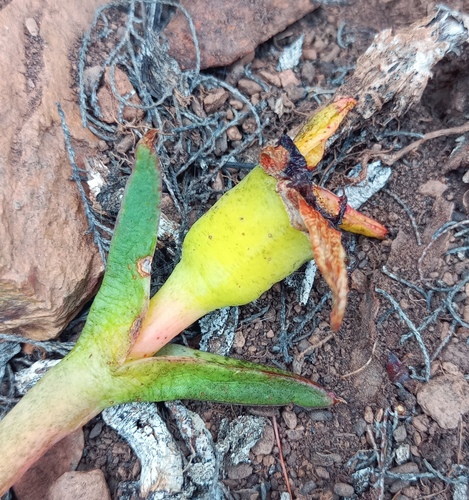
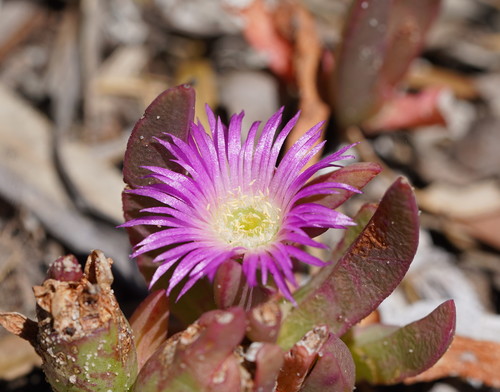
A sprawling herb. This is a low lying fleshy plant. The stems are reddish at the nodes and 20 to 50 cm long with short upright branches. The stems are thick. The leaves are oblong and narrow. They can be 1-7 cm long by 2-15 mm wide. They are fleshy and glossy green. The flowers are small and pink or red. They are star like and have 5 petals. The occur singly in the axils of leaves. There are several pea shaped seeds. They are 1.5 mm across.
Edible Uses
The leaves can be eaten raw or cooked and are considered an excellent vegetable with a salty, succulent texture and an acidulous flavour similar to sorrel. Because they are very salty, they require repeated boiling in fresh water before eating. They can also be pickled. The leaves are a good source of vitamin C. The plant is gathered from the wild in many countries and is sometimes sold in local markets.
Traditional Uses
Young leaves are cooked and eaten. (Because they are salty sometimes the water needs to be changed.) They are also eaten raw with fish sauces. They are also pickled.
Medicinal Uses
The plant is used as a haemostatic. A decoction is considered the best antidote for stings of venomous fish and should be applied externally for an extended period. The leaves are said to be antiscorbutic.
Distribution
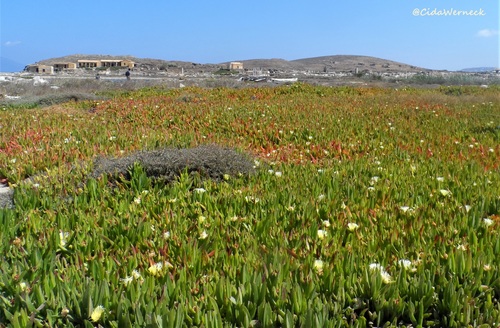
A tropical and subtropical plant. It grows on mud flats and sand. It is often associated with mangroves. It occurs in paddy fields. It grows along the sea shore in the Philippines. It occurs along all coasts of Africa. It is very salt tolerant. It grows in the lowlands.
Where It Grows
Africa, American Samoa, Angola, Anguilla, Antigua, Argentina, Asia, Australia, Bangladesh, Belize, Benin, Brazil, Cambodia, Cameroon, Caribbean, Central Africa, Central America*, Chile, China, Congo, Côte d'Ivoire, Cuba, Dominica, Dominican Republic, East Africa, East Timor, Easter Island, Equatorial Guinea, Fiji, Gabon, Gambia, Ghana, Grenada, Guiana, Guianas, Guinea, Guinée, Guinea-Bissau, Guyana, Haiti, Hawaii, India, Indochina, Indonesia, Ivory Coast, Jamaica, Kenya, Kiribati, Liberia, Malaysia, Maldives, Marquesas, Mauritania, Mediterranean, Mexico, Morocco, Mozambique, Myanmar, Namibia, New Caledonia, Nigeria, Norfolk Island, North America, Pacific, Paraguay, Papua New Guinea, PNG, Philippines, Sao Tome and Principe, SE Asia, Senegal, Sierra Leone, Solomon Islands, Somalia, South Africa, Southern Africa, South America, St. Kitts and Nevis, Suriname, Taiwan, Tanzania, Thailand, Timor-Leste, Togo, Tonga, Uruguay, USA, Venezuela, Vietnam, West Africa, West Indies,
Cultivation
It can be grown from cuttings or seeds. It is best in well drained sandy soils. A spacing of 75-150 cm is suitable.
Propagation
Propagate by seed or by rooted stem cuttings.
Other Uses
Sea Purslane is used for erosion control and as ground cover in coastal areas, and can serve as a food source for some wildlife. It is cultivated as a ground cover to prevent erosion in dune vegetation. As a pioneer sand-colonising plant, it grows on the upper beach and seaward slope of the frontal dune or beach ridge, trapping and holding wind-blown sand and tending to form small ridges or mounds. It does not survive complete burial under wind-blown sand. It also grows well in more protected littoral locations and can be included in dune revegetation programmes. The plant has potential for phytoremediation on heavy-metal-polluted sites and has been used as a revegetator for salty areas in the United Arab Emirates.
Other Information
A commonly used minor leafy green used in many tropical countries. Leaves are sold in local markets. It is a cultivated plant.
Notes
There are 8 Sesuvium species. They grow in tropical and subtropical salty locations.
Nutrition
| Part | Moisture | kJ | kcal | Protein | Vit A | Vit C | Iron | Zinc |
|---|---|---|---|---|---|---|---|---|
| Leaves | 89 | 105 | 25 | 2.1 | — | — | 6.3 | — |
| Shoots | — | — | — | — | — | — | — | — |
Synonyms
Also Known As
'Akulikuli, Bossaha, Burunque, Cenicilla, Dampalit, Dhapa, Enhade, Erwi, Gelang laut, Gelang pasir, Haichau, Jadu palang, Krokot, Lonumagoo, Nuntashak, Sagu sagu, Samphire, Sepit-sepit, Sepit, Sesepit, Strandpostelein, Taraumpalit, Te boi, Uondgi, Van kiru valai, Vangarreddi kura, Vungaravasee, Vungaravasi
References (60)
- Alegado, A. M. & De Guzman, R. B., 2014, Indigenous food crops of the Aetas tribe in the Philippines and their traditional methods of food preparation. in Promotion of Underutilized Indigenous Food Resources for Food Security and Nutrition in Asia and Pacific. FAO. Bangkok p 160
- Ambasta, S.P. (Ed.), 2000, The Useful Plants of India. CSIR India. p 570
- Arora, R. K., 2014, Diversity in Underutilized Plant Species - An Asia-Pacific Perspective. Bioversity International. p 46
- Brown, W.H., 1920, Wild Food Plants of the Philippines. Bureau of Forestry Bulletin No. 21 Manila. p 54
- Burkill, H. M., 1985, The useful plants of west tropical Africa, Vol. 1. Kew.
Show all 60 references Hide references
- Busson, 1965,
- Catarino, L. et al, 2019, Edible Leafy Vegetables from West Africa (Guinea-Bissau): Consumption, Trade and Food Potential. Foods 2019, 8, 493
- Checklist of NT Vascular Plant Species. January 2003.
- Cowie, I, 2006, A Survey of Flora and vegetation of the proposed Jaco-Tutuala-Lore National Park. Timor-Lests (East Timor) www.territorystories.nt/gov.au p 42
- Cribb, A.B. & J.W., 1976, Wild Food in Australia, Fontana. p 128
- Facciola, S., 1998, Cornucopia 2: a Source Book of Edible Plants. Kampong Publications, p 4
- Flora of Australia, Volume 4, Phytolaccaceae to Chenopodiaceae, Australian Government Publishing Service, Canberra (1984) p 61
- Flora of Australia Volume 49, Oceanic Islands 1, Australian Government Publishing Service, Canberra. (1994) p 79
- Flora of Solomon Islands
- Flora Malesiana Vol 13 p 272
- Food Composition Tables for use in East Asia FAO http://www.fao.org/infoods/directory No. 734
- Grivetti, L. E., 1980, Agricultural development: present and potential role of edible wild plants. Part 2: Sub-Saharan Africa, Report to the Department of State Agency for International Development. p 26, 48
- Grubben, G. J. H. and Denton, O. A. (eds), 2004, Plant Resources of Tropical Africa 2. Vegetables. PROTA, Wageningen, Netherlands. p 468
- Gueye, M. & Meissa, D., 2007, Traditional Leafy Vegetables in Senegal: Diversity and medicinal Uses. Afr. J. Trad. CAM (2007) 4 (4): 469 – 475
- Hossain, U. & Rahman, A., 2018, Study and quantitative analysis of wild vegetable floral diversity available in Barisal district, Bangladesh. Asian J. Med. Biol. Res. 2018, 4 (4), 362-371
- Jackes, B. R., 2010, Plants of Magnetic Island. 3rd Edition. James Cook University, Australia. p 19
- Jardin, C., 1970, List of Foods Used In Africa, FAO Nutrition Information Document Series No 2.p 101
- Kenneally, K.E., Edinger, D. C., and Willing T., 1996, Broome and Beyond, Plants and People of the Dampier Peninsula, Kimberley, Western Australia. Department of Conservation and Land Management. p 53
- Kermath, B. M., et al, 2014, Food Plants in the Americas: A survey of the domesticated, cultivated and wild plants used for Human food in North, Central and South America and the Caribbean. On line draft. p 799
- Lazarides, M. & Hince, B., 1993, Handbook of Economic Plants of Australia, CSIRO. p 217
- Levitt, D., 1981, Plants and people. Aboriginal uses of plants on Groote Eylandt, Australian Institute of Aboriginal Studies, Canberra. p 80
- Low, T., 1991, Wild Herbs of Australia and New Zealand. Angus & Robertson. p 61
- Low, T., 1991, Wild Food Plants of Australia. Australian Nature FieldGuide, Angus & Robertson. p 26
- Low, T., 1992, Bush Tucker. Australia’s Wild Food Harvest. Angus & Robertson. p 133
- Martin, F.W. & Ruberte, R.M., 1979, Edible Leaves of the Tropics. Antillian College Press, Mayaguez, Puerto Rico. p 172, 200
- McLaughlin, J., Woody and Herbaceus Plants Native to Haiti. University of Florida.
- McMakin, P.D., 2000, Flowering Plants of Thailand. A Field Guide. White Lotus. p 72
- Melzer, R. & Plumb, J., 2011, Plants of Capricornia. Belgamba, Rockhampton. p 510
- Monsalud, M.R., Tongacan, A.L., Lopez, F.R., & Lagrimas, M.Q., 1966, Edible Wild Plants in Philippine Forests. Philippine Journal of Science. p 434
- Morley, B.D., & Toelken, H.R., (Eds), 1983, Flowering Plants in Australia. Rigby. p 73
- Mutie, F. M., et al, 2023, Important Medicinal and Food Taxa (Orders and Families) in Kenya, Based on Three Quantitative Approaches. Plants 2023, 12, 1145
- Nassif, F., & Tanji, A., 2013, Gathered food plants in Morocco: The long forgotten species in Ethnobotanical Research. Life Science Leaflets 3:17-54
- Ochse, J.J. et al, 1931, Vegetables of the Dutch East Indies. Asher reprint. p 5
- Paczkowska, G. & Chapman, A.R., 2000, The Western Australian Flora. A Descriptive Catalogue. Western Australian Herbarium. p 135
- Peekel, P.G., 1984, (Translation E.E.Henty), Flora of the Bismarck Archipelago for Naturalists, Division of Botany, Lae, PNG. p 174, 175
- Peters, C. R., O'Brien, E. M., and Drummond, R.B., 1992, Edible Wild plants of Sub-saharan Africa. Kew. p 46
- Pham-Hoang Ho, 1999, An Illustrated Flora of Vietnam. Nha Xuat Ban Tre. p 720
- Phon, P., 2000, Plants used in Cambodia. © Pauline Dy Phon, Phnom Penh, Cambodia. p 556
- Plants of Haiti Smithsonian Institute http://botany.si.edu
- Ruffo, C. K., Birnie, A. & Tengnas, B., 2002, Edible Wild Plants of Tanzania. RELMA p 610
- Ryan, M. (Ed.), 2003, Wild Plants of Greater Brisbane. Queensland Museum. p 40
- Scarpa, G. F., 2009, Wild food plants used by the indigenous peoples of South American Gran Chaco: A general synopsis and intercultural comparison. Journal of Applied Botany and Food Quality 83:90-101
- Shah, G.L., 1984, Some economically important plant of Salsette Island near Bombay. J. Econ. Tax. Bot. Vol. 5 No. 4 pp 753-765
- SHORTT,
- Singh, H.B., Arora R.K.,1978, Wild edible Plants of India. Indian Council of Agricultural Research, New Delhi. p 37, 85
- Smith, A.C., 1981, Flora Vitiensis Nova, Lawaii, Kuai, Hawaii, Volume 2 p 270
- Sujanapal, P., & Sankaran, K. V., 2016, Common Plants of Maldives. FAO & Kerala FRI, p 243
- Syst. nat. ed. 10, 2:1058. 1759
- Thaman, R. R., 1987, Plants of Kiribati: A listing and analysis of vernacular names. Atoll Research Bulletin No. 296
- Townsend, K., 1994, Across the Top. Gardening with Australian Plants in the tropics. Society for Growing Australian Plants, Townsville Branch Inc. p 335
- Wheeler, J.R.(ed.), 1992, Flora of the Kimberley Region. CALM, Western Australian Herbarium, p 90
- Whistler, A. S., Edible vascular plants of the Line Islands. Pacific Health Dialog. Vol. 3 No. 2
- Williams, K.A.W., 1999, Native Plants of Queensland Volume 4. Keith A.W. Williams North Ipswich, Australia. p 354
- World Checklist of Useful Plant Species 2020. Royal Botanic Gardens, Kew
- Yuncker, T.G., 1959, Plants of Tonga, Bernice P. Bishop Museum, Hawaii, Bulletin 220. p 111