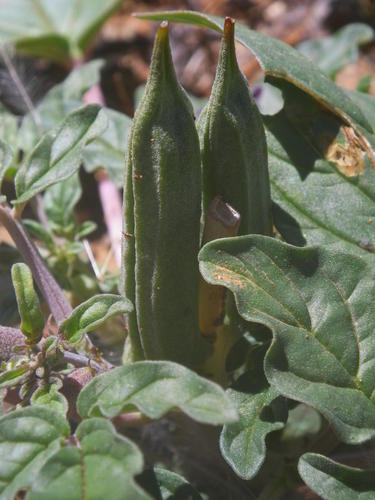
Sesamothamnus busseanus
Engl.
Sesame bush
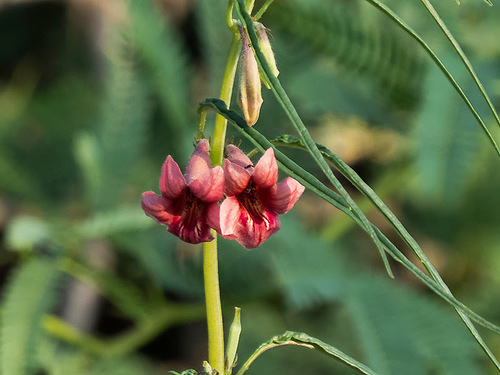
iNaturalist· cc-by-nc
(c) Judy Flatt, some rights reserved (CC BY-NC)
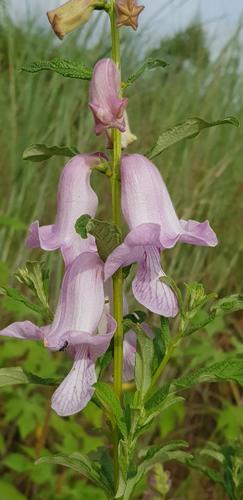
iNaturalist· cc-by-nc
(c) Judy Flatt, some rights reserved (CC BY-NC)
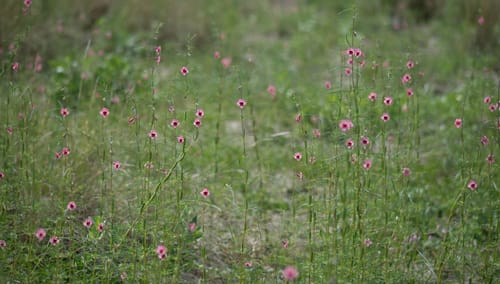
iNaturalist· cc-by-nc
(c) Judy Flatt, some rights reserved (CC BY-NC)
Description
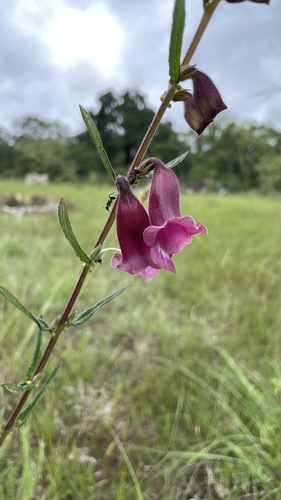
A spiny shrub or small tree. It grows 1-5 m tall. The trunk is swollen at the base. The wood is soft. The bark is coppery pink-green. It flakes off in papery layers. The young shoots are hairy. There are many spines. The leaves fall off during the year. The leaves grow in bundles from cushions along the stem. They are 2-5 cm long and wider at the tip. The flowers appear in the bare tree. There are only a few and they are white. They are tube shaped and have a sweet scent. The tube can be bright red. The tube can be 4 cm long and their is a long thin spur 6 cm long. The flower is 4-9 cm across. The fruit is a woody capsule. It is hairy when young. It is long and flattened and brown. It can be 4 cm long by 2 cm wide. There are several small winged seeds.
Edible Uses
Leaves and flowers - cooked. They are wilted and then cooked on their own or mixed with other vegetables such as amaranth or peas and eaten along with a staple such as rice. The leaves can be pounded, soaked in cold water and filtered, then the infusion used as a tenderizer when cooking other vegetables. Flowers - cooked, usually with the leaves. They can be cooked alone or mixed with other vegetables such as amaranth or peas and eaten along with a staple such as rice.
Traditional Uses
Africa, East Africa, Kenya, Somalia, Tanzania,
This uses section is brief — help expand it
Medicinal Uses
The leaves are pounded then soaked in water. The infusion is drunk as a remedy for constipation and intestinal gas. Applied externally, the pounded leaves and stems are used as a poultice or paste on fresh wounds to stop the bleeding.
Distribution
It is a tropical plant. In Tanzania it grows in woodland and grassland on shallow rocky soils. It grows between 300-1,300 m above sea level. It can grow in very arid conditions.
Where It Grows
Dry Acacia-Commiphora bushland or grassed bushland on shallow rocky soils at elevations from 300 - 1,300 metres.
Cultivation
A plant of arid regions in the tropics, where it is found at elevations from 300 - 1,300 metres. Plants are not tolerant of frost. Requires a sunny position in a well-drained soil. Established plants are very drought tolerant.
Propagation
Seed - Cuttings.
Other Uses
The soft wood is used for making fire by friction.
Also Known As
Chung'ungu, Ifufu, Mlyang'ungu, Mulyanhungu
References (3)
- Grubben, G. J. H. and Denton, O. A. (eds), 2004, Plant Resources of Tropical Africa 2. Vegetables. PROTA, Wageningen, Netherlands. p 564
- Ruffo, C. K., Birnie, A. & Tengnas, B., 2002, Edible Wild Plants of Tanzania. RELMA p 604
- World Checklist of Useful Plant Species 2020. Royal Botanic Gardens, Kew