Careya sphaerica
Roxb.
Tummy-wood
iNaturalist· cc-by-nc
(c) Rujuta Vinod, some rights reserved (CC BY-NC)
iNaturalist· cc-by-nc
(c) Rujuta Vinod, some rights reserved (CC BY-NC)
iNaturalist· cc-by-nc
(c) Rujuta Vinod, some rights reserved (CC BY-NC)
Description
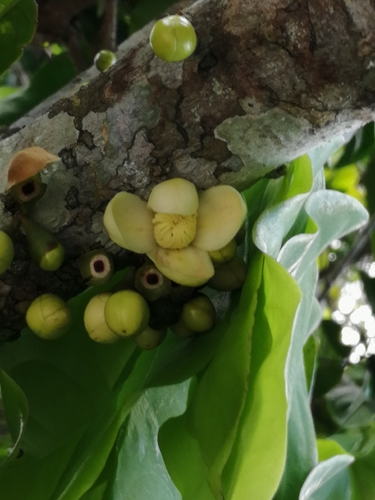
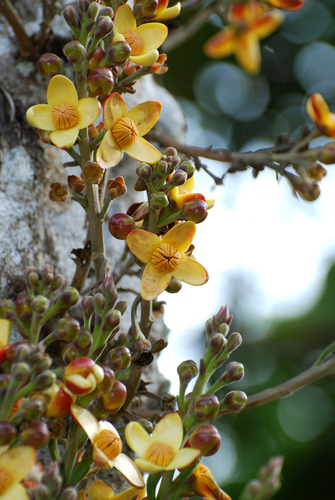
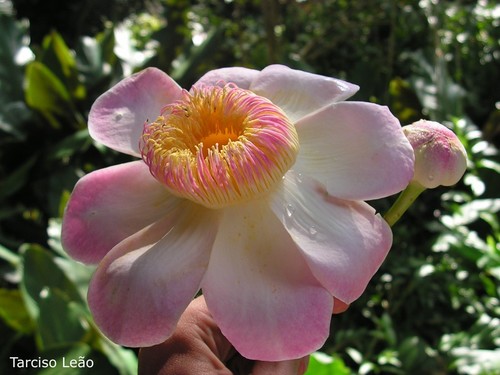
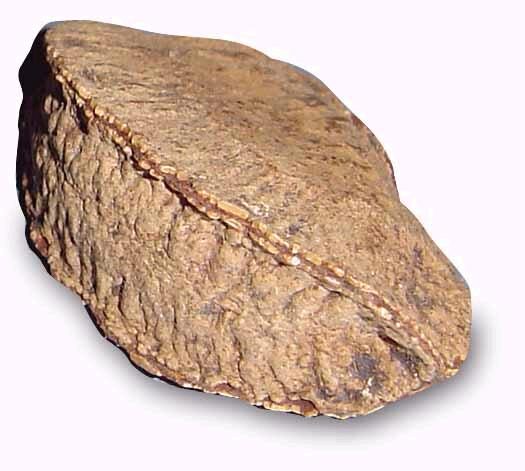
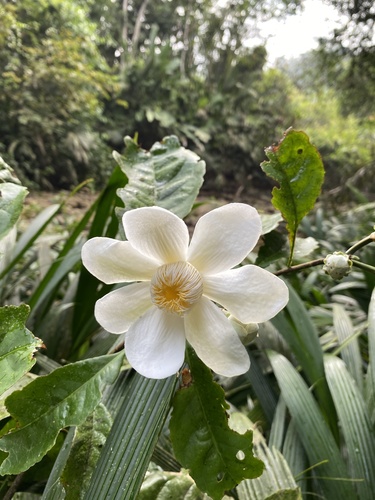
A tree 10-30 m high. The leaves are alternate. They are oblong with a wavy edge. They are 10-30 cm long by 6-15 cm wide. The leaf stalk is 3 cm long. Leaves fall before flowering. The flowers are in clusters with equal length stalks and at the end of branches. These are 6-10 cm long. There are 6-12 flowers together. Each flower is 4 cm long. Flowers are white. The fruit are round and fleshy. They are 4-6 cm long by 5 cm wide. The seeds are oblong.
Edible Uses
In colonial times in India, the fibrous bark of this tree was found to be an ideal substitute for beech bark as matches for matchlocks. The Careya arborea leaves are traditionally used to roll cheroots in Myanmar (Burma). The town of Pyay (formerly Prome) is known for a local delicacy known as taw laphet (တောလက်ဖက်; lit. 'rural laphet') or Nibbinda laphet (နိဗ္ဗိန္ဒလက်ဖက်) that is tightly packed in parcel-like Careya arborea leaves for fermentation and preservation purposes. Flowers and young leaves are eaten as salad greens in Thailand. Young fruit is reported to be edible, though seeds are slightly poisonous.
Traditional Uses
The shoots and young leaves are eaten as a vegetable. The flowers are eaten raw. The fruit is eaten fresh.
This uses section is brief — help expand it
Distribution
A tropical plant. It grows in mixed deciduous forest. It grows up to 1,000 m above sea level.
Where It Grows
Asia, Cambodia, Indochina, Laos, SE Asia, Thailand,
Cultivation
It can be grown from seeds. It can also be grown from stem cuttings, layering or root suckers.
Other Information
They are sold in markets.
Notes
There are about 5 Careya species.
Synonyms
Also Known As
Kradon, Pak-kradon, Patana oak
References (12)
- Cengel, D. J. & Dany, C., (Eds), 2016, Integrating Forest Biodiversity Resource Management and Sustainable Community Livelihood Development in the Preah Vihear Protected Forest. International Tropical Timber Organization p 134 (As Careya sphaerica)
- Eiadthong, W., et al, 2010, Management of the Emerald Triangle Protected Forests Complex. Botanical Consultant Technical Report. p 47 (As Careya sphaerica)
- Jacquat, C., 1990, Plants from the Markets of Thailand. D.K. Book House p 68 (As Careya sphaerica)
- Japanese International Research Centre for Agricultural Science www.jircas.affrc.go.jp/project/value_addition/Vegetables (As Careya sphaerica)
- Kachenchart, B., et al, 2008, Phenology of Edible Plants at Sakaerat Forest. In Proceedings of the FORTROP II: Tropical Forestry Change in a Changing World. Bangkok, Thailand. (As Careya sphaerica)
Show all 12 references Hide references
- Maituthisakul, P., et al, 2007, Assessment of phenolic content and free radical-scavenging capacity of some Thai indigenous plants. Food Chemistry 100: 1409-1418 (As Careya sphaerica)
- Nakahara, K. et al, 2002, Antimutagenicity of Some Edible Thai Plants, and a Biocative Carbazole Alkaloid, Mahanine, Isolated from Micromelum minutum. Journal of Agricultural and Food Chemistry. 50: 4796-4892 (As Careya sphaerica)
- Somnasang, P., Moreno, G and Chusil K., 1998, Indigenous knowledge of wild hunting and gathering in north-east Thailand. Food and Nutrition Bulletin 19(4) p 359f (As Careya sphaerica)
- Srichaiwong, P., et al, 2014, A Study of the Biodiversity of Natural Food Production to Support Community Upstream of Chi Basin, Thailand. Asian Social Science 10 (2): (As Careya sphaerica)
- Sakunpak, A. & Panichayupakaranant, P., 2012, Antibacterial activity of Thai edible plants against gastrointestinal pathogenic bacteria and isolation of a new broad spectrum antibacterial polyisoprenylated benzophenone, chamuangone. Food Chemistry 130 (2012) 826–831 (As Careya sphaerica)
- Terra, G.J.A., 1973, Tropical Vegetables. Communication 54e Royal Tropical Institute, Amsterdam, p 35 (As Careya sphaerica)
- Thitiprasert, W., et al, 2007, Country report on the State of Plant Genetic Resources for Food and Agriculture in Thailand (1997-2004). FAO p 95 (As Careya sphaerica)