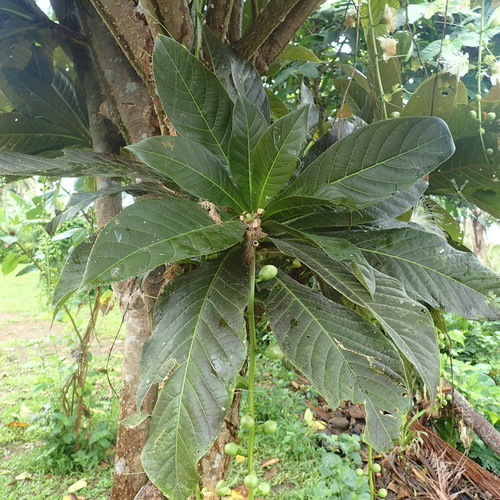
Eschweilera grandiflora
(Aubl.) Sandwith
Big flower eschweilera
iNaturalist· cc-by-nc
(c) Hervé GALLIFFET, some rights reserved (CC BY-NC), uploaded by Hervé GALLIFFET
iNaturalist· cc-by-nc
(c) Hervé GALLIFFET, some rights reserved (CC BY-NC)
Description
An evergreen tropical tree reaching 30 m tall that grows as an understorey species in rainforests at low elevations in moist regions, and is sometimes cultivated.
Edible Uses
The nuts and seeds are edible, and oil is extracted from the seeds.
Medicinal Uses
An infusion of the flowers is used in the treatment of ophthalmia. The fruit is acidic and refreshant. An emulsion of the seed is used in the treatment of infections of the urinary tract.
Distribution
A tropical plant. It is an understorey tree in the rainforest. It grows at low elevations in the moist tropics.
Where It Grows
Amazon, Brazil, Ecuador, French Guiana, Guadeloupe, Guyana, Peru, South America, West Indies,
Cultivation
A plant of low elevations in the moist tropics.
Other Uses
An oil extracted from the seeds is used in soap-making and as lubricant. The light red to orange-red wood is dense, close-grained and very strong. It is used for spokes. We do not have any more specific information for this species, but the general description for the wood of this genus is as follows:- The heartwood of most species is light brown, grayish-brown, reddish-brown, or brownish-buff, sometimes with black streaks; it is usually distinct from the yellowish sapwood. The texture is fine and uniform; the grain typically straight; lustre is low; there is no distinctive odour or taste. Depending on the species, silica content may be as high as 2.4%. Most species are highly resistant to attack by both brown-rot and white-rot fungi. Also most of the species have gained wide recognition for their high degree of resistance to marine-borer attack. Resistance to dry-wood termite attack is variable, depending on species. The wood is rated as fairly difficult to air season, drying rates are slow to moderate. Warp and checking are rated as slight to moderate, depending on species. Most of the species are difficult to work because of the high density and high silica content (excepting E. Tenax); specially tipped cutters are suggested. They can be used for purposes such as marine and other heavy construction, industrial flooring, pulpmill equipment, railroad crossties, piling, and turnery.
Other Information
It is sometimes cultivated.
Notes
There are 85 Eschweilera species.
Synonyms
Also Known As
Baikaaki, Castanha vermelha, Castanharana, Machimango, Matamata, Tibira
References (10)
- Fern, K., 2012, Tropical Species Database http://theferns.info/tropical/
- Fouqué, A. 1972. Espèces fruitières d'Amérique tropicale. Institut français de recherches fruitierès outre-mer
- Grandtner, M. M. & Chevrette, J., 2013, Dictionary of Trees, Volume 2: South America: Nomenclature, Taxonomy and Ecology. Academic Press p 231
- Hedrick, U.P., 1919, (Ed.), Sturtevant's edible plants of the world. p 375 (As Lecythis grandiflora)
- Hedrick, 1972,
Show all 10 references Hide references
- Kermath, B. M., et al, 2014, Food Plants in the Americas: A survey of the domesticated, cultivated and wild plants used for Human food in North, Central and South America and the Caribbean. On line draft. p 348
- Martin, F. W., et al, 1987, Perennial Edible Fruits of the Tropics. USDA Handbook 642 p 98
- Mori, S. A. & G. T. Prance. 1990. Lecythidaceae - Part II. The zygomorphic-flowered New World genera (Couroupita, Corythophora, Bertholletia, Couratari, Eschweilera, & Lecythis). In: Organization for Flora Neotropica, ed., Fl. Neotrop. Monogr. 21(2):216–218.
- Uphof,
- Wickens, G.E., 1995, Edible Nuts. FAO Non-wood forest products. FAO, Rome. p 139