Couroupita guianensis
Aublet
Cannon-ball tree
iNaturalist· cc-by-nc
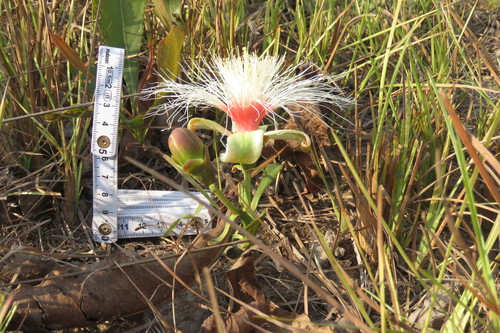
(c) Ericson Cernawsky Igual, some rights reserved (CC BY-NC)
iNaturalist· cc-by-nc
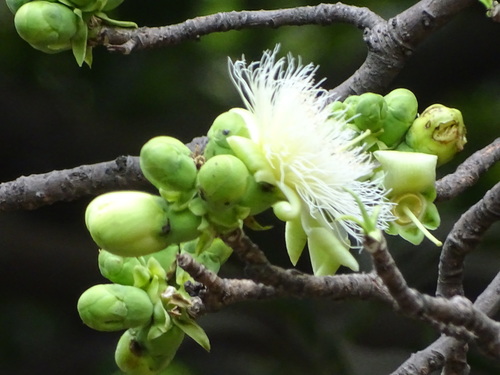
(c) Mohini Kekan, some rights reserved (CC BY-NC)
iNaturalist· cc-by-nc
(c) Mohini Kekan, some rights reserved (CC BY-NC)
Summary
Source: WikipediaCouroupita guianensis, known by a variety of common names including cannonball tree, is a deciduous tree in the flowering plant family Lecythidaceae. It is native to lowland tropical rainforests of Central and South America, from Costa Rica, south to Brazil and northern Bolivia and it is cultivated in many other tropical areas throughout the world because of its fragrant flowers and large fruit, which are brownish grey. There are potential medicinal uses for many parts of Couroupita guianensis, and the tree has cultural and religious significance in South and Southeast Asia. In Sri Lanka and India, the cannonball tree has been widely misidentified as the Sal tree (Shorea robusta), after its introduction to the island by the British in 1881, and has been included as a common item in Buddhist temples as a result.
Description
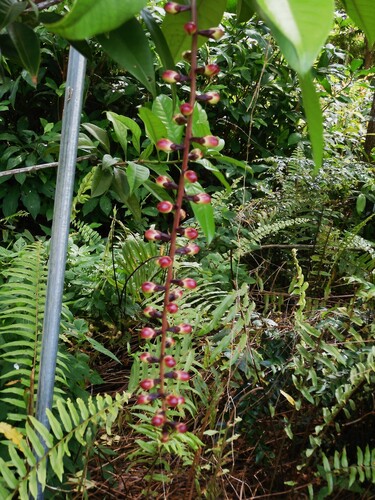
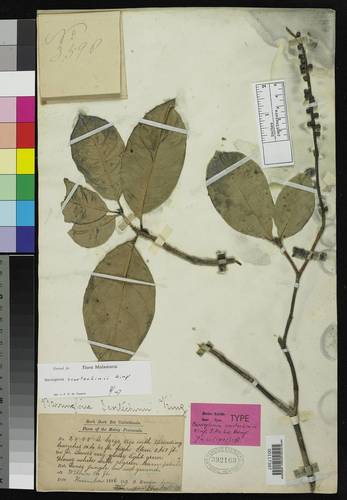
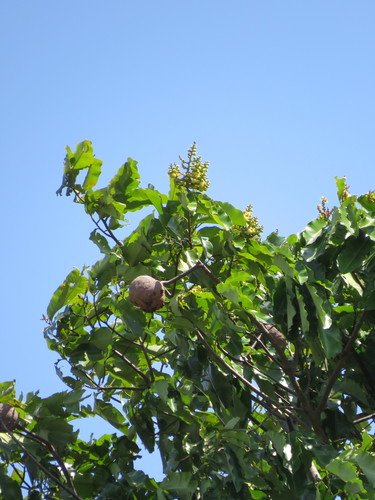
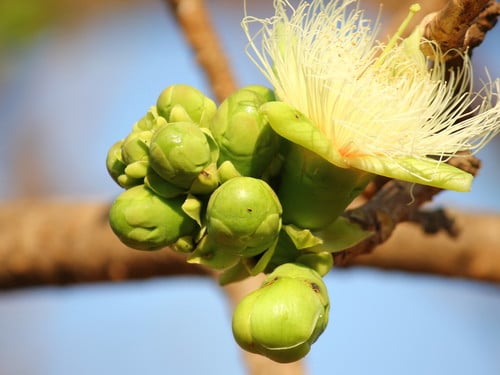
A large tree. It can be 25-30 m tall. It has a large spreading crown. The trunk is dark brown. It looses its leaves during the year. The wood is soft. The leaves are simple and alternate. They are oval and broader at the base. They are 15-20 cm long by 5-7 cm wide. The flowers grow directly on the trunk. They are on small branches. They hang down. The flowers are red and 10 cm across. They have large numbers of stamens arranged in 2 groups. One of these is in the flower centre and the other is on a lower petal. The fruit is large and the size of a cannon ball. They can be 25 cm across. Large numbers of fruit hang on stalks around the trunk. These stalks can be 15-30 cm long. The fruit have a soft fleshy centre. The fruit are edible but have a bad smell. The flesh is red. The fruit often burst explosively when they fall from the tree.
Edible Uses
Fruit - raw. Although the fruits are edible, the smell of the white flesh discourages most people from trying them, so they are only occasionally eaten.
Traditional Uses
The pulp is eaten and made into a beveridge.
This uses section is brief — help expand it
Medicinal Uses
The pulp of the wood is used, after exposure, in the treatment of skin diseases of animals. The fruit pulp and the seeds are ingested as a refreshant.
Known Hazards
Fruit often burst explosively when they fall from the tree.
Distribution
It is native to tropical America. A tropical plant. It is very sensitive to frost. Plants need lots of water and humidity. It grows on flood plains. In the Cairns Botanical Gardens. It suits plant hardiness zones 11-12.
Where It Grows
Amazon, Andaman Is., Asia, Australia, Bangladesh, Bolivia, Brazil, Central America, Colombia, Costa Rica, Cuba, Dominican Republic, East Africa, Ecuador, French Guiana*, Guianas, Guyana*, Haiti, Hawaii, Honduras, India, Indochina, Indonesia, Laos, Mozambique, Myanmar, Nicobar Is., North America, Pacific, Pakistan, Panama, Peru, Puerto Rico, SE Asia, Singapore, South America, Sri Lanka, Suriname, Thailand, Trinidad-Tobago, USA, Venezuela, Vietnam, West Indies, Winward Is.,
Cultivation
Plants are grown from seed. The fruit are cracked open and the seeds removed, washed and dried in the sun. Germination is slow. Fresh seed should be planted. They germinate in 8-15 days and can be transplanted in 5-7 months.
Propagation
Seed - best sown as soon after harvesting as possible, it does not require pre-treatment. Seeds can be sown in semi-shade, either in nursery beds or in individual containers. When fresh seed is used, a germination rate in excess of 80% usually occurs within 8 - 15 days. Seedlings should be placed in individual containers by the time they are 6 - 10cm tall, and are ready to plant out when 7 months old.
Other Uses
The flowers have a wonderful smell and can be used to scent perfumes and cosmetics. The hard shells of the fruit are sometimes used as containers. The heartwood is light yellow; it is not clearly demarcated from the sapwood. The texture is medium to coarse; the grain straight or interlocked; there is an unpleasant odour from the green wood. The wood is light to very light in weight; very soft to soft; not durable, being susceptible to fungi, dry wood borers and termites. It seasons somewhat slowly, with only a slight risk of checking or distortion; once dry it is moderately stable in service. The wood works easily with ordinary tools, though there is a tendency to woolliness and filling is recommended in order to obtain a good finish; nailing and screwing are poor; gluing is correct. The wood is used for various lower value purposes including toys, boxes and crates, matches, interior joinery and panelling, furniture components, wood-ware, floats, blockboard and fibre boards.
Production
Plants grow quickly. They can be 2.5 m tall in 2 years. The fruit ripen in 8 months.
Notes
There are 3-4 Couroupita species.
Synonyms
Also Known As
Amyauk-san-bin, Bala de canon, Bola de canon, Buah kanon, Coco de mono, Dau lau, Huatisasa, Ilustinta, Kailaspati, Lustuntu muyu, Pankabokawe, Pohon peluru meriam, Pohon sala, Sa-lah, Sala-lan-kaa, Supay mati
References (29)
- Ambasta, S.P. (Ed.), 2000, The Useful Plants of India. CSIR India. p 144
- Andrade, E. H. A. et al, 1999, Seed Composition of Amazonian Lecythidaceae Species: Part 3 in the Series ‘‘Studies of Edible Amazonian Plants’’. Journal of Food Composition and Analysis 12:37-51
- Barwick, M., 2004, Tropical and Subtropical Trees. A Worldwide Encyclopedic Guide. Thames and Hudson p 134
- Beasley, J., 2011, Plants of Tropical North Queensland - the compact guide. Footloose publications. p 184
- Bodkin, F., 1991, Encyclopedia Botanica. Cornstalk publishing, p 293
Show all 29 references Hide references
- Bole, P.V., & Yaghani, Y., 1985, Field Guide to the Common Trees of India. OUP p 23
- Condit, R., et al, 2011, Trees of Panama and Costa Rica. Princeton Field Guides. p 260
- Cundall, P., (ed.), 2004, Gardening Australia: flora: the gardener's bible. ABC Books. p 429
- Engel, D.H., & Phummai, S., 2000, A Field Guide to Tropical Plants of Asia. Timber Press. p 38, 99
- Etherington, K., & Imwold, D., (Eds), 2001, Botanica's Trees & Shrubs. The illustrated A-Z of over 8500 trees and shrubs. Random House, Australia. p 238
- Hedrick, U.P., 1919, (Ed.), Sturtevant's edible plants of the world. p 223
- Heywood, V.H., Brummitt, R.K., Culham, A., and Seberg, O. 2007, Flowering Plant Families of the World. Royal Botanical Gardens, Kew. p 184
- Hist. pl. Guiane 2:708, t. 282. 1775
- Kew Plants of the World Online
- Llamas, K.A., 2003, Tropical Flowering Plants. Timber Press. p 244
- Lopez-Diago, D. & Garcia, N., 2021, Wild edible fruits of Colombia. Biota ColomBiana 22 (2) p 40
- Martin, F. W., et al, 1987, Perennial Edible Fruits of the Tropics. USDA Handbook 642 p 97 (Also as Couroupita surinamensis)
- McMakin, P.D., 2000, Flowering Plants of Thailand. A Field Guide. White Lotus. p 18
- Morley, B. & Everard, B., 1970, Wild Flowers of the World. Ebury press. Plate 179
- Perry, F., and Hay, R., 1982, Guide to Tropical and Subtropical Plants. Sun Books p 24
- Roa, J. A. G. & Boada, D. S. G., 2018, Fundación para el Fortalecimiento de la Fruticultura y Plantas Alimenticias no Convencionales en Colombia.
- Schuler, S., (Ed.), 1977, Simon & Schuster's Guide to Trees. Simon & Schuster. No. 97
- Smith, N., et al, 2007, Amazon River Fruits. Flavors for Conservation. Missouri Botanical Gardens Press. p 136
- Staples, G.W. and Herbst, D.R., 2005, A tropical Garden Flora. Bishop Museum Press, Honolulu, Hawaii. p 369
- Sukarya, D. G., (Ed.) 2013, 3,500 Plant Species of the Botanic Gardens of Indonesia. LIPI p 212
- Swaminathan, M.S., and Kochnar, S.L., 2007, An Atlas of Major Flowering Trees in India. Macmillan. p 162
- Torre, de la, L., et al, 2008, Enciclopedia de las Plantas Útiles del Ecuador. Herbario QCA. Pontificia Universidad Católica del Ecuador. p 401
- Young, J., (Ed.), 2001, Botanica's Pocket Trees and Shrubs. Random House. p 289
- Zuchowski W., 2007, Tropical Plants of Costa Rica. A Zona Tropical Publication, Comstock Publishing. p 275