Careya arborea
Roxb.
Patana Oak, Slow-match tree
iNaturalist· cc-by-nc-sa
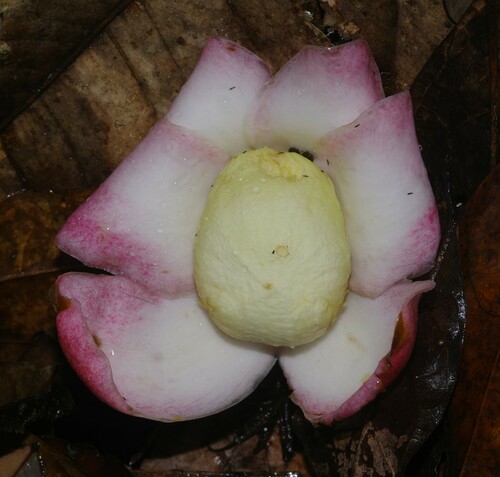
(c) satish nikam, some rights reserved (CC BY-NC-SA)
iNaturalist· cc-by-nc
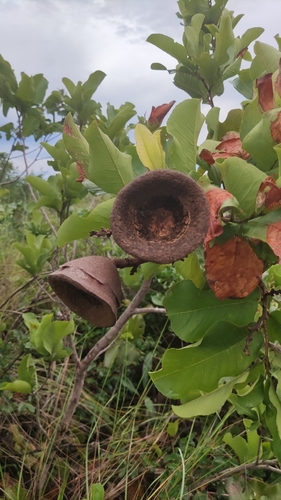
(c) Rujuta Vinod, some rights reserved (CC BY-NC)
iNaturalist· cc-by-nc
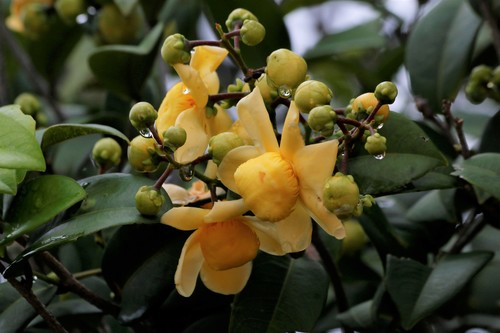
(c) Rujuta Vinod, some rights reserved (CC BY-NC)
Summary
Source: WikipediaCareya arborea is a species of tree in the Lecythidaceae family, native to the Indian subcontinent, Afghanistan, and Indochina. Its common English names include wild guava, Ceylon oak, patana oak. Careya arborea is a deciduous tree that grows up to 15 metres (49 ft) high. Its leaves turn red in the cold season. Flowers are yellow or white in colour that become large green berries. The tree grows throughout India in forests and grasslands.
Description
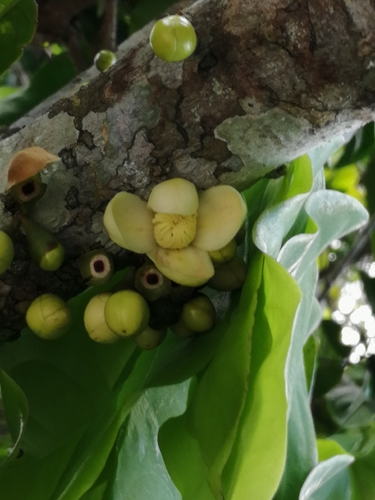
A small tree 7-15 m high. It can reach 20 m high. The trunk is low and the crown is dense and round. The bark is dark grey and thick and rough. The leaves are alternate. They do not have stalks. The edges of the leaves have a few teeth. The leaves are broadly oval and 15-20 cm long by 10-12 cm wide. They are leathery. The flowers are white. They are 8 cm across and occur in thick clusters. They look like big bottle brushes. The fruit are green and has sepals which remain. The fruit are urn shaped and 6-7 cm across. They are smooth.
Edible Uses
In colonial times in India, the fibrous bark of this tree was found to be an ideal substitute for beech bark as matches for matchlocks. The Careya arborea leaves are traditionally used to roll cheroots in Myanmar (Burma). The town of Pyay (formerly Prome) is known for a local delicacy known as taw laphet (တောလက်ဖက်; lit. 'rural laphet') or Nibbinda laphet (နိဗ္ဗိန္ဒလက်ဖက်) that is tightly packed in parcel-like Careya arborea leaves for fermentation and preservation purposes. Flowers and young leaves are eaten as salad greens in Thailand. Young fruit is reported to be edible, though seeds are slightly poisonous.
Traditional Uses
Young shoots are eaten uncooked. The flowers are eaten as a vegetable. The bark or outside root is removed and pounded and ground to make flour for bread. The seeds are eaten roasted. This is presumably to remove poison. The ripe fruit are eaten raw. They are also used as a vegetable. They are also pickled. CAUTION. There are some reports the seeds are poisonous.
Medicinal Uses
The fibrous bark has been applied medicinally for relieving body swellings. The juice of the bark, and the calices of the flowers, are astringent and mucilaginous. They are often used internally in India for treating coughs and colds, and are applied externally as an embrocation. An astringent gum exudes from the fruit and stem. The pulped leaves are used as a poultice. The bark of the tree and the sepals of the flowers are well-known Indian remedies, and are valued on account of their astringent and mucilaginous properties, being administered internally in coughs and colds and applied externally as an embrocation.
Known Hazards
The seeds are slightly poisonous.
Distribution
A tropical plant. It grows in open forest. They are common in deciduous and semi-evergreen forests all over the Indian plains. It grows up to 1,600 m above sea level. In the Himalayas it grows up to 800 m above sea level.
Where It Grows
Asia, Bangladesh, Cambodia, Himalayas, India, Indochina, Laos, Malaysia, Myanmar, Northeastern India, Philippines, SE Asia, Sri Lanka, Thailand, Vietnam,
Cultivation
Plants can be grown from seeds. Seeds germinate in 11-46 days.
Propagation
Seed - there is over 90% germination in 11 - 46 days.
Other Uses
The fibrous bark contains a brown dye. The bark yields a good fibre that is used locally for coarse cordage. It is also suitable for making brown paper and is used as a slow match to ignite gunpowder. The bark is a source of tannins. A gum is obtained from the tree. The tree yields a medium-weight to heavy hard wood with a density of 770 kg/m cubic to over 1000 kg/m cubic at 15% moisture content. Heartwood pale red to dark red-brown in older trees, sapwood wide, pale reddish-white; grain straight; texture medium and even. Shrinkage of the wood is very high, so it should be seasoned slowly as it easily develops surface checks, end splits, and is very liable to warp and twist It is moderately hard and somewhat difficult to saw, but presents no difficulties when worked with hand and machine tools. It yields a smooth finish and a good polish. The wood is durable, especially under water. The wood is used, mainly in India and Myanmar, for general construction (house posts, planking), furniture and cabinet work, carts, mouldings, turnery, piling and agricultural implements.
Production
In India fruit are produced April to August.
Other Information
Mainly used as a famine food.
Notes
There are about 5 Careya species. The genus was named for Rev Carey of Serampore.
Synonyms
Also Known As
Aalagavvele, Alam, Araya, Ayma, Asanda, Bambwe, Doddaale, Doddala, Duddippa, Garva hannu, Gaula mara, Gonji, Hennu matthi, Hou-no, Kariyal, Kachaddai, Kadon kok, Kadon, Kalikatbai, Kanndaol, Kanndol, Katabhi, Kaulumara, Kaval, Khum, Khumbi, Kimbia, Kok kadon, Kradon, Kum kumari, Kumba bidipata, Kumbha, Kumbher, Kumbhi, Kumbi, Mai-pinngo, Paer, Panibhela, Pelu, Phak kadon kok, Sangawn-gnawt, Sloek raing, Thelawaw, Vakambha
References (38)
- Ambasta S.P. (Ed.), 2000, The Useful Plants of India. CSIR India. p 105
- Ashton, M. S., et al 1997, A Field Guide to the Common Trees and Shrubs of Sri Lanka. WHT Publications Ltd. pdf p 232
- Bircher, A. G. & Bircher, W. H., 2000, Encyclopedia of Fruit Trees and Edible Flowering Plants in Egypt and the Subtropics. AUC Press. p 83
- Bohra, N., et al, 2017, Ethnobotany of wild edible plants traditionally used by the local people in the Ramnagar regions from Nainital District, Uttarakhand, India. Biolife 5(1): 12-19
- Bole, P.V., & Yaghani, Y., 1985, Field Guide to the Common Trees of India. OUP p
Show all 38 references Hide references
- Burkill, I.H., 1966, A Dictionary of the Economic Products of the Malay Peninsula. Ministry of Agriculture and Cooperatives, Kuala Lumpur, Malaysia. Vol 1 (A-H) p 464
- Chatterjee, A.S. & Koma, Y.S., 1995, List of Vegetables and Edible Plants in Cambodia. JVC Trainers' training manual. Home Garden Series No. 1. JVC Cambodia
- Cruz-Garcia, G. S., & Price, L. L., 2011, Ethnobotanical investigation of 'wild' food plants used by rice farmers in Kalasin, Northeast Thailand. Journal of Ethnobiology and Ethnomedicine 7:33
- Dey, A. & Mukhererjee, A., 2015, Living and Survival Amidst Hunger: Wild Edible Botanicals as a Prime Forest Productivity in the Rural Purulia District, West Bengal, India from Colonial to Present. Research Journal of Forestry 9(3): 71-86
- Dhyani, S.K., & Sharma, R.V., 1987, Exploration of Socio-economic plant resources of Vyasi Valley in Tehri Garwhal. J. Econ. Tax. Bot. Vol. 9 No. 2 pp 299-310
- Dobriyal, M. J. R. & Dobriyal, R., 2014, Non Wood Forest Produce an Option for Ethnic Food and Nutritional Security in India. Int. J. of Usuf. Mngt. 15(1):17-37
- Gardner, S., et al, 2000, A Field Guide to Forest Trees of Northern Thailand, Kobfai Publishing Project. p 200
- Hedrick, U.P., 1919, (Ed.), Sturtevant's edible plants of the world. p 162
- Hort. bengal. 52. 1814; Pl. Coromandel 3:14, t. 218. 1819
- Jadhav, R., et al, 2015, Forest Foods of Northern Western Ghats: Mode of Consumption, Nutrition and Availability. Asian Agri-History Vol. 19, No. 4: 293-317
- Kala, C. P., 2009, Aboriginal uses and management of ethnobotanical species in deciduous forests of Chhattisgarh state in India. Journal of Ethnobiology and Ethnomedicine. 5:32
- Khumgratok, S., Edible Plants in Cultural Forests of Northeastern Thailand. Mahasarakham University Thailand.
- Kuvar, S. D. & Shinde, R. D., 2019, Wild Edible Plants used by Kokni Tribe of Nasik District, Maharashtra. Journal of Global Biosciences. Volume 8, Number 2, 2019, pp. 5936-5945
- Luczaj, L., et al, 2021, Wild food plants and fungi sold in the markets of Luang Prabang, Lao PDR. Journal of Ethnobiology and Ethnomedicine (2021) 17:6
- Menninger, E.A., 1977, Edible Nuts of the World. Horticultural Books. Florida p 39
- Mishra, S. & Chaudhury, S. S., 2012, Ethnobotanical flora used by four major tribes of Koraput, Odisha, India. Genetic Resources Crop Evolution 59:793-804
- Misra S. & Misra M., 2016, Ethnobotanical and Nutritional Evaluation of Some Edible Fruit Plants of Southern Odisha, India. International Journal of Advances in Agricultural Science and Technology, Vol.3 Issue.1, March- 2016, pg. 1-30
- Natuhara, Y., et al, 2011, Uses of trees in paddy fields in Champasak Province, Southern Lao PDR. Landscape and Ecological Engineering. p 7
- Pasha, M. K. & Uddin, S. B., 2019, Minor Edible Fruits of Bangladesh. Bangladesh J. Plant Taxon. 26(2): 299–313
- Patiri, B. & Borah, A., 2007, Wild Edible Plants of Assam. Geethaki Publishers. p 57
- Phatlamphu, N., et al, 2021, Ethnobotany of edible plants in Muang District, Kalasin Province, Thailand, Biodiversitas Vol. 22, No. 12 pp 5432-5444
- Phon, P., 2000, Plants used in Cambodia. © Pauline Dy Phon, Phnom Penh, Cambodia. p 134
- Sarma, H., et al, 2010, Updated Estimates of Wild Edible and Threatened Plants of Assam: A Meta-analysis. International Journal of Botany 6(4): 414-423
- Sen, R., et al, 1985, Ethnobotanical Uses of Herbaria - 4 J. Econ. Tax. Bot. Vol 6. No.2 pp 331-335
- Singh, H.B., Arora R.K.,1978, Wild edible Plants of India. Indian Council of Agricultural Research, New Delhi. p 78
- Sosef, M. S. M., Hong, L. T., & Prawirohatmodjo, S., (Eds.), 1998, Timber tree: Lesser-known timbers. Plant Resources of South-East Asia, 5(3), p 139
- Terra, G.J.A., 1973, Tropical Vegetables. Communication 54e Royal Tropical Institute, Amsterdam, p 35
- Toppo, P. et al, 2016, Wild edible plants of Dhamtari district of Chhattisgarh, India. Van Sangyan Vol. 3, No. 4
- Upreti, K., et al, 2010, Diversity and Distribution of Wild Edible Fruit Plants of Uttarakhand. Bioversity Potentials of the Himalaya. p 164
- Wickens, G.E., 1995, Edible Nuts. FAO Non-wood forest products. FAO, Rome. p 139
- Wild edible plants of Himachal Pradesh
- World Checklist of Useful Plant Species 2020. Royal Botanic Gardens, Kew
- www.worldagroforestrycentre.org/sea/products/afdbases/af/asp/SpeciesInfo.asp?SpID=18147