Canarium odontophyllum
Miq.
Borneo olive, Sibu olive
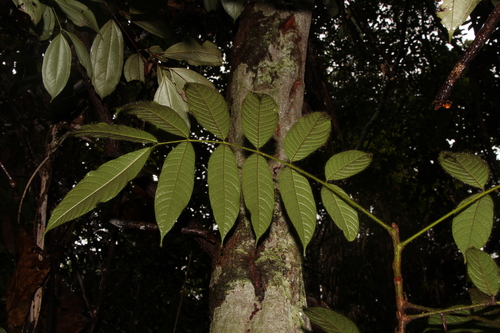
iNaturalist· cc-by-nc-sa
(c) filibot.web, some rights reserved (CC BY-NC-SA)
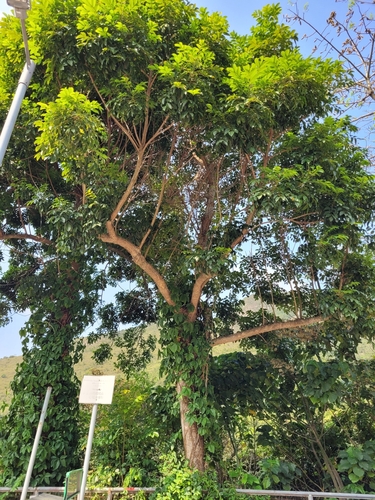
iNaturalist· cc-by-nc
(c) Arief Hamidi, some rights reserved (CC BY-NC)
Summary
Source: WikipediaCanarium odontophyllum, also referred to as the Borneo olive, is a fruit-bearing tree of the genus Canarium in the family Burseraceae. Native to Borneo, where it is locally known as dabai in Sarawak and kembayau in Sabah and Brunei. Its fruit is a prized seasonal delicacy in Sarawak, which earned the fruit a dedicated festival - Pesta Dabai - which is held annually since 2018 in Song, Sarawak.
Description
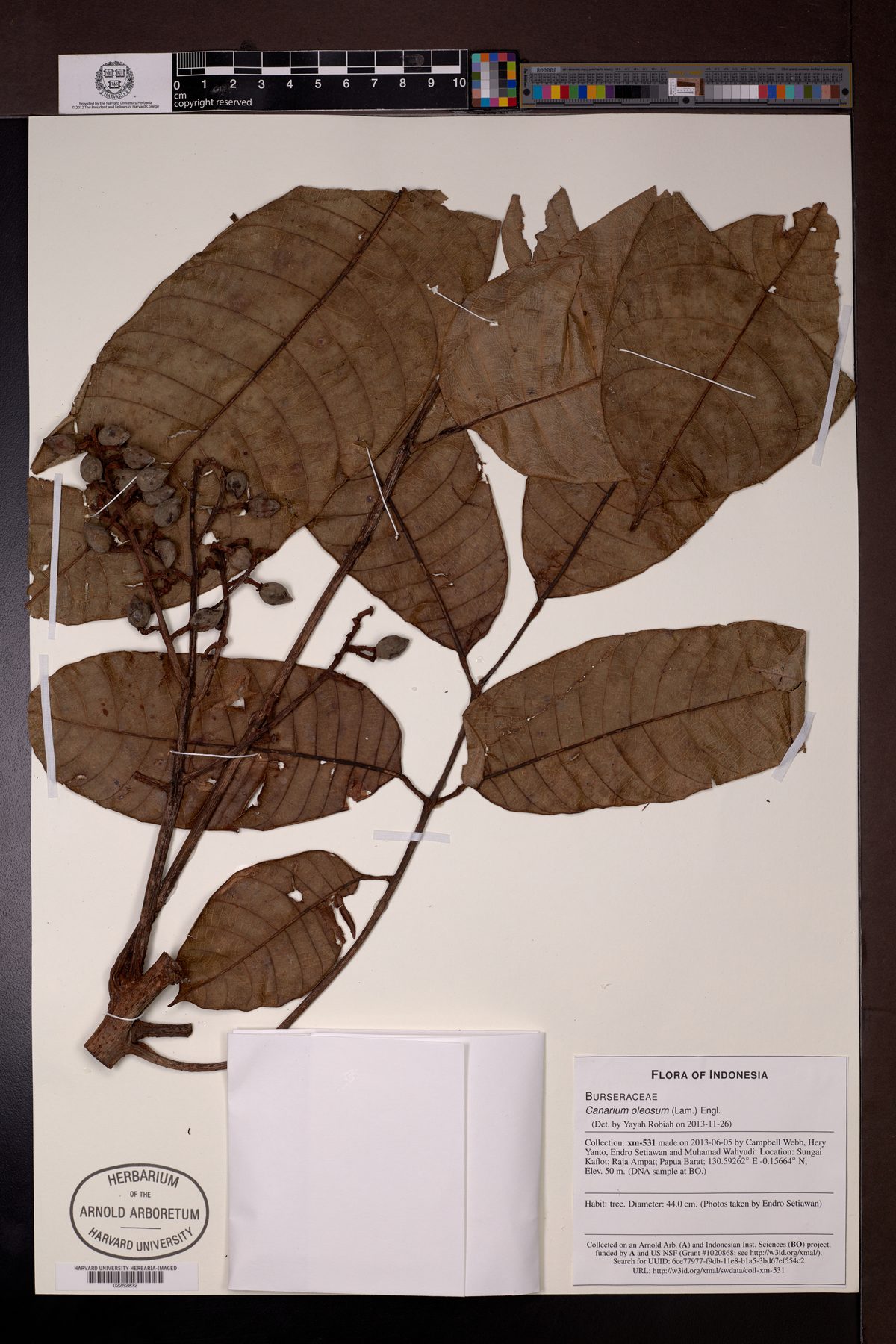
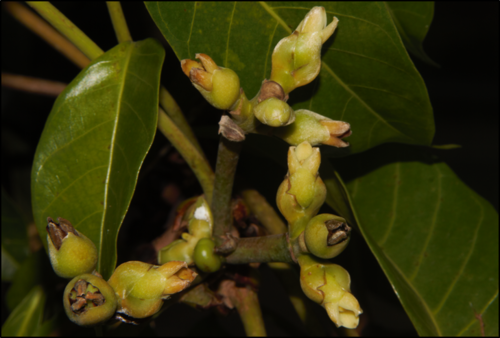
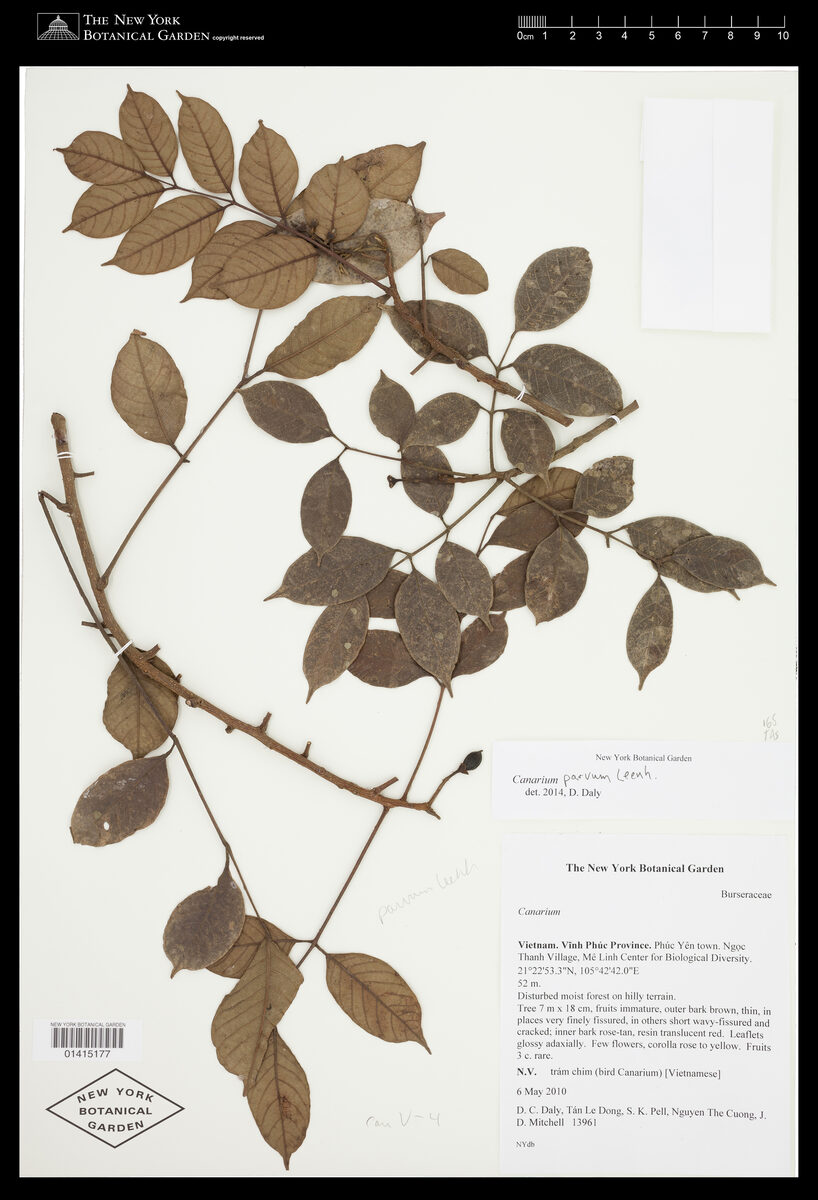
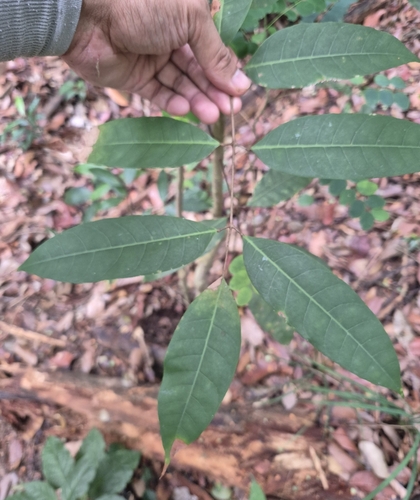
A medium sized tree. It grows up to 35 m high and can be 50 cm across in the trunk. It has buttresses. The small branches are 1-3 cm thick and have dense rusty coloured hairs. When cut crossways there is a ring of small vascular strands around the edge of the branch, more like in a root. The small leafy structure (stipule) near the base of the leaf stalk remains on the branch. It is split along the edge into 2-4 cm long lobes. This stipule is 2-9 cm long by 1.5-3.5 cm wide. The leaves have 3-8 pairs of leaflets. These leaflets are oblong and 15-40 cm long by 5-10 cm across. They are leathery and can have hairs along the main vein. The base of the leaflets is wedge shaped and the edges can have teeth. There are 15-28 pairs of veins which are raised underneath the leaf. The flower clusters are in the axils of leaves and near the ends of branches. The male flower stalks are 30-50 cm long with many flowers while the female are 15-20 cm long with few flowers. The flowers are hairy. The fruit clusters are 20-35 cm long with up to 40 fruit. The fruit are oval and rounded to triangular in cross section. They are 2.5-3.5 cm long by 1.7-2 cm wide. The shell is smooth with 3 ribs. There is 1 seed inside and 2 empty shells.
Edible Uses
Canarium odontophyllum fruit is colloquially known as "Sarawak olive" and can be eaten raw or blanched, eaten with sugar, salt or soy sauce upon serving. In Sarawak, the fruit has become an added ingredient in sauces and fried rice recipes. Besides being eaten in its original form, the fruit can be made into a paste, and can also be dried and milled into powder form for use in foods and drinks. Under commercialization, the fruit can be incorporated in pizzas, desserts, juices, and even mayonnaise.
Traditional Uses
The blue-black fruit are eaten raw. For eating fresh they are soaked in hot water for 10 minutes until softened and eaten with soy sauce or as a snack. The kernel is also eaten.
Distribution
A tropical plant. It grows in forests from sea level to 450 m altitude. It can be in swamps and along rivers.
Where It Grows
Asia, Australia, Brunei, Indonesia, Malaysia*, Sarawak, Pacific, Philippines, SE Asia,
Cultivation
When grown from seed, 70% or the trees are male.
Propagation
Seed - we have no specific information for this species but seeds of this genus generally have a hard seed coat and germinate erratically. Filing away some of the seed coat to allow moisture to enter more readily, without damaging the seed, will encourage a faster and more even germination.
Other Uses
The wood of most species in the genus Canarium is usually soft to moderately hard and probably not very durable in exposed positions. It is not, therefore of any great commercial value and is only used locally or not at all. This species is one of the sources of kedondong timber, which is obtained from several species in the family Burseraceae. We do not have a specific description of the wood for this species, but the general description of kedondong wood is as follows:- The heartwood is generally a light brown; it is not sharply demarcated from the 3 - 5cm wide band of lighter-coloured sapwood. The texture is moderately fine and even; the grain is interlocked to wavy; the surface is lustrous. The wood is light in weight; moderately hard; not very durable, being susceptible to fungi, dry wood borers and termites. It seasons somewhat slowly with only a slight risk of checking and distortion; once dry it is moderately stable to stable in service. The wood has a fairly high blunting effect, stellite-tipped and tungsten carbide tools are recommended; it is moderately easy to slightly difficult to plane; finishes smooth to rough; can be easy to very difficult to bore; slightly difficult to difficult to turn; nailing and screwing properties are good; gluing is correct. The wood is suitable for internal use as a general utility timber for planking, cladding, plywood, flooring, furniture, packing cases, pallets and general carpentry work.
Production
Flowering is from March to April and September to October and fruiting from May to November. Fruit can only be kept for 2-3 days after harvesting. The fruit are put into hot water to soften.
Other Information
It is widely cultivated in Sarawak for its edible fruit.
Notes
There are 80-95 Canarium species. The fruit is high in oil content.
Nutrition
| Part | Moisture | kJ | kcal | Protein | Vit A | Vit C | Iron | Zinc |
|---|---|---|---|---|---|---|---|---|
| Fruit | 41.3 | 1417 | 339 | 3.8 | — | — | 1.3 | 4.7 |
| Nuts | 35 | — | — | 9 | — | — | — | — |
Synonyms
Also Known As
Bundui-bundui, Dabai, Dabang, Dabu, Danau majang, Dawai, Kambayau, Kembayau, Kumbayan, Kurihang, Saluan
References (18)
- Altschul, S.V.R., 1973, Drugs and Foods from Little-known Plants. Notes in Harvard University Herbaria. Harvard Univ. Press. Massachusetts. no. 1979
- Blench, R., 2004, Fruits and Arboriculture in the Indo-Pacific Region. Indo-Pacific Prehistory Association Bulletin 24. (Taipei Papers Volume 2) p 36
- Chai, P. P. K. (Ed), et al, 2000, A checklist of Flora, Fauna, Food and Medicinal Plants. Lanjak Entimau Wildlife Sanctuary, Sarawak. Forestry Malaysia & ITTO. p 166
- Chua, H. P., et al, 2015, Physical properties and nutritional values of dabai fruit (Canarium odontophyllum) of different genotypes. J. Trop. Agric. and Fd. Sc. 43(1)p 1-10
- Ding, P. and Tee, Y. K., 2011, Physicochemical characteristics of dabai (Canarium odontophyllum Miq.) fruit. Fruits, Vol 66. p 47-52
Show all 18 references Hide references
- Facciola, S., 1998, Cornucopia 2: a Source Book of Edible Plants. Kampong Publications, p 62
- Fl. Ned. Ind., Eerste bijv. 525. 1861
- Hoe, V. B. & Siong, K. H., 1999, The nutritional value of indigenous fruit and vegetables in Sarawak. Asia Pacific J. Clin. Nutr. 8(1):24-31
- Leenhouts, P.W., 1955, Burseraceae in Flora Malesiana 5(1) p 272
- Milow, P., et al, 2013, Malaysian species of plants with edible fruits or seeds and their evaluation. International Journal of Fruit Science. 14:1, 1-27
- Siong, K. H., 2003, Indigenous Fruits of Sarawak. ITTO & Sarawak Forest Department. p 34
- Slik, F., www.asianplant.net
- Soepadmo, E. and Wong, K. M., 1995, Tree Flora of Sabah and Sarawak. Forestry Malaysia. Volume One. p 59
- Tanaka,
- Tankard, G., 1990, Tropical fruit. An Australian Guide to Growing and using exotic fruit. Viking p 127
- USDA, ARS, National Genetic Resources Program. Germplasm Resources Information Network - (GRIN). [Online Database] National Germplasm Resources Laboratory, Beltsville, Maryland. Available: www.ars-grin.gov/cgi-bin/npgs/html/econ.pl (10 April 2000)
- Wiersema, J. H. & Leon, B., 2013, World Economic Plants. A Standard Reference CRC Press. 2nd Ed. p 138
- World Checklist of Useful Plant Species 2020. Royal Botanic Gardens, Kew