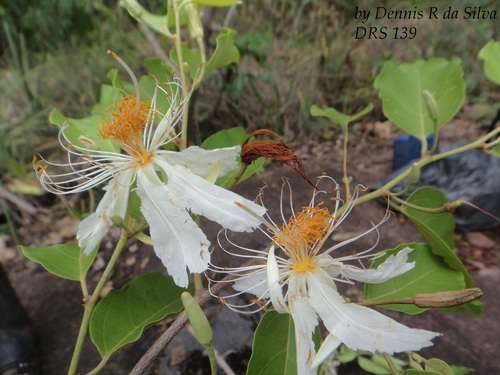
Cola gigantea
A. Chev.
Giant cola
iNaturalist· cc-by-nc-sa
(c) Reuben C. J. Lim, some rights reserved (CC BY-NC-SA)
iNaturalist· cc-by-nc
(c) International Institute of Tropical Agriculture, some rights reserved (CC BY-NC)
iNaturalist· cc-by-nc
(c) thierry_aebischer_chinko, some rights reserved (CC BY-NC), uploaded by thierry_aebischer_chinko
Description
A large tree. It grows 50 m high. The trunk has narrow buttresses. The crown is dense and spreading. The bark is grey with cracks along it. The leaves are simple and 17-45 cm long by 14-32 cm wide. They are oval and can have 3 lobes. They are deeply heart shaped at the base. The flowering shoots are in the axils of leaves. They are covered with rusty brown hairs. The fruit is a berry made up of 4-5 boat shaped sections. The fruit is about 15 cm long. There are about 8 seeds each 3 cm long by 1.5 cm wide.
Edible Uses
The seeds are used as a condiment for thickening soup and are consumed as a spice. The fruit and seeds (nuts) are eaten and are an important commonly used food in West Africa.
Traditional Uses
The seeds are used as a condiment for thickening soup.
This uses section is brief — help expand it
Distribution
It is a tropical plant. In grows in moist semi-deciduous forest in West Africa. It also grow in savannah. It can grow in dry sandy soils and also fairly heavy soils.
Where It Grows
Africa, Benin, Burkina Faso, Central Africa, Central African Republic, CAR, Congo DR, East Africa, Ghana, Liberia, Nigeria, SE Asia, Singapore, Sudan, Togo, Uganda, West Africa,
Cultivation
Plants can be grown from seeds. These germinate in 16-40 days. Plants can be budded. Plants can be grown from stem cuttings.
Other Information
It is an important and commonly used food in West Africa. It is cultivated.
Notes
Also put in the family Sterculiaceae.
Also Known As
Dodowa, Ebenebe, Grand ouara, Ndaba, Nguu
References (12)
- Ambe, G., 2001, Les fruits sauvages comestibles des savanes guinéennes de Côte-d’Ivoire : état de la connaissance par une population locale, les Malinké. Biotechnol. Agron. Soc. Environ. 5(1), 43-48
- Assogbadjo, A. E. et al, 2013, Specific Richness and Cultural Importance of Wild Edible Trees in Benin. Acta Hort. 979, ISHS 2013
- Atato, A., et al, 2010, Diversity of Edible Wild Fruit Tree Species of Togo. Global Science Books.
- Burkill, H. M., 1985, The useful plants of west tropical Africa, Vol. 5. Kew.
- Chapman, J. D. & Chapman, H. M., 2001, The Forest Flora of Taraba and Andamawa States, Nigeria. WWF & University of Canterbury. p 204
Show all 12 references Hide references
- Codjia, J. T. C., et al, 2003, Diversity and local valorisation of vegetal edible products in Benin. Cahiers Agricultures 12:1-12
- FAO Corporate Document Repository. The Major Significance of 'Minor' Forest Products. Appendix 3
- Hwang, L. C., et al, 2020, Traditional Botanical Uses of Non-Timber Forest Products (NTFP) in Seven Counties in Liberia. ACS Symposium Series; American Chemical Society: Washington, DC, 2020.
- Oteng-Amoako, A. A. (Ed.), 2006, 100 Tropical African Timber Trees from Ghana. Forestry Research Institute of Ghana. p 110
- von Katja Rembold, 2011, Conservation status of the vascular plants in East African rain forests. Dissertation Universitat Koblenz-Landau p 160
- World Checklist of Useful Plant Species 2020. Royal Botanic Gardens, Kew
- Zeven, A. C. & de West, J. M. J., 1982, Dictionary of cultivated plants and their regions of diversity. Wageningen. p 53