Bombax buonopozense
P. Beauv.
Cotton tree, Red flower silk cotton tree
iNaturalist· cc-by-nc
(c) Carel Jongkind, some rights reserved (CC BY-NC), uploaded by Carel Jongkind
iNaturalist· cc-by-nc
(c) Carel Jongkind, some rights reserved (CC BY-NC), uploaded by Carel Jongkind
iNaturalist· cc-by-nc
(c) Carel Jongkind, some rights reserved (CC BY-NC), uploaded by Carel Jongkind
Summary
Source: WikipediaBombax buonopozense, commonly known as the Gold Coast bombax or red-flowered silk cotton tree, is a tree in the mallow family. It is also known in the Dagbani language as Vabga (plural Vabsi). It is native primarily in West Africa, where it is found in rainforests from Sierra Leone in the northwest, east to Uganda and south to Angola, typically at elevations of 900 to 1200 metres. A large tree, it often reaches heights of 40 metres (130 feet) with buttress roots up to 6 metres (20 feet) in diameter. The bark of younger trees is covered with spines and large, deep pink-to-red flowers emerge while the tree is leafless. Various parts of the plant are used for medicinal purposes, as food, as a source of clothing fibre, as a building material, and as a dye. The fruits are eaten by animals such as the water chevrotain.
Description
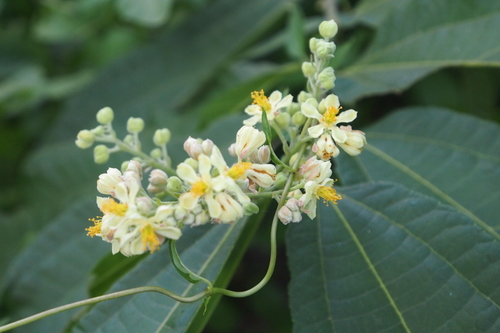
A tree which loses its leaves during the year. It grows to 15-40 m tall and spreads to 3 m wide. The trunk is erect and stout. It is swollen in the middle and branches at the top. It has rough spiny bark. The leaves are divided like fingers on a hand. There are 5 bright green leaflets which are oblong and pointed towards the tip. The flowers are deep pink to red. They are 5 cm across. They are bell shaped and have 5 petals. They occur in crowded clusters near the ends of branches. The fruit is a ball shaped capsule.
Edible Uses
The fleshy calyxes are used in soups and sauces. Young fruit are cut and dried then eaten in various meals. Young leaves are dried and eaten as a potherb or in soup. The oil from the seeds is used in cooking.
Traditional Uses
The fleshy calyxes are used in soups and sauces. The young fruit are cut and dried then eaten in various meals. The young leaves are dried and eaten as a potherb. They are also used in soup. The oil from the seeds is used in cooking.
Medicinal Uses
Many parts of the plant are utilised for medicinal and traditional purposes. In Ghana, where it is native, the leaves are common as fodder for domestic livestock. The bark is burnt to produce a smoke that is believed to drive away evil spirits called alizini in Dagbani. The abundant thorns present on the bark are burnt and the resulting charcoal is mixed with butter to treat swelling. Dried gum produced from the tree is used as an incense. Various parts of the plant have also been used as contraceptives or abortifacients. The wood is quite light, which limits its uses to canoes and other implements. A dye can be made from the tannins within the bark, while the cotton-like fibre that covers the seeds is gathered and used as a cotton substitute. It cannot be spun, however, so its use is limited to a stuffing for pillows and clothing. Both the flowers and the young fruits are used in food. Various ethnic groups of northern Ghana such as the Mamprusi and Konkomba people dry and grind the flowers' calyces and use them in a soup (comparable to the use of calyces of the Sahelian red-flowered kapok tree, Bombax costatum).
Known Hazards
The plant is drought and frost tender.
Distribution
A tropical plant. It is native to C. and W. Africa. It does best in soils rich in humus. They need to be well drained. The plants should be in a protected sunny position. It is drought and frost tender. In Nigeria it has been recorded at 240 and 980 m above sea level.
Where It Grows
Africa, Asia, Australia, Benin, Cameroon, Central Africa, Central African Republic, CAR, Congo DR, Côte d'Ivoire, Gabon, Ghana, Indonesia, Ivory Coast, Liberia, Nigeria, SE Asia, Sierra Leone, Togo, West Africa*,
Cultivation
It is grown from seed.
Other Uses
Seed hairs are useful as packing material for pillows, mattresses etc.
Notes
There are about 8-20 Bombax species. Also put in the family Bombacaceae. In the subfamily Bombacoideae.
Synonyms
Also Known As
Akpu, An-folan, An-ponk-ponk, Disile, Dombi, Fua, Fua-kone, Fula, Gold Coast Bombax, Ikue, Ndombi, Ponpola, Song, Songo, Titii, Togba, Yawumbui
References (23)
- Abbiw, D.K., 1990, Useful Plants of Ghana. West African uses of wild and cultivated plants. Intermediate Technology Publications and the Royal Botanic Gardens, Kew. p 41
- Barwick, M., 2004, Tropical and Subtropical Trees. A Worldwide Encyclopedic Guide. Thames and Hudson p 55
- Bircher, A. G. & Bircher, W. H., 2000, Encyclopedia of Fruit Trees and Edible Flowering Plants in Egypt and the Subtropics. AUC Press. p 61
- Bodkin, F., 1991, Encyclopedia Botanica. Cornstalk publishing, p 153
- Dalziel, J. M., 1937, The Useful plants of west tropical Africa. Crown Agents for the Colonies London.
Show all 23 references Hide references
- Facciola, S., 1998, Cornucopia 2: a Source Book of Edible Plants. Kampong Publications, p 50
- Fl. Oware 2:42, t. 83. 1816
- Grivetti, L. E., 1980, Agricultural development: present and potential role of edible wild plants. Part 2: Sub-Saharan Africa, Report to the Department of State Agency for International Development. p 26
- Jardin, C., 1970, List of Foods Used In Africa, FAO Nutrition Information Document Series No 2.p 39, 59
- Keay, R.W.J., 1989, Trees of Nigeria. Clarendon Press, Oxford. p 137
- Kunkel, G., 1965, The Trees of Liberia. German Forestry Mission Report No. 3 p 52
- Le Houerou, H. N., (Ed.), 1980, Browse in Africa. The current state of knowledge. International Livestock Centre for Africa, Ethiopia. p 161
- Martin, F.W. & Ruberte, R.M., 1979, Edible Leaves of the Tropics. Antillian College Press, Mayaguez, Puerto Rico. p 179
- Morley, B. & Everard, B., 1970, Wild Flowers of the World. Ebury press. Plate 57
- Okigbo, B.N., Vegetables in Tropical Africa, in Opena, R.T. & Kyomo, M.L., 1990, Vegetable Research and development in SADCC countries. Asian Vegetable Research and development Centre. Taiwan. p 38
- Peters, C. R., O'Brien, E. M., and Drummond, R.B., 1992, Edible Wild plants of Sub-saharan Africa. Kew. p 70
- Purseglove, J.W., 1968, Tropical Crops Dicotyledons, Longmans. p 33
- Savill, P. S. & Fox, J. E. D., Trees of Sierra Leone. p 55
- Terra, G.J.A., 1973, Tropical Vegetables. Communication 54e Royal Tropical Institute, Amsterdam, p 29
- Uphof,
- Vickery, M.L. and Vickery, B., 1979, Plant Products of Tropical Africa, Macmillan. p 73
- Vivien, J. & Faure, J.J., 1985, Abres des forets dense d'Afrique Centrale. Agence de Cooperation Culturelle et Technique. Paris. p 42
- World Checklist of Useful Plant Species 2020. Royal Botanic Gardens, Kew