Festuca pratensis
L.
Meadow fescue
iNaturalist· cc-by-nc
(c) reinderw, some rights reserved (CC BY-NC)
iNaturalist· cc-by-nc
(c) reinderw, some rights reserved (CC BY-NC)
iNaturalist· cc-by-nc
(c) reinderw, some rights reserved (CC BY-NC)
Summary
Source: WikipediaFestuca pratensis is an evergreen perennial grass growing to 1 m tall and 0.5 m wide at a medium rate. Wind-pollinated flowers bloom throughout the growing season. The plant establishes in light, medium, and heavy soils with good drainage, tolerating poor soil fertility. It grows in mildly acidic to very alkaline soils and adapts to semi-shade or full sun, preferring dry or moist conditions. Noted for wildlife attraction but sensitive to atmospheric pollution. Hardy to UK zone 5.
Description
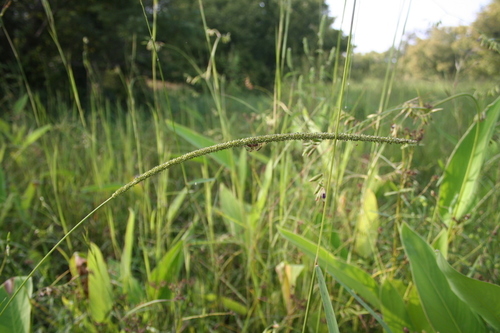
A grass. It forms loose tufts and keeps growing from year to year. It grows 30-120 cm high. It can be erect or spreading. The leaf blades are flat and ribbed above. They are 45 cm long and 3-8 mm wide. They are shiny underneath.
Edible Uses
The seeds are possibly edible.
Medicinal Uses
None known.
Distribution
It is a temperate plant. In Pakistan it grows at about 2,000 m altitude. In Sichuan and Yunnan.
Where It Grows
Asia, Balkans, Britain, China, Europe, Falklands, Korea, Kyrgyzstan, Luxembourg, Macedonia, North America, Pakistan, Poland, Slovenia,
Cultivation
A perennial grass growing 30-120cm high. It can be erect or spreading. Ranging from Boreal Moist to Rain through Subtropical Dry Forest Life Zones, meadow fescue is reported to tolerate annual precipitation of 3.2 to 13.6 dm, annual temperature of 4.3 to 21.1?C, and pH of 4.5 to 8.2 (Duke, 1978, 1979). Adapted to cool climates as a cool-season turfgrass. Thrives in deep rich soil, but also grows well on calcareous or sandy soils provided they are moist. In native areas, found in meadows, forest margins, thin forests (Reed, 1976). In Pakistan it grows at about 2,000 m altitude. In Sichuan and Yunnan. Flowering from June until August in the Northern Hemisphere. US Forest Service (2016) records that it is tolerant of acid soils but may also occur in calcareous soils. Although it survives regular mowing, this grass prefers unmowed or little-mowed areas.
Propagation
Slow to establish, meadow fescue requires a clean seedbed. It is propagated from seed sown at a rate of 11–28 kg/ha, with an optimum germination temperature of 20–30°C. In mixtures with clovers it is sown at 9–13 kg/ha; with alfalfa, at 3 kg/ha. It combines well with clovers, Lotus corniculatus, alfalfa, and grasses such as Phleum pratense and Dactylis glomerata, producing a large proportion of leafy bottom growth.
Other Uses
Meadow fescue has been valued for centuries as a pasture grass in temperate regions. It is more cold tolerant than Festuca arundinacea, though less productive. It is used for animal feed, fodder, and forage, and also for erosion control and dune stabilisation. It is of genetic importance as a gene source and is grown as an ornamental grass. Insects associated with fescue grasses include caterpillars of the skipper Atalopedes campestris, larvae of the moth Pediasia trisecta, Camnula pellucida, Oulema melanopus, Sphenophorus parvulus, Blissus leucopterus hirtus, Metopolophium dirhodum, Rhopalosiphum oxyacanthae, Tetraneura ulmi, and other aphids. Horses, cattle, and other hoofed farm animals graze on the foliage, and the seeds are eaten by the Greater Prairie Chicken. During winter the plant collapses into sprawling mats that likely provide cover for voles and other small rodents.
Synonyms
Also Known As
Travniška bilnica
References (3)
- Flora of Pakistan. www.eFloras.org
- Łukasz Łuczaj and Wojciech M Szymański, 2007, Wild vascular plants gathered for consumption in the Polish countryside: a review. J Ethnobiol Ethnomedicine. 3: 17
- Upson, R., & Lewis R., 2014, Updated Vascular Plant Checklist and Atlas for the Falkland Islands. Falklands Conservation and Kew.