Butia yatay
(Mart.) Becc.
Yatay palm, Wine palm, Argentine yatay
iNaturalist· cc-by-nc
(c) Pablo Preliasco, some rights reserved (CC BY-NC), uploaded by Pablo Preliasco
iNaturalist· cc-by-nc
(c) Cecilia Trujillo, some rights reserved (CC BY-NC)
iNaturalist· cc-by-nc
(c) Cecilia Trujillo, some rights reserved (CC BY-NC)
Summary
Source: WikipediaButia yatay, the jelly palm or yatay palm, is a Butia palm native to southern Brazil, Uruguay and northern Argentina. It is known as the butiá-jataí in Portuguese in the south of Brazil, as well as simply jataí or butiá. It is sometimes cultivated as an ornamental in Europe and the United States. It is the tallest of all the species in the genus Butia. The fruit is edible with a sweet flavour.
Description
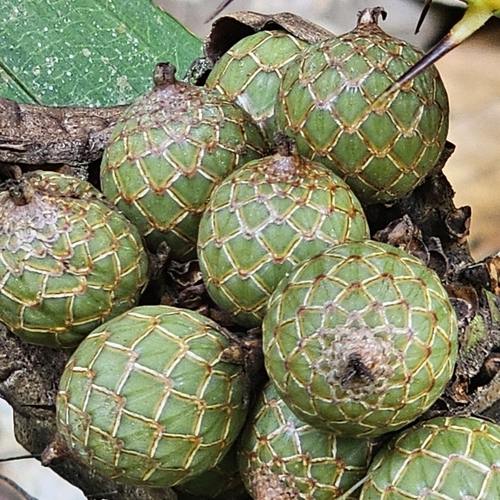
An evergreen palm. It grows up to 4-5 m tall, but can be 12 m tall. The trunk has the leaf bases attached. The leaves are long and feather like. They are 2-3 m long and bright blue-grey. They curve over. The leaf stalk has spines. The large bract below the flower stalk had a waxy bloom and is hairy. The flowers are large 10-16 mm long. The fruit are large and yellow. They are 3-4 cm long. They are edible.
Edible Uses
The young leaf buds are eaten. The fruit are eaten raw and used to prepare a local brandy. The seeds are eaten and yield a fatty oil. The palm heart (cabbage) is also consumed.
Traditional Uses
The young buds are eaten. The seeds are eaten and yield a fatty oil. The fruit are used to prepare a local brandy.
This uses section is brief — help expand it
Medicinal Uses
The seeds yield a fatty oil.
Distribution
A tropical plant. It grows in tropical and subtropical regions. They need a well drained soil and sunny position. They are fairly hardy to frost and can be grown in temperate areas. In Argentina it grows below 500 m above sea level.
Where It Grows
Argentina*, Australia, Brazil*, Europe, India, Paraguay, South America, Uruguay,
Cultivation
Plants are grown from seed. Seed are slow and erratic to germinate. They take 6 months to 2 years to germinate. The seed have a hard outer shell and cracking this may quicken germination.
Propagation
Seed - best sown as soon as it is ripe in containers. Stored seed is very slow to germinate. Pre-soaking the seed for 24 hours in warm water prior to sowing may shorten the germination time. Plants form a long tap-root some time before forming a shoot. Germination of fresh seed usually takes place in 3 - 4 months at 25°c. Plant out into deep pots or the open ground either as soon as root growth is noticed or as soon as top growth appears.
Other Uses
The seed kernel is anthelmintic.
Production
Plants are generally slow growing.
Notes
There are about 9 Butea species.
Synonyms
Also Known As
Butiazeiro-jatai
References (19)
- Agric. Colon. 10(2):498, t. 5, figs. 1-2. 1916
- Ambasta S.P. (Ed.), 2000, The Useful Plants of India. CSIR India. p 92
- Balick, M.J. and Beck, H.T., (Ed.), 1990, Useful palms of the World. A Synoptic Bibliography. Colombia p 122 (As Butia yatay var. paraguayensis)
- Barbieri, R. L., et al, 2014, Agricultural Biodiversity in Southern Brazil: Integrating Efforts for Conservation and Use of Neglected and Underutilized Species. Sustainability 6:741-757
- Bircher, A. G. & Bircher, W. H., 2000, Encyclopedia of Fruit Trees and Edible Flowering Plants in Egypt and the Subtropics. AUC Press. p 69
Show all 19 references Hide references
- Bodkin, F., 1991, Encyclopedia Botanica. Cornstalk publishing, p 178
- Brack, P., et al, 2020, Frutas nativas do Rio Grande do Sul, Brasil: riqueza e potencial alimentício. Native fruits of Rio Grande do Sul, Brazil: richness and potential as food. Rodriguésia 71: e03102018.
- Facciola, S., 1998, Cornucopia 2: a Source Book of Edible Plants. Kampong Publications, p 27
- Grandtner, M. M. & Chevrette, J., 2013, Dictionary of Trees, Volume 2: South America: Nomenclature, Taxonomy and Ecology. Academic Press p 82
- Haynes, J., & McLaughlin, J., 2000, Edible palms and Their Uses. University of Florida Fact sheet MCDE-00-50-1 p 4
- Henderson, A., Galeano, G and Bernal, R., 1995, Field Guide to the Palms of the Americas. Princeton. p 138
- Hibbert, M., 2002, The Aussie Plant Finder 2002, Florilegium. p 48
- Jones, D.L., 1994, Palms throughout the World. Smithtonian Institution, Washington. p 55, 153
- Jones, D.L., 2000, Palms of Australia 3rd edition. Reed/New Holland. p 127
- Jones, D.L., 2000, Palms of Australia 3rd edition. Reed/New Holland. p 148 (re Cocos yatay)
- Lord, E.E., & Willis, J.H., 1999, Shrubs and Trees for Australian gardens. Lothian. p 94
- Lorenzi, H., Bacher, L., Lacerda, M. & Sartori, S., 2006, Brazilian Fruits & Cultivated Exotics. Sao Paulo, Instituto Plantarum de Estuados da Flora Ltda. p 76
- Martin, F.W. & Ruberte, R.M., 1979, Edible Leaves of the Tropics. Antillian College Press, Mayaguez, Puerto Rico. p 210 (As Cocos yatay)
- Riffle, R.L. & Craft, P., 2003, An Encyclopedia of Cultivated Palms. Timber Press. p 283