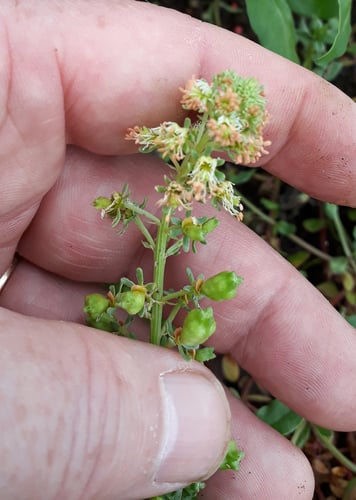
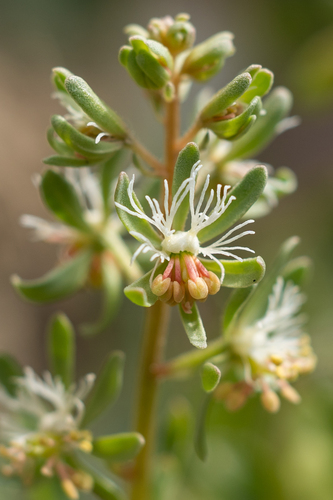
Caylusea abyssinica
(Fresen.) Fisch. & Mey.
Arencho
iNaturalist· cc-by
(с) nberhe, некоторые права защищены (CC BY), загрузил nberhe
iNaturalist· cc-by
(с) nberhe, некоторые права защищены (CC BY), загрузил nberhe
iNaturalist· cc-by
(с) nberhe, некоторые права защищены (CC BY), загрузил nberhe
Summary
Source: WikipediaCaylusea abyssinica is a plant species found in East Africa. The edible aerial parts are used as a vegetable in Tanzania and Ethiopia.
Description
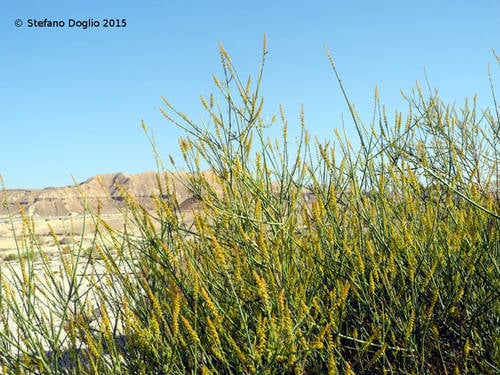
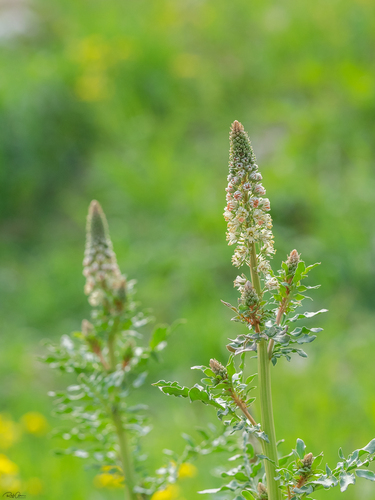
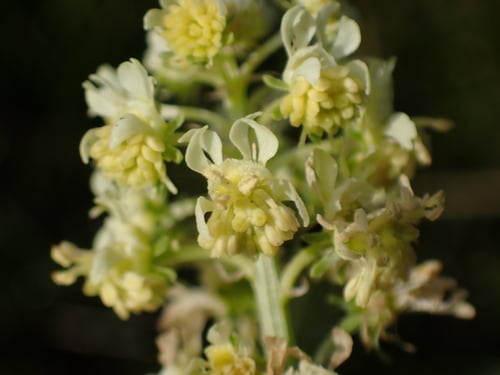
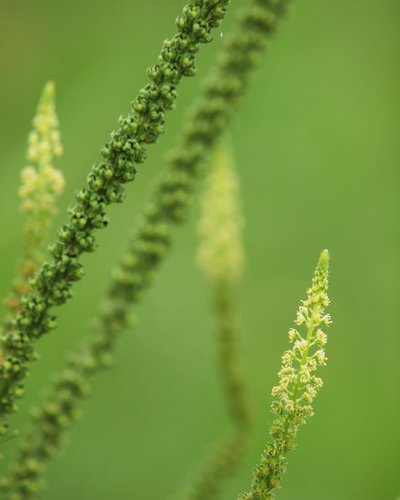
A herb. It is erect and 1.5 m tall. The taproot is slightly woody. The leaves are alternate and the upper leaves can be in rings. They do not have leaf stalks. There can be a cluster of small leaves in the axils. The leaf blade is narrow and 2-9 cm long by 0.5-2.5 cm wide. The edges can be wavy and there can be teeth. The flowering stalk is like a spike and 40 cm long. The flowers have both sexes. The fruit is made up of one seeded sections spreading out like a star. The seeds are kidney shaped and 1.5 mm long by 1 mm wide. They are dark brown and wrinkled.
Edible Uses
The leaves are boiled as a vegetable—washed, chopped, cooked, and eaten with other vegetables. They are sold in local markets and are popular cooked with pounded cannabis seeds.
Traditional Uses
The leaves are boiled as a vegetable. They are washed, chopped, cooked and eaten with other vegetables. It is popular where it is cooked with pounded cannabis seeds.
Medicinal Uses
The boiled leaves are used to treat stomach pains and to eliminate intestinal worms. The ash of the whole burnt plant, or a root decoction, is taken as a remedy for abdominal pain.
Known Hazards
The seeds are said to be poisonous to grazing animals. They give a bitter flavour to foods if they become mixed with cereal crops.
Distribution
It is a tropical plant. It grows in open grassland between 1,500-2,750 m above sea level.
Where It Grows
Africa, Burundi, East Africa, Eritrea, Ethiopia, Kenya, Malawi, Mozambique, Rwanda, Sudan, Tanzania, Uganda,
Cultivation
Plants can be grown from seeds.
Production
Leaves are mostly collected during the rainy season.
Other Information
It is a minor vegetable. It is popular in some places. Leaves are sold in local markets.
Synonyms
Also Known As
Mkalifya, Xomita, Ziambee
References (12)
- Asfaw, Z. and Tadesse, M., 2001, Prospects for Sustainable Use and Development of Wild Food Plants in Ethiopia. Economic Botany, Vol. 55, No. 1, pp. 47-62
- Balemie, K., & Kebebew, F., 2006, Ethnobotanical study of wild edible plants in Derashe and Kucha Districts, South Ethiopia. Journal of Ethnobiology and Ethnomedicine.
- East African herbarium records, 1981,
- Grubben, G. J. H. and Denton, O. A. (eds), 2004, Plant Resources of Tropical Africa 2. Vegetables. PROTA, Wageningen, Netherlands. p 165
- Kidane, B., et al, 2014, Wild and semi-wild leafy vegetables used by the Maale and Ari ethnic communities in southern Ethiopia. Genetic Resour Crop Evol. Springer. p 8
Show all 12 references Hide references
- Lulekal, E., et al, 2011, Wild edible plants in Ethiopia: a review on their potential to combat food insecurity. Afrika Focus - Vol. 24, No 2. pp 71-121
- Molla, A., Ethiopian Plant Names. http://www.ethiopic.com/aplants.htm
- Msola, D. K., 2007, The role of Wild Foods in Household Income and Food Security in Mufundi District, Tanzania. Morogoro, Tanzania. p 46
- Peters, C. R., O'Brien, E. M., and Drummond, R.B., 1992, Edible Wild plants of Sub-saharan Africa. Kew. p 165
- Ruffo, C. K., Birnie, A. & Tengnas, B., 2002, Edible Wild Plants of Tanzania. RELMA p 190
- Siegenthaler,
- World Checklist of Useful Plant Species 2020. Royal Botanic Gardens, Kew