Reseda odorata
L.
Mignonette
iNaturalist· cc0
no rights reserved, uploaded by Peter de Lange
iNaturalist· cc-by
(c) bythepark, some rights reserved (CC BY)
iNaturalist· cc-by
(c) bythepark, some rights reserved (CC BY)
Summary
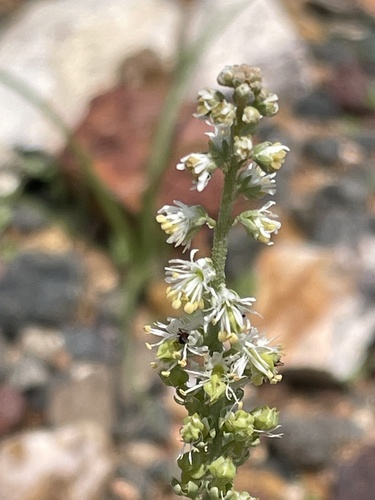
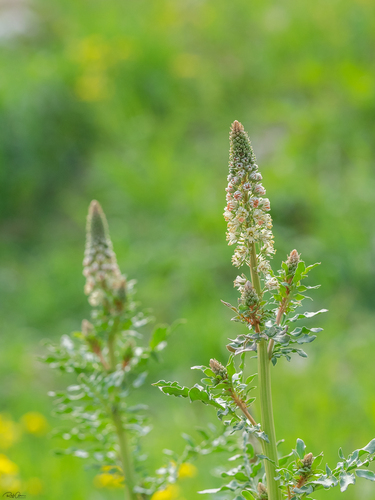
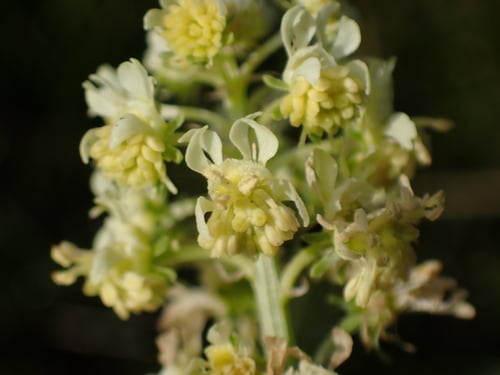
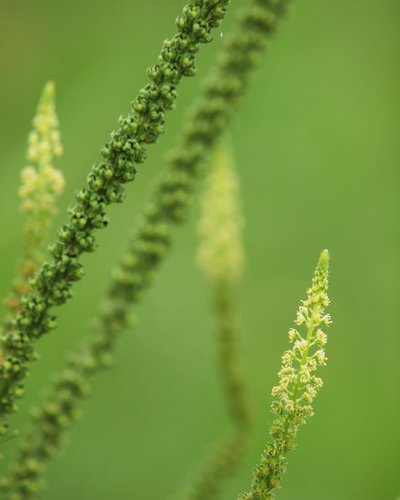
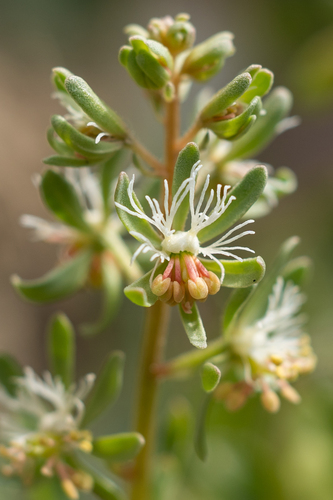
Source: WikipediaReseda odorata is a species of flowering plant in the reseda family known by many common names, including garden mignonette and common mignonette. It is probably native to the Mediterranean Basin, but it can sometimes be found growing in the wild as an introduced species in many parts of the world. These introductions are often garden escapees; the plant has long been kept as an ornamental plant for its fragrant flowers, the essential oil of which has been used in perfumes. This is an annual herb, producing branching erect stems to 80 centimeters in maximum height. The inflorescence is a spike-like raceme of many flowers. The fragrant flower has six white to yellowish or greenish petals, the upper ones each divided into three narrow, finger-like lobes. At the center of the flower are up to about 25 stamens tipped with large dangling orange anthers.
Description
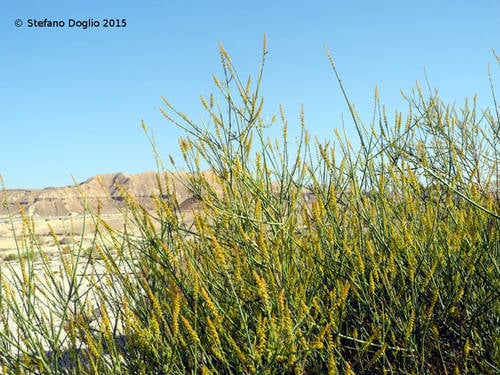
An annual herb. It can be erect or lie over. It grows 45 cm high. The leaves are 3-7 cm long by 2-3 cm wide. The lower leaves are entire and sword shaped. The upper leaves have 3 leaflets or lobes. The flowers have a sweet smell. They are yellowish-white. They are in groups up to 50 cm long in the axils of leaves or at the ends of branches. The fruit is an almost round capsule. It hangs down. The seeds are black.
Edible Uses
None known.
Traditional Uses
The flowers are occasionally floated in a bowl of wine or added to ice cream. Mignonette flavoured salt is used in Turkish cooking with veal and lamb dishes.
Medicinal Uses
The root is acrid and acts as a diaphoretic, diuretic, and laxative. The seed is applied externally as a resolvent.
Distribution
It is a warm temperate or Mediterranean climate plant.
Where It Grows
Africa, Algeria, Asia, Australia, Austria, Central Asia, Chile, China, Cyprus, Czech Republic, East Africa, Egypt*, Europe, Greece, India, Italy, Kazakhstan, Lebanon, Libya*, Mediterranean, Morocco, Myanmar, North Africa, North America, Pakistan, Palestine, Romania, Russia, SE Asia, Taiwan, Tajikistan, Turkey, Türkiye, Turkmenistan, USA, Uzbekistan, Yugoslavia, Zimbabwe,
Cultivation
Easily grown in any well-drained neutral to slightly alkaline soil in a sunny position or in some shade if the summers are long and hot. The flowers are very fragrant. Plants are sometimes cultivated for the essential oil in their flowers. A good plant for bees and butterflies, it is also an important food plant for the caterpillars of many species of butterfly.
Propagation
Sow seed in situ in spring with only a light covering. Germination typically occurs within 2 weeks. An autumn sowing usually succeeds in areas where winter temperatures do not fall below about -10°c.
Other Uses
An essential oil derived from the flowers is used in perfumery — 1,200 kg of flowers yields 350 g of absolute. A yellow dye is also obtained from the plant. Special uses: attracts wildlife, scented plant.
Other Information
It is a commercially cultivated vegetable.
Synonyms
Also Known As
Mya-hmwe
References (5)
- Amoen. acad. 3:51. 1756 (Syst. nat. ed. 10, 2:1046. 1759)
- Facciola, S., 1998, Cornucopia 2: a Source Book of Edible Plants. Kampong Publications, p 190
- Kays, S. J., and Dias, J. C. S., 1995, Common Names of Commercially Cultivated Vegetables of the World in 15 languages. Economic Botany, Vol. 49, No. 2, pp. 115-152
- Kew Plants of the World Online
- Zeven, A. C. & de West, J. M. J., 1982, Dictionary of cultivated plants and their regions of diversity. Wageningen. p 78, 118