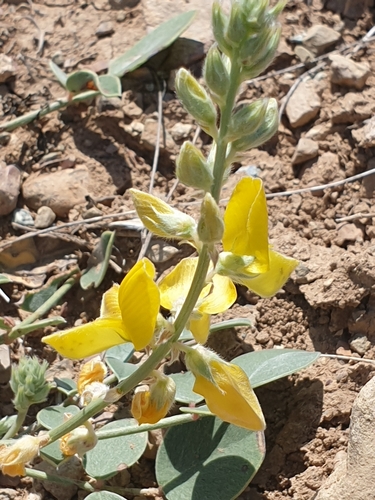
Erythrina abyssinica
Lam. ex DC.
Red hot poker tree, Lucky-bean tree
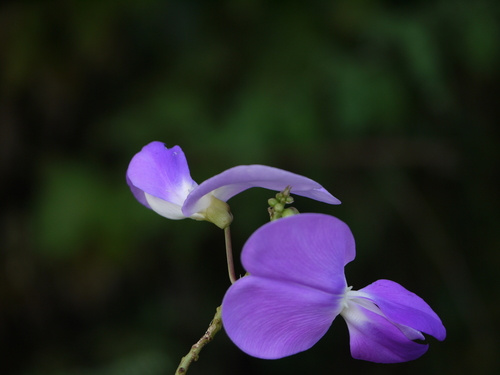
iNaturalist· cc-by
(c) Tatters ❀, some rights reserved (CC BY)
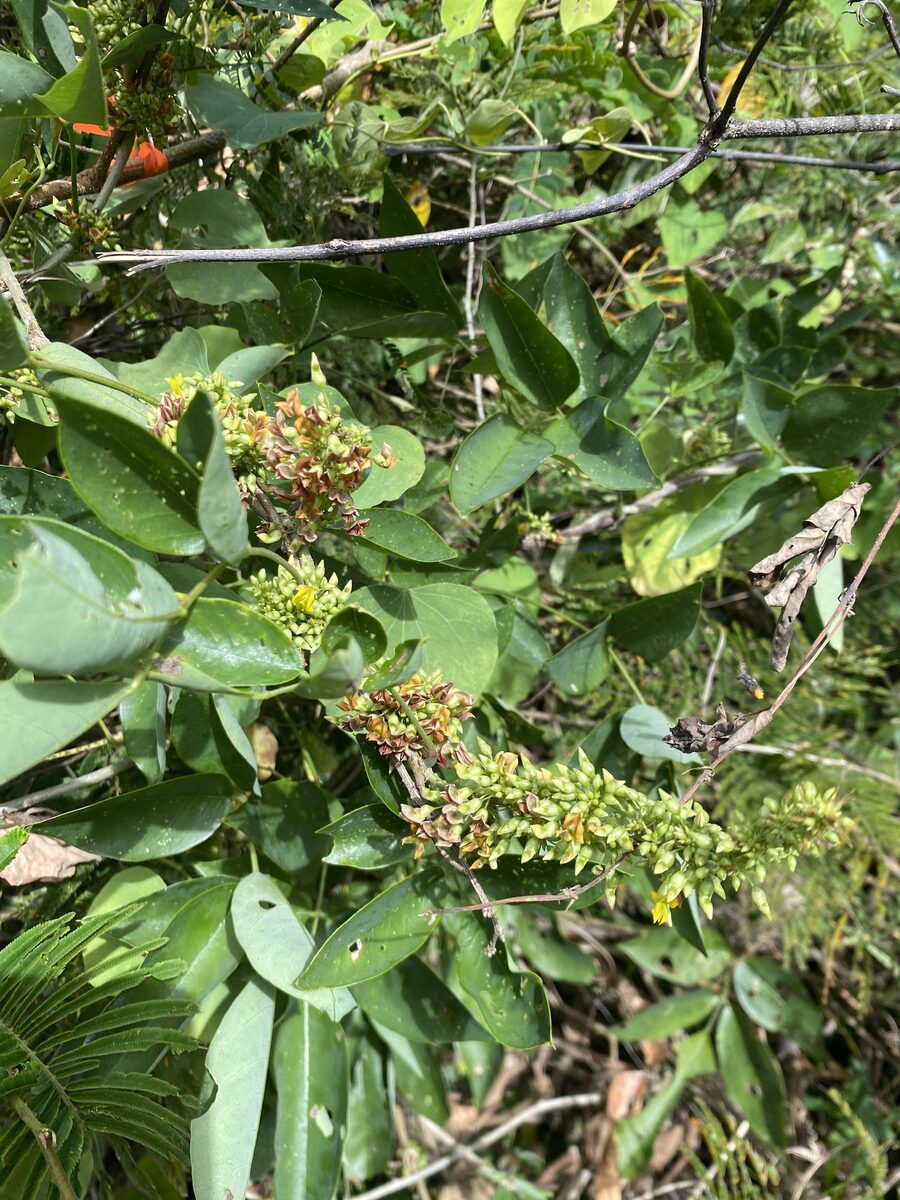
iNaturalist· cc-by
(c) Mike Musgrave, some rights reserved (CC BY), uploaded by Mike Musgrave
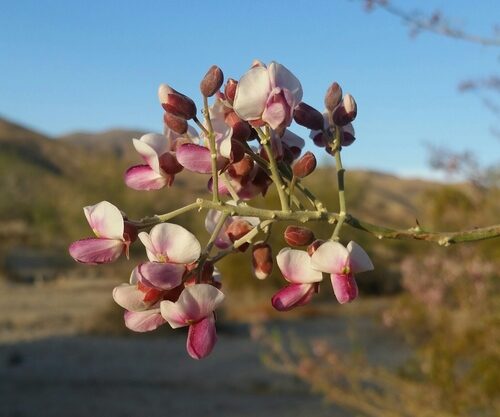
iNaturalist· cc-by-nc
(c) mikeloomis, some rights reserved (CC BY-NC), uploaded by mikeloomis
Summary
Source: WikipediaErythrina abyssinica (lucky bean or flame tree) is a tree species of the genus Erythrina belonging to the plant family of the Fabaceae (or Leguminosae) described by Augustin Pyramus de Candolle in 1825. This leguminous tree species is native to East Africa, Eastern DRC and southern Africa. In Zimbabwe its range overlaps with the similar Erythrina latissima.
Description
A tree. It grows 40 m tall. The bark is corky and has furrows. The branches have spines. The crown is rounded. The leaves are diamond shaped and hairy. They are 15 cm long. The flowers are bright red. They hang down in groups. The fruit are curved pods. These are 10-15 cm long. There are 5-8 bright red seeds.
Edible Uses
The leaves, bark, and root are used as a tea substitute.
Traditional Uses
Caution: The seeds are poisonous. The leaves and bark are used as a tea substitute.
This uses section is brief — help expand it
Medicinal Uses
The root is probably used in medicine.
Known Hazards
The seeds are used as fish poison and decoratively in necklaces. The soft wood of the trunk has been used to carve small statues and animals. The wood is also used for making beehives and African drums or Tam Tam.
Distribution
It is a tropical plant. It grows between 200-2,500 m above sea level. It can grow in arid places. In Zimbabwe it grows between 800-1,750 m above sea level. In Brisbane Botanical Gardens.
Where It Grows
Africa*, Angola, Asia, Australia, Botswana, Central Africa, Congo DR, East Africa, Eritrea, Eswatini, Ethiopia, Indonesia, Kenya, Malawi, Mozambique, Rwanda, SE Asia, South Africa, Southern Africa, Sudan, Swaziland, Tanzania, Uganda, Zambia, Zimbabwe,
Cultivation
Plants can be grown from seed or cuttings. It can be cut back and will re-grow.
Propagation
Seed - the germination rate is generally low, around 10 - 30%. Pre-treatment with hot water or concentrated sulphuric acid may increase the germination rate up to 90%. Scarification of seeds is also beneficial for germination; this can be done by rubbing with sandpaper or nicking with a knife, after which the seeds should be immersed in water for some hours until they begin to swell. To obtain optimal growth, seeds are inoculated with appropriate Rhizobium bacteria immediately before sowing. Seeds can be sown in seed beds of sterile sand or in polythene bags with a mixture of soil, sand and compost (2:1:1). They should be sown with the hilum facing downward and covered with a thin layer of potting medium. Seedlings can be transplanted when 20 - 30 cm tall. Direct sowing in the field is also possible. Seeds should be collected from ripe pods still on the tree; they are widely available. They are sun dried for one day before storage. Seeds can be stored for long periods if they are kept in a cool and dry place and kept free from insects, e.g. By adding ash. Cuttings are often successful when these are planted in the rainy season. They are stripped of leaves and planted directly. Truncheons up to 2.5 metres long are commonly used to make living fences and produce shade trees quickly. Air-layering is possible.
Other Uses
The seeds are locally popular for making curios and necklaces. The bark is sometimes used as a brown dye for textiles. A red dye is obtained from the sap. When damaged, the tree exudes a brown, gummy sap. Cork from the bark is used as floats for fishing nets. The greyish white wood sometimes has shades of red. The grain is usually straight; the texture coarse. The wood is light in weight; soft; not durable, being prone to fungal and wood-borer attacks, though it is moderately resistant to termites. It is easy to work, but planed surfaces may be woolly; it does not split when nailed, but the nail-holding capacity is poor. The wood is commonly used for making carvings, stools, drums, mortars, beehives, tool handles, brake blocks and floats for fishing nets, and sometimes also in house construction. Wood from the roots is used for making walking sticks. The wood serves as firewood; it smoulders readily without flaming and keeps smouldering for long periods. Plants can be grown as a 'living fence' from truncheons. They are extensively used as a live fence around homesteads. Planting large stakes, 250cm long and 8 - 10cm in diameter, can produce a canopy of 3 - 4 metres diameter within 6 months. Most Erythrina species are very easy to grow from cuttings, with even quite large branches striking well. In addition, they generally fix atmospheric nitrogen, have nutrient-rich leaves that make an excellent soil-enriching mulch, often have open crowns that do not overly restrict light, and are also often quite thorny and can provide impenetrable barriers to protect from unwelcome intrusions. Many species are therefore used as living fences to provide boundaries and livestock-proof hedges. The tree is recommended for soil conservation programmes, for erosion control, and for use as green manure. It is the main planted shade tree for coffee in Ethiopia. It is planted on stream banks and terraces to conserve the soil.
Production
It grows slowly.
Other Information
It is sold in local markets.
Notes
There are about 108 Erythrina species. The root is probably used in medicine.
Synonyms
Also Known As
Dus, Kuara, Mulungu lungu, Mungoma ngoma, Munhimbiti, Mutete, Mutiti, Muwale, Nacona, Narlico, Pohon dadap merah, Titi-titi, Umgqogqogqo, Umuko
References (14)
- Bunderson, W. T. et al, 2002, Common Agroforestry Species in Malawi. Malawi Agroforestry Extension Project, Pubication No. 46, Lilongwe. p 28
- Fowler, D. G., 2007, Zambian Plants: Their Vernacular Names and Uses. Kew. p 37
- Glover, et al, 1966b,
- Grivetti, L. E., 1980, Agricultural development: present and potential role of edible wild plants. Part 2: Sub-Saharan Africa, Report to the Department of State Agency for International Development. p 45
- http://www.ntbg.org/plants/plant details.php
Show all 14 references Hide references
- Latham, P., 2004, Useful Plants of Bas-Congo province. Salvation Army & DFID p 125
- Mawunu, M., et al, 2020, First Survey of the Edible Non-Wood Forest Products Sold in Uige Province, Northern Angola. European Journal of Agriculture and Food Sciences. Vol. 2, No. 6
- Mawunu, M., et al, 2022, Ethnobotanical uses of wild edible plants of Mucuba municipality, Angola. Natural Resources for Human Health. 2022, 0:1-10
- Mutie, F. M., et al, 2023, Important Medicinal and Food Taxa (Orders and Families) in Kenya, Based on Three Quantitative Approaches. Plants 2023, 12, 1145
- Peters, C. R., O'Brien, E. M., and Drummond, R.B., 1992, Edible Wild plants of Sub-saharan Africa. Kew. p 134
- Royal Botanic Gardens, Kew (1999). Survey of Economic Plants for Arid and Semi-Arid Lands (SEPASAL) database. Published on the Internet; http://www.rbgkew.org.uk/ceb/sepasal/internet [Accessed 28th April 2011]
- Sukarya, D. G., (Ed.) 2013, 3,500 Plant Species of the Botanic Gardens of Indonesia. LIPI p 261
- Swaziland's Flora Database http://www.sntc.org.sz/flora
- www.zimbabweflora.co.zw 2011