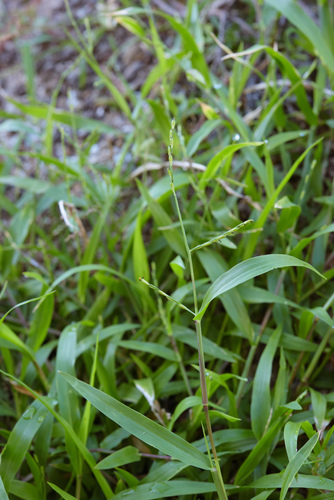
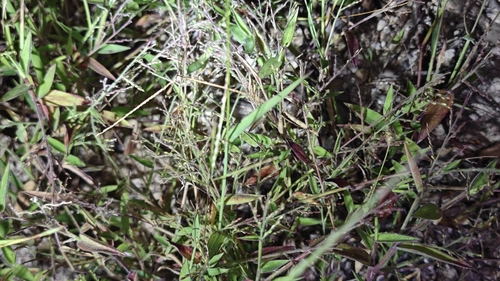
Sporobolus africanus
(Poir.) Robyns & Tournay
Rat's tail grass
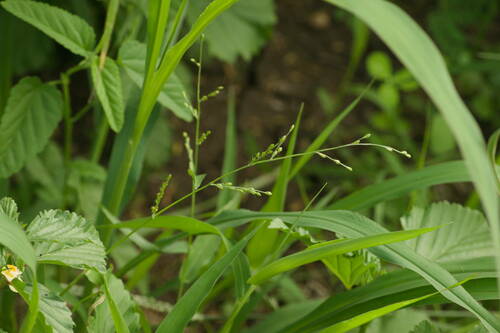
iNaturalist· cc-by-nc
(c) Igmar Grewar, some rights reserved (CC BY-NC), uploaded by Igmar Grewar
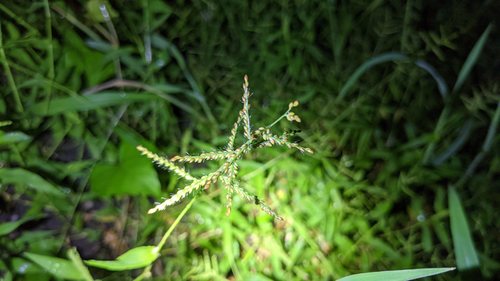
iNaturalist· cc-by-nc
(c) Joseph Knight, some rights reserved (CC BY-NC)
iNaturalist· cc-by-nc
(c) Joseph Knight, some rights reserved (CC BY-NC)
Summary
Source: WikipediaSporobolus africanus, or rat's tail grass, is a true grass in the tribe Zoysieae. Sporobolus africanus is known by many common names, including African dropseed, African dropseed grass, dropseed grass, Indian rat's tail grass, Parramatta grass, rat tail grass, rat's tail, rat's tail grass, rats' tails, ratstail, ratstail dropseed, rattail dropseed, rat-tail grass, rattail grass, rattailgrass, rush grass, smut grass, smutgrass, tough dropseed, tufty grass, and tussock grass.
Description
A grass. It is densely tufted and wiry. It grows 60-100 cm high. The leaf blade is 40 cm long by 1-4 mm wide. The flowering shoot is like a dense spike with very small spikelets. They are less than 2.5 cm long.
Edible Uses
The seeds are crushed to powder and used to make bread or injera. It is also used as a cereal crop and serves as a famine food.
Traditional Uses
The seeds are crushed to a powder and used to make bread or injera.
This uses section is brief — help expand it
Distribution
It is a tropical plant. In Swaziland it grows in the high veld only. It grows on floodplains and swampy grasslands. It grows between 100-2,300 m altitude.
Where It Grows
Africa, Arabia, Australia, Botswana, Cameroon, Central Africa, East Africa, Easter Island, Eswatini, Ethiopia, Hawaii, Kenya, Malawi, Marquesas, Middle East, Mozambique, Nigeria, Pacific, South Africa, Southern Africa, Sri Lanka, St Helena, Swaziland, Tasmania, Uganda, West Africa, Zambia, Zimbabwe,
Other Information
It is a famine food.
Synonyms
Also Known As
Goor, Murii, Muriye, Nandinde, Pagame
References (14)
- Burkill, H. M., 1985, The useful plants of west tropical Africa, Vol. 2. Kew.
- Chapman, J. D. & Chapman, H. M., 2001, The Forest Flora of Taraba and Andamawa States, Nigeria. WWF & University of Canterbury. p 213
- Fowler, D. G., 2007, Zambian Plants: Their Vernacular Names and Uses. Kew. p 73
- Lulekal, E., et al, 2011, Wild edible plants in Ethiopia: a review on their potential to combat food insecurity. Afrika Focus - Vol. 24, No 2. pp 71-121
- Peters, C. R., O'Brien, E. M., and Drummond, R.B., 1992, Edible Wild plants of Sub-saharan Africa. Kew. p 28
Show all 14 references Hide references
- Peters & Maguire, 1981,
- Regassa, T., et al, 2014, Ethnobotany of Wild and Semi-Wild Edible Plants of Chelia District, West-Central Ethiopia. Science, Technology and Arts Research Journal. 3(4): 122-134
- Ruiters-Welcome, A. K., 2019, Food plants of southern Africa. Ph.D. thesis. Univ. of Johannesburg p 90
- Tasmanian Herbarium Vascular Plants list p 88
- Tebkew, M. et al, 2014, Underutilized wild edible plants in the Chilga District, northwestern Ethiopia: focus on wild woody plants. Agriculture & Food Security 3:12
- van Oudtshoorn, F and van Wyck, E., 2004, Guide to Grasses of Southern Africa. Briza. p 98
- Welcome, A. K. & Van Wyk, B.-E., 2019, An inventory and analysis of the food plants of southern Africa. South African Journal of Botany 122 (2019) 136–179
- World Checklist of Useful Plant Species 2020. Royal Botanic Gardens, Kew
- Zizka, G., 1991, Flowering Plants of Easter Island. Palmarum Hortus Francofurtensis