Duguetia furfuracea
(A. St. Hil.) Safford
Araticum
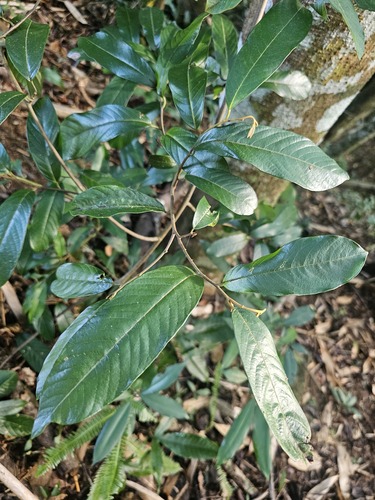
iNaturalist· cc-by-nc
(c) Valter K. Filho, some rights reserved (CC BY-NC)
iNaturalist· cc-by-nc
(c) Justyn Stahl, some rights reserved (CC BY-NC)
iNaturalist· cc-by-nc-sa
(c) Mauricio Mercadante, some rights reserved (CC BY-NC-SA)
Description
An evergreen tree. It grows 15-20 m tall. The leaves are leathery and 8-12 cm long. The flowers are in the axils of leaves. The fruit are compound and the lumps on the fruit have sharp points. The pulp is fleshy, and tasty with a strong smell. There is not a lot of pulp around the seeds.
Edible Uses
Fruit - raw. A pleasant, sweet flavour, somewhat reminiscent of coconuts. The pulp around the seeds is very scarce, but it is succulent, very tasty with a strong aroma. The fruit is around 10cm long x 7cm wide. The globose to ellipsoid fruit is green to greyish green, becoming brownish when ripe. It can range from 2 - 7cm in diameter, comprising up to 140 fertile carpels each 10 - 15mm long and 10 - 15mm in diameter.
Traditional Uses
The flesh of the fruit is eaten raw.
This uses section is brief — help expand it
Medicinal Uses
The ground up seeds, suspended in water, are active against head lice. An infusion of the plant (part not specified) is used internally and externally to treat pain. The leaves are used in folk medicine for the treatment of dysmenorrhea, diarrhoea and rheumathism The inner bark and roots are used as a soothing medication to treat stomach pain, renal colic and spine pain.
Distribution
It is a tropical plant. It grows in sandy soil in forests near the Atlantic in Brazil. It grows from sea level to 1,400 m altitude.
Where It Grows
Bolivia*, Brazil*, Paraguay, South America,
Cultivation
Plants are grown from seed.
Other Uses
The bark is used to make strings. An excellent, flexible wood, it is used for making barrel staves.
Production
Plants grow slowly.
Synonyms
Also Known As
Ariticunzinho, Marolinho-do-cerrado, Pindauvarana, Pinha brava
References (7)
- Bortolotto, I. M., et al, 2018, Lista preliminar das plantas alimenticias nativas de Mato Grosso do Sul, Brasil. Iheringia, Serie Botanica, Porto Alegre, 73 (supl.):101-116
- Fouqué, A. 1972. Espèces fruitières d'Amérique tropicale. Institut français de recherches fruitierès outre-mer (ifac) (As Annona furfuracea)
- Leticia, Z., et al, 2015, Do Socioeconomic characteristics explain the knowledge and use of native food plants in semiarid environments in Northeastern Brazil? Journal of Arid Environments 115:53-61
- Lorenzi, H., Bacher, L., Lacerda, M. & Sartori, S., 2006, Brazilian Fruits & Cultivated Exotics. Sao Paulo, Instituto Plantarum de Estuados da Flora Ltda. p 49
- Maas, O. J. M. et al, 2003, Duguetia (Annonaceae), Flora Neotropica, Vol 88 p 118
Show all 7 references Hide references
- Martin, F. W., et al, 1987, Perennial Edible Fruits of the Tropics. USDA Handbook 642 p 80 (As Annona furfuracea)
- www.colecionandofrutas.org