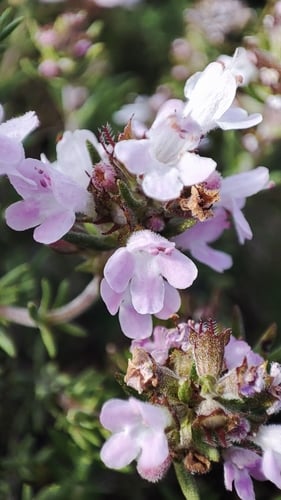
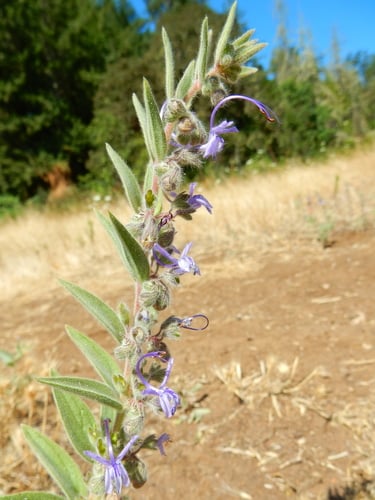
Vitex negundo var. cannabifolia
(Siebold & Zucc.) Hand.-Mazz.
Chinese chaste tree
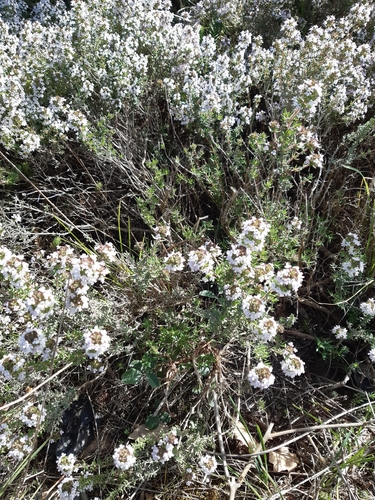
iNaturalist· cc0
no rights reserved, uploaded by 葉子
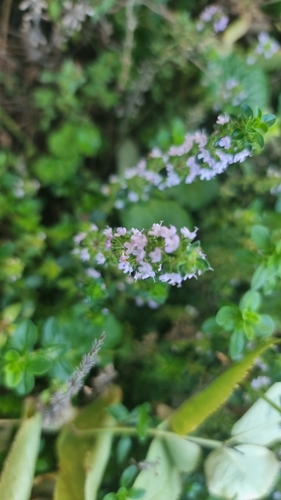
iNaturalist· cc0
no rights reserved, uploaded by 葉子
iNaturalist· cc0
no rights reserved, uploaded by 葉子
Summary
Source: WikipediaVitex negundo, commonly known as the Chinese chaste tree, five-leaved chaste tree, or horseshoe vitex, or nisinda is a large aromatic shrub with quadrangular, densely whitish, tomentose branchlets. It is widely used in folk medicine, particularly in South and Southeast Asia. Vitex negundo is an erect shrub or small tree growing from 2 to 8 m (6.6 to 26.2 ft) in height. The bark is reddish brown. Its leaves are digitate, with five lanceolate leaflets, sometimes three. Each leaflet is around 4 to 10 cm (1.6 to 3.9 in) in length, with the central leaflet being the largest and possessing a stalk. The leaf edges are toothed or serrated and the bottom surface is covered in hair. The numerous flowers are borne in panicles 10 to 20 cm (3.9 to 7.9 in) in length. Each is around 6 to 7 cm (2.4 to 2.8 in) long and are white to blue in color. The petals are of different lengths, with the middle lower lobe being the longest. Both the corolla and calyx are covered in dense hairs. The fruit is a succulent drupe, 4 mm (0.16 in) in diameter, rounded to egg-shaped. It is black or purple when ripe.
Description
A shrub. It loses its leaves during the year. It grows 1-2.5 m high. The branches are 4 sided. The leaves are opposite. They are compound with 5 leaflets arranged like fingers on a hand. The leaflets are sword shaped and 3-15 cm long by 1-3 cm wide. They taper to the tip. There can be coarse teeth. The leaves are green and have a dense hairy covering underneath. The flowers are small and purple-blue. There are many flowers in groups at the ends of branches. The fruit are oval and 3 mm long. The are 4 stones with seeds.
Edible Uses
The dried seeds are ground into flour and mixed with wheat flour to make noodles.
Traditional Uses
The dried seeds are ground into flour. This is mixed with wheat flour and made into noodles.
This uses section is brief — help expand it
Medicinal Uses
Purified extracts are believed to have medicinal properties. Vitex negundo is used for treating stored garlic against pests. It is also listed as one of the ten herbal medicine approved by the Department of Health as a cough remedy in the Philippines, and sold under the trade names Ascof, Plemex, and Lagundex. In Malaysia, it is used in traditional herbal medicine for women's health, including treatments for regulating the menstrual cycle, fibrocystic breast disease and post-partum remedies.
Distribution
It is a tropical plant. It grows in mixed thickets on mountain slopes and along roadsides between 100-1,100 m above sea level.
Where It Grows
Asia, China, Himalayas, India, Indonesia, Nepal, New Guinea, SE Asia, Taiwan, Thailand,
Cultivation
Plants can be grown from seeds.
Notes
Also put in the family Verbenaceae.
Synonyms
Also Known As
Ninjin-boku, Perdu suci cina
References (5)
- Acti Horti Gothob. 9:67. 1934
- Facciola, S., 1998, Cornucopia 2: a Source Book of Edible Plants. Kampong Publications, p 245
- Hu, Shiu-ying, 2005, Food Plants of China. The Chinese University Press. p 644
- Sukarya, D. G., (Ed.) 2013, 3,500 Plant Species of the Botanic Gardens of Indonesia. LIPI p 731
- Tanaka,