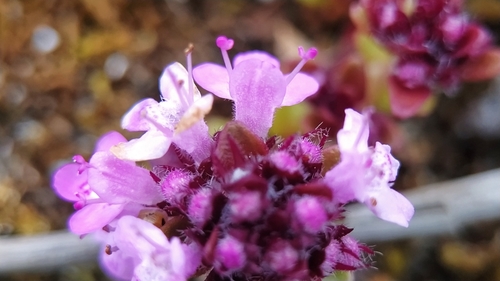
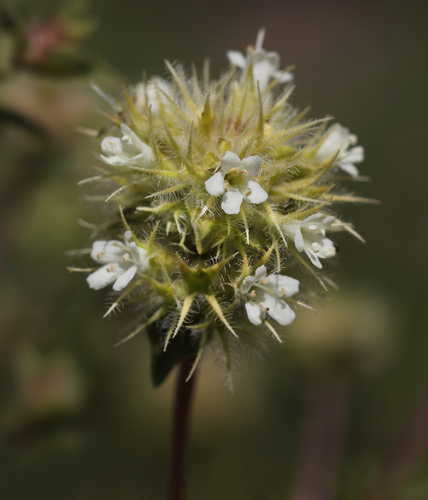
Thymus x citriodorus - (Pers.)Schreb.
(Pers.)Schreb.
Lemon Thyme, Creeping Lemon Thyme, Lemon-Scented Thyme
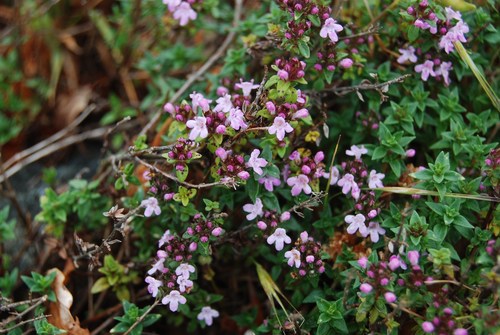
gbif· cc-by-sa
Cecile Clement
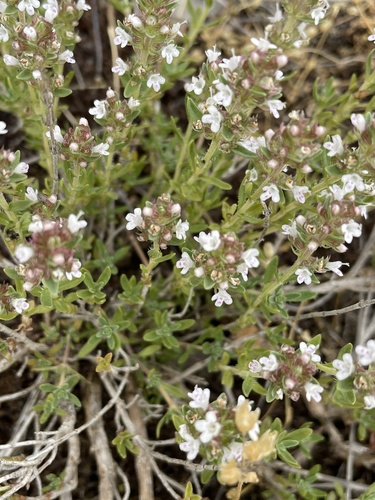
gbif· cc-by-sa
Chérif-Jacques Allali
gbif· cc-by-sa
Chérif-Jacques Allali
Description
Thymus x citriodorus is an evergreen Shrub growing to 0.1 m (0ft 4in) by 0.3 m (1ft) at a medium rate. See above for USDA hardiness. It is hardy to UK zone 7 and is not frost tender. It is in leaf all year, in flower from July to August. The species is hermaphrodite (has both male and female organs) and is pollinated by Bees, flies, Lepidoptera (Moths & Butterflies). The plant is self-fertile. It is noted for attracting wildlife. Suitable for: light (sandy) and medium (loamy) soils and prefers well-drained soil. Suitable pH: neutral and basic (mildly alkaline) soils. It cannot grow in the shade. It prefers dry or moist soil. The plant can tolerates strong winds but not maritime exposure.
Edible Uses
Tea. Leaves - raw in salads or added as a flavouring to cooked foods. A delicious lemon flavour. If the leaves are to be dried, the plants should be harvested in early and late summer just before the flowers open and the leaves should be dried quickly. An aromatic tea is made from the leaves. It has a pleasant lemon-like flavour and is very refreshing.
Medicinal Uses
Antiseptic Aromatherapy Deodorant Disinfectant. The leaves, and especially the essential oil contained in them, are strongly antiseptic, deodorant and disinfectant. The plant can be used fresh at any time of the year, or it can be harvested as it comes into flower and either be distilled for the oil or dried for later use. The leaves contain an antioxidant and regular use of the raw leaves has been shown to increase average life expectancy by about 10%. The essential oil obtained from this plant is thought to be less irritant than other thyme oils and so it is used in aromatherapy to treat asthma and other respiratory complaints, especially in children.
Distribution
A hybrid of garden origin between T. pulegioides and T. vulgaris.
Where It Grows
France, Spain
Cultivation
Requires a light well-drained preferably calcareous soil in a sunny position. Succeeds in dry soils. Thymes dislike wet conditions, especially in the winter. A layer of gravel on the soil around them will help protect the foliage from wet soils. Plants are hardy to about -15°c. This is a very difficult genus taxonomically, the species hybridize freely with each other and often intergrade into each other. Often cultivated in the herb garden for its leaves, there are some named varieties. The flowers are rich in nectar and are very attractive to honey bees. A good companion for most plants. Thyme is typically harvested in late spring to early summer, just before the plant flowers for the best flavor. Thyme usually flowers in late spring to early summer, generally from June to August (Northern Hemisphere). Thyme is considered a slow to moderate grower, reaching maturity in about 1 to 2 years under optimal conditions. Thymus × citriodorus (Pers.) Schreb. is an accepted hybrid. The native range of this hybrid is SW. Europe. The hybrid formula is T. pulegioides × T. vulgaris.
Propagation
Seed - sow spring in a cold frame. Seed can also be sown in autumn in a greenhouse. Surface sow or barely cover the seed. Germination can be erratic. When they are large enough to handle, prick the seedlings out into individual pots and grow them on in the greenhouse for at least their first winter. Plant them out into their permanent positions in late spring or early summer, after the last expected frosts. This species is a hybrid and will not breed true from seed. Division in spring or autumn. Larger divisions can be planted out direct into their permanent positions. We have found that it is best to pot up smaller divisions and grow them on in light shade in a greenhouse or cold frame until they are growing away well. Plant them out in the summer or the following spring. Cuttings of young shoots, 5 - 8cm with a heel, May/June in a frame. Cuttings of half-ripe wood, 5 - 8cm with a heel, July/August in a frame. Layering.
Other Uses
Deodorant Disinfectant Essential Pot-pourri Agroforestry uses: Thyme can be used as a ground cover and is beneficial for attracting pollinators. Its aromatic properties may also repel certain pests, making it a useful companion plant in gardens. The essential oil obtained from the leaves and flowering stems is used in perfumery, as a mouth wash, medicinally etc. The aromatic leaves are dried and used in pot-pourri and herbal pillows. The plant makes an attractive ground cover for a sunny position. They are best spaced about 30cm apart each way.
Synonyms
Also Known As
Tomillo