Cochlospermum religiosum
(Linn.) Alston
Yellow silk cotton tree, Buttercup tree, Torchwood tree
iNaturalist· cc-by-nc-sa
(c) 106611639464075912591, some rights reserved (CC BY-NC-SA), uploaded by 106611639464075912591
iNaturalist· cc-by-nc
(c) Rujuta Vinod, some rights reserved (CC BY-NC)
iNaturalist· cc-by-nc
(c) shivaprakash, some rights reserved (CC BY-NC)
Summary
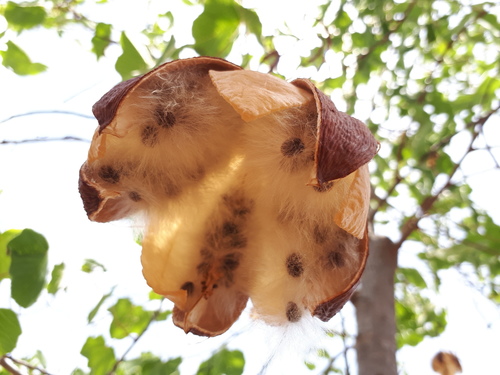
Source: WikipediaCochlospermum religiosum is a flowering plant from the tropical region of Southeast Asia and the Indian subcontinent. It is a small tree growing to a height of 7.5 m (25 ft) usually found in dry deciduous forests. The name religiosum derives from the fact that the flowers are used as temple offerings. It is also known as silk-cotton tree because the capsules containing the seeds have a fluffy cotton-like substance similar to kapok. Another common name is buttercup tree because its yellow and bright flowers look like large-sized buttercups. In Theravada Buddhism, this plant is said to have been used as the tree for achieving enlightenment, or Bodhi, by the nineteenth Buddha, who was named "Siddhaththa" (Sinhala script: "සිද්ධත්ථ"). The plant is known as කිණිහිරියා (Kinihiriyaa) in the Sinhala language, and කණිකාර (Kanikaara) in Sanskrit.
Description
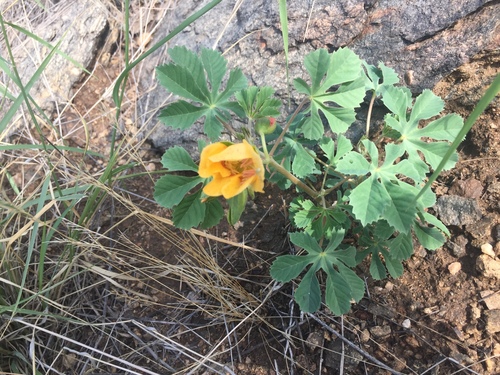
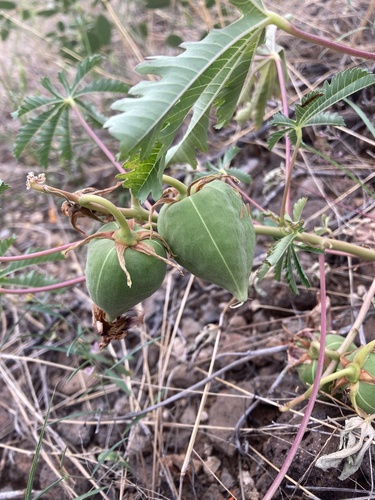
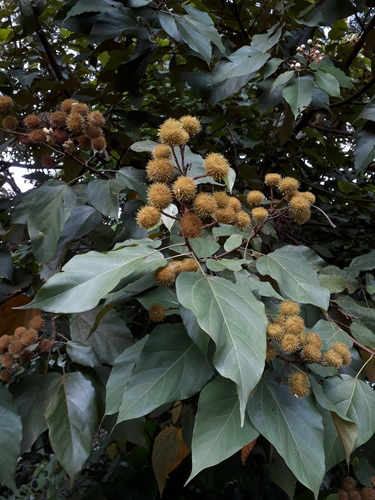
A small deciduous tree. It grows about 6 m tall. The bark is fluted. It only has a few branches. The leaves are alternate and 7.5-20 cm across. They are gathered towards the ends of branches. They are divided like fingers on a hand with 3-7 lobes. These are softly hairy. The leaf stalk is 5-23 cm long. The flowers occur before the leaves. The flowers are large and golden yellow. They are 7.5-13 cm across. They occur in groups. There are 5 petals and these can be 5 cm long. They are broadly oval and notched. The fruit are pear shaped and leathery. They are 5-10 cm long and hang down. The seeds are kidney shaped. They are 0.8 cm long and covered with a silky floss. There are many seeds. These fruit capsules open when ripe and spread the seeds.
Edible Uses
The seeds are roasted and eaten as a vegetable. The gum extracted from the bark is used for thickening ice cream.
Traditional Uses
The gum is used for thickening ice cream. The seeds are roasted and eaten as a vegetable.
This uses section is brief — help expand it
Medicinal Uses
The gum obtained from this plant is sweetish, cooling and sedative. It is used in the treatment of coughs and gonorrhoea. The dried leaves and flowers are stimulant.
Distribution
A tropical plant. It grows in the sub-Himalayas up to 900 m altitude. It is resistant to drought and can tolerate forest fires. It grows in dry places.
Where It Grows
Asia, India, Indochina, Indonesia, Malaysia, Myanmar, SE Asia, Sri Lanka, Thailand, Vietnam,
Cultivation
Plants can be grown from seeds and cuttings.
Propagation
Seed - Cuttings of leafy shoots as new growth commences. Any branch, stuck in the ground in wet weather, will make roots and grow.
Other Uses
An oil is obtained from the seed. The source of an insoluble gum that can be used as a substitute for gum tragacanth. It occurs in irregular, rounded, translucent clumps of a pale bluff colour. Gum tragacanth, obtained from several Astragalus spp, has a wide range of uses including in cosmetics, calico printing, confectionary, medicinally as a suspending medium for insoluble medicines etc. The seeds possess a short but very soft and elastic floss. This floss is much too short to be of any service as a textile but, along with the flosses of Bombax malabaricum, Eriodendron anfractuosum and Calotropis gigantea, it has been classed as a 'silk cotton'. In some parts of India the floss of this tree is collected and used for stuffing pillows, for which purpose it would seem better suited than the floss from Bombax malabaricum, since it is not so liable to get matted. The floss is said to induce sleep when stuffed into pillows. It might also be found serviceable as a gun cotton. The wood is extremely soft.
Production
In southern India fruit are available February to April.
Notes
There are about 20 Cochlospermum species. Also put in the family Cochlospermaceae.
Also Known As
Appakudukka, Bebaru, Chaor, Galgal, Ganeri, Ganglai, Gogal, Golgol, Gum kondagogu, Kongilam, Kumbi, Maha-hlega, Octu, Pahad-vel, Pohon kapuk kuning
References (13)
- Ambasta, S.P. (Ed.), 2000, The Useful Plants of India. CSIR India. p 133
- Burkill, I.H., 1966, A Dictionary of the Economic Products of the Malay Peninsula. Ministry of Agriculture and Cooperatives, Kuala Lumpur, Malaysia. Vol 1 (A-H) p 603 (As Cochlospermum gossypium)
- Dobriyal, M. J. R. & Dobriyal, R., 2014, Non Wood Forest Produce an Option for Ethnic Food and Nutritional Security in India. Int. J. of Usuf. Mngt. 15(1):17-37
- Jadhav, R., et al, 2015, Forest Foods of Northern Western Ghats: Mode of Consumption, Nutrition and Availability. Asian Agri-History Vol. 19, No. 4: 293-317
- Janaki, B. & R. B. Sashidhar, 1998, Physico-chemical analysis of gum kondagogu (Cochlospermum gossypium): a potential food additive. Food Chemistry, Vol. 61, No. 1/2, pp. 231-236 (As Cochlospermum gossypium)
Show all 13 references Hide references
- Prodr. 1:527. 1824 (As Cochlospermum gossypium)
- Ramachandran, V. S., 2007, Wild edible plants of the Anamalais, Coimbatore district, western Ghats, Tamil Nadu. Indian Journal or Traditional Knowledge. 6(1) pp 173-176
- Sahni, K.C., 2000, The Book of Indian Trees. Bombay Natural History Society. Oxford. p 22
- Sukarya, D. G., (Ed.) 2013, 3,500 Plant Species of the Botanic Gardens of Indonesia. LIPI p 206
- Swaminathan, M.S., and Kochnar, S.L., 2007, An Atlas of Major Flowering Trees in India. Macmillan. p 31
- Trimen, Handb. fl. Ceylon 6:14. 1931
- World Checklist of Useful Plant Species 2020. Royal Botanic Gardens, Kew
- Yesodharan, K. & Sujana, K. A., 2007, Wild edible plants traditionally used by the tribes in the Parambokulam Wildlife Sanctuary, Kerala, India. Natural Product Radiance 6(1) pp 74-80