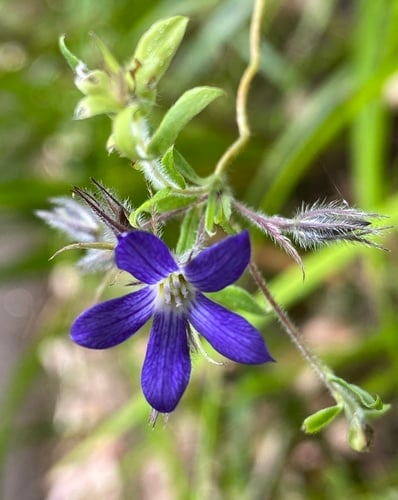
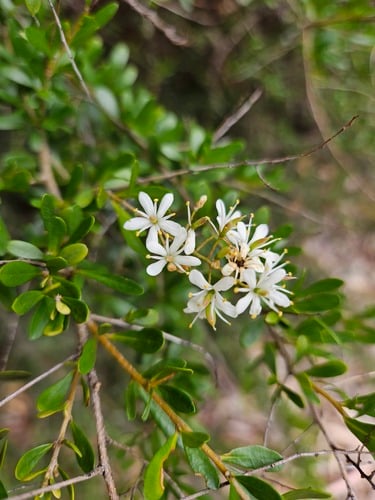
Billardiera longiflora
Labill.
Purple Apple-berry, Mountain Blue Berry
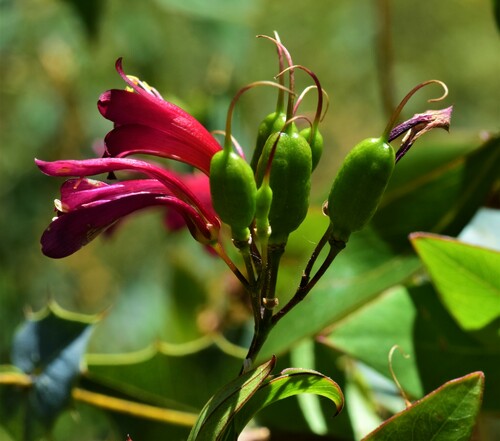
iNaturalist· cc-by-nc
(c) Nick Fitzgerald, some rights reserved (CC BY-NC), uploaded by Nick Fitzgerald
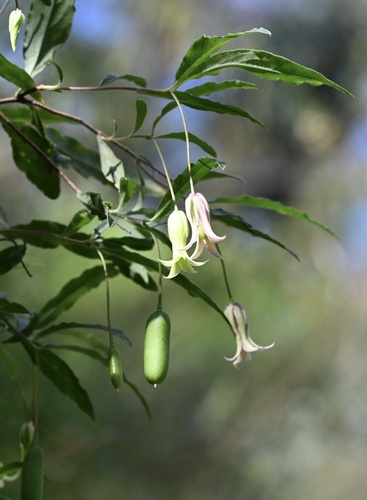
iNaturalist· cc-by-nc
(c) christine1970, some rights reserved (CC BY-NC)
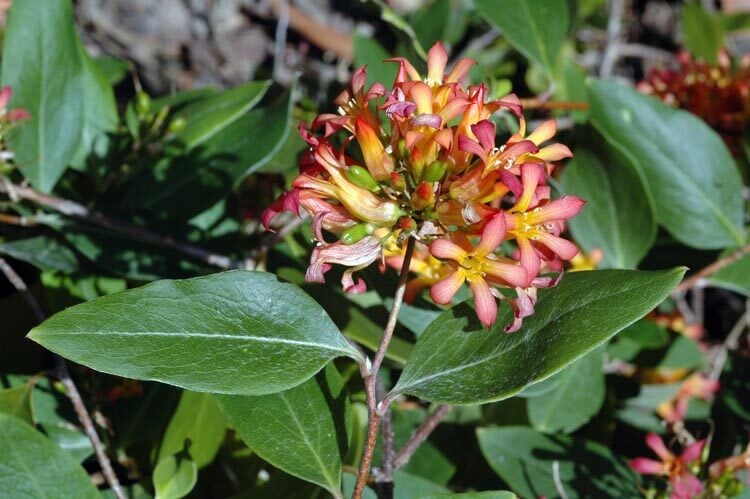
iNaturalist· cc-by-nc
(c) ngaruru, some rights reserved (CC BY-NC), uploaded by ngaruru
Summary
Source: WikipediaBillardiera longiflora is a species of flowering plant in the family Pittosporaceae and is endemic to Tasmania. It is a woody twiner or climber that has variably-shaped, often elliptic leaves, often varying with altitude, and greenish-yellow, pendent, tube-shaped flowers arranged singly and turning blue as they age. This species is often confused with the similar Billardiera macrantha of south-eastern Australia, including Tasmania.
Description
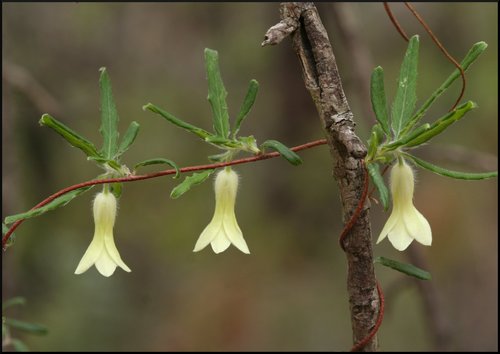
A slender woody plant. It has twining stems. It climbs over other plants. It grows 2-4 m tall. The leaves are narrow. They are produced alternately. The leaves are dark green and shiny. They are 2-5 cm long by 0.3-0.5 cm wide. The flowers have 5 petals and hang downwards. They are greenish-yellow and flushed with purple. The flowers are bell shaped. They are 1-3 cm long. The fruit is a berry. It is purple. It is 2 cm long and fleshy. It contains many seeds.
Edible Uses
Edible Parts: Fruit Edible Uses: Fruit - raw. Aromatic, mealy and pleasant. Remove the seeds before eating the fruit. The fruit does not have a pulp and is dry and boring. The deep blue fruit is up to 25mm long.
Traditional Uses
The purple fruit is eaten. They are also pureed or added to fruit salads. They can be used for jams, jelly and chutney.
This uses section is brief — help expand it
Medicinal Uses
None known
Known Hazards
The leaves contain saponins. Although poisonous, saponins are poorly absorbed by the human body and so most pass through without harm. Saponins are quite bitter and can be found in many common foods such as some beans. They can be removed by carefully leaching in running water. Thorough cooking, and perhaps changing the cooking water once, will also normally remove most of them. However, it is not advisable to eat large quantities of food that contain saponins. Saponins are much more toxic to some creatures, such as fish, and hunting tribes have traditionally put large quantities of them in streams, lakes etc in order to stupefy or kill the fish.
Distribution
A temperate plant. It grows in cool, wet forests. It needs well drained soil. It can grow in full sunlight. It can stand light frosts. In Tasmania it grows to 900 m altitude. Hobart Botanical Gardens. Tasmania Herbarium. Arboretum Tasmania.
Where It Grows
Australia*, Tasmania*, USA,
Cultivation
Requires a moist well-drained humus-rich lime-free soil in a sheltered position in sun or semi-shade with a cool root run. Plants are only hardy to about -5°c. They succeed outdoors only in the mildest areas of Britain. They can survive quite cold winters outdoors if given a suitable position. They are hardy to at least -7°c in Australian gardens though this cannot be translated directly to British gardens because of our cooler summers and longer, wetter and colder winters. Mulching the roots in winter will provide extra protection for the plant and even if the top is cut back by the cold it might resprout from the base. A very ornamental plant.The flowers are deliciously scented. Any pruning is best done in spring.
Propagation
Seed - best sown in a warm greenhouse as soon as it is ripe. Only just cover the seed. Sow stored seed in early spring in a warm greenhouse. The germination of fresh seed is usually prolific, but stored seed can take a year to germinate. When they are large enough to handle, prick the seedlings out into individual pots and grow them on in the greenhouse for at least their first winter. Plant them out into their permanent positions in late spring or early summer, after the last expected frosts. Cuttings of half-ripe wood, 10 - 12cm with a heel, July/August in a frame. Fair percentage. Layering.
Other Uses
None known Special Uses Scented Plants
Production
Plants flower from October to January.
Notes
There are about 25 Billardiera species. They grow in Australia.
Also Known As
Climbing blueberry
References (30)
- Bodkin, F., 1991, Encyclopedia Botanica. Cornstalk publishing, p 147
- Brickell, C. (Ed.), 1999, The Royal Horticultural Society A-Z Encyclopedia of Garden Plants. Convent Garden Books. p 179
- Cameron, M., (Ed.) 1981, A Guide to Flowers & Plants of Tasmania. Reed p 48
- Cherikoff V. & Isaacs, J., The Bush Food Handbook. How to gather, grow, process and cook Australian Wild Foods. Ti Tree Press, Australia p 198
- Cronin, L., 1989, The Concise Australian Flora. Reed. p 24
Show all 30 references Hide references
- Curtis, W.M., 1956, The Students Flora of Tasmania Vol 1 p 55
- Elliot, W.R., & Jones, D.L., 1982, Encyclopedia of Australian Plants suitable for cultivation. Vol 2. Lothian. p 322
- Facciola, S., 1998, Cornucopia 2: a Source Book of Edible Plants. Kampong Publications, p 173
- Gilfedder, L et al, 2003, The Nature of the Midlands. Midlands Bushweb. PO Box 156 Longford, Tasmania. p 77
- Grieg, D., 2002, A photographic guide to Wildflowers of South-eastern Australia. New Holland. p 100
- Heyne, G. & P., 1985, Australian Plants for your Garden. Lothian. p 48
- Heywood, V.H., Brummitt, R.K., Culham, A., and Seberg, O., 2007, Flowering Plant Families of the World. Royal Botanical Gardens, Kew. p 257
- Hibbert, M., 2002, The Aussie Plant Finder 2002, Florilegium. p 43
- John, L., & Stevenson, V., 1979, The Complete Book of Fruit. Angus & Robertson p 56
- Jones, D.L. & Gray, B., 1977, Australian Climbing Plants. Reed. p 54, 79
- Kirkpatrick, J., 1997, Alpine Tasmania, An Illustrated guide to the flora and vegetation. Oxford, p 54
- Lord, E.E., & Willis, J.H., 1999, Shrubs and Trees for Australian gardens. Lothian. p 321
- Low, T., 1991, Wild Food Plants of Australia. Australian Nature FieldGuide, Angus & Robertson. p 124
- Lyle, S., 2006, Discovering fruit and nuts. Land Links. p 94
- Minchin, R.F., Tasmanian Wildflowers. A Field Guide. Volume one. Regal Publications, Launceston p 168
- Molyneux, B & Forrester, S., 1997, The Austraflora A-Z of Australian Plants. Reed. p 54
- Morley, B.D., & Toelken, H.R., (Eds), 1983, Flowering Plants in Australia. Rigby. p 139
- Nicholson, N & H., 1994, Australian Rainforest Plants 4, Terania Rainforest Publishing. NSW. p 16
- Nov. Holl. pl. 1:64, t. 89. 1805
- Plants for a Future database, The Field, Penpol, Lostwithiel, Cornwall, PL22 0NG, UK. http://www.scs.leeds.ac.uk/pfaf/
- Smith, K & I., 199, Grow your own bushfoods. New Holland. Australia. p 25
- Steenbeeke, Greg as part of the Plants Directory project. List of plant species from northern NSW that may be used as food plants p 11
- Tasmanian Herbarium Vascular Plants list p 43
- Whiting, J. et al, 2004, Tasmania's Natural Flora. Tasmania's Natural Flora Editorial Committee PO Box 194, Ulverstone, Tasmania, Australia 7315 p 250
- Woolmore, E et al, 2002, King Island Flora: A Field Guide. p 63