Pittosporum phillyreoides
DC.
Weeping pittosporum, Butter bush, Native willow, Meemeei, Wild apricot, Berrigan
iNaturalist· cc-by-nc
(c) rodneya63, some rights reserved (CC BY-NC), uploaded by rodneya63
iNaturalist· cc-by-nc-sa
(c) Arthur Chapman, some rights reserved (CC BY-NC-SA)
iNaturalist· cc-by-nc
(c) rodneya63, some rights reserved (CC BY-NC), uploaded by rodneya63
Summary
Source: WikipediaPittosporum phillyreoides, with the common names weeping pittosporum and willow pittosporum, is a shrub or small columnar tree in the Apiales order, endemic to Australia.
Description
A small tree. It grows 4-8 m high. It spreads 2-5 m across. The branches hang down in a weeping fashion. They can droop to near ground level. The bark is pale grey and fairly smooth. The leaves are narrow. They are 5-10 cm long and bright green. They are 6-10 mm wide. They have a smooth, hooked point. The flowers are creamy-yellow. They are small and bell shaped. They occur in masses. They have a perfume. The fruit are orange berries. They split open when ripe to reveal deep red, sticky seeds.
Edible Uses
The seed is dried and ground into a powder; it is very bitter. The plant also produces a good edible gum that oozes from wounded branches.
Traditional Uses
The seeds are pounded to flour for food.
This uses section is brief — help expand it
Medicinal Uses
The plant is antispasmodic, antipruritic and galactogogue. It is used in the treatment of eczema, pruritis and colds.
Known Hazards
This plant contains saponins. Saponins are found in many foods, such as some beans, and although they are fairly toxic to people they are poorly absorbed by the body and most pass straight through without any problem. They are also broken down if the food is thoroughly cooked for a long time. Saponins are much more toxic to some creatures, such as fish, and hunting tribes have traditionally put large quantities of them in streams, lakes etc in order to stupefy or kill the fish.
Distribution
It grows in warm temperate regions but will also grow in arid and semi-arid places. It needs well drained soil. It can grow in full sun or light shade. It can stand heavy frosts. In the Inland Botanical Gardens Mildura.
Where It Grows
Australia*,
Cultivation
Requires a well-drained light loamy soil, succeeding in very dry soils. Requires a sunny position. Plants tolerate much wetter conditions in cultivation than they experience in their native habitat. Not very hardy in Britain, tolerating temperatures down to about -5°c. Plants succeed outdoors in Cornwall though they need greenhouse protection in other parts of the country. A slow growing plant. Very amenable to pruning, plants can be cut right back into old wood if required. The species in this genus are very likely to hybridize with other members of the genus. When growing a species from seed it is important to ensure that the seed either comes from a known wild source, or from isolated specimens in cultivation. Plants in this genus are notably resistant to honey fungus.
Propagation
Sow seed when ripe in autumn or in late winter in a warm greenhouse; it usually germinates freely. Prick out seedlings into individual pots when large enough to handle, move to a cold frame once established, and plant out in late spring the following year. Some protection from cold is advisable during their first winter outdoors. Cuttings of half-ripe wood, 5–7cm with a heel, can be taken in July or August and rooted in a frame, with a poor to fair success rate. Basal ripewood cuttings can be taken in late autumn in a cold frame.
Other Uses
The plant contains saponins that have potential use as a soap or as a bird repellent. Because of their bitterness, they can be sprayed over plants to deter birds from feeding on them; the saponins are easily removed by washing or rain. The wood is close-grained and very hard, used for turnery and cabinet making.
Notes
There are about 200 Pittosporum species. It is regarded as medicine.
Synonyms
Also Known As
Gumbi gumbi, Guwiirra, Miyaymiyaay
References (30)
- Alice, L. & O'Quinn, T., Australian Bush Superfoods. Explore Australia p 62 (As Pittosporum angustifolium)
- Bindon, P., 1996, Useful Bush Plants. Western Australian Museum. p 200
- Bodkin, F., 1991, Encyclopedia Botanica. Cornstalk publishing, p 806
- Boomsma, C.D., 1972, Native Tree of South Australia. Woods & Forests Department South Australia, Bulletin No.19. p 211
- Brickell, C. (Ed.), 1999, The Royal Horticultural Society A-Z Encyclopedia of Garden Plants. Convent Garden Books. p 806
Show all 30 references Hide references
- Cancilla, D., 2018, Ethnobotanical and Ethnozoological Values Desktop Assessment - Eliwana Project. p 42
- Cherikoff V. & Isaacs, J., The Bush Food Handbook. How to gather, grow, process and cook Australian Wild Foods. Ti Tree Press, Australia p 190
- Clarke, P. A., 2013, The Aboriginal Ethnobotany of the Adelaide Region, South Australia. Transactions of the Royal Society of South Australia. (2013), 137(1): 97-126
- Cribb, A.B. & J.W., 1976, Wild Food in Australia, Fontana. p 91, 185
- Cronin, L., 1989, The Concise Australian Flora. Reed. p 129
- Dashorst, G.R.M., and Jessop, J.P., 1998, Plants of the Adelaide Plains & Hills. Botanic Gardens of Adelaide and State Herbarium. p 76
- Elliot, W.R., & Jones, D.L., 1997, Encyclopedia of Australian Plants suitable for cultivation. Vol 7. Lothian. p 339
- Hall, N. et al, 1972, The Use of Trees and Shrubs in the Dry Country of Australia, AGPS, Canberra. p 389
- Hibbert, M., 2002, The Aussie Plant Finder 2002, Florilegium. p 235
- Holliday, I., 1989, A Field Guide to Australian Trees. Hamlyn. p 282
- Hunter, J. T. & Sheringham, P., 2006, Vegetation and Floristics of Melville Range Nature Reserve. A Report to the New South Wales Parks and Wildlife Service. p 178 (As Pittosporum angustifolium)
- Lazarides, M. & Hince, B., 1993, Handbook of Economic Plants of Australia, CSIRO. p 191
- Lord, E.E., & Willis, J.H., 1999, Shrubs and Trees for Australian gardens. Lothian. p 19
- Low, T., 1991, Wild Food Plants of Australia. Australian Nature FieldGuide, Angus & Robertson. p 182
- McKerney, M. & White, H., 2011, Bush Tucker, Boomerangs & Bandages. Border River-Gwyder Catchment Management Authority p 79 (As Pittosporum angustifolium)
- Melzer, R. & Plumb, J., 2011, Plants of Capricornia. Belgamba, Rockhampton. p 271 (As Pittosporum angustifolium)
- Milson. J., 2000, Trees and Shrubs of north-west Queensland. DPI p 248
- Molyneux, B. and Forrester, S., 1997, The Austraflora A-Z of Australian Plants. Reed. p 145
- Morley, B.D., & Toelken, H.R., (Eds), 1983, Flowering Plants in Australia. Rigby. p 139
- Oates, A., & Seeman, A., 1979, Victorian Aborigines: Plant Foods. National Museum, Melbourne.
- Paczkowska, G . & Chapman, A.R., 2000, The Western Australian Flora. A Descriptive Calatogue. Western Australian Herbarium. p 456
- Plants for a Future database, The Field, Penpol, Lostwithiel, Cornwall, PL22 0NG, UK. http://www.scs.leeds.ac.uk/pfaf/
- Prodr. 1:347. 1824 "phylliraeoides"
- Townsend, K., 1994, Across the Top. Gardening with Australian Plants in the tropics. Society for Growing Australian Plants, Townsville Branch Inc. p 314
- World Checklist of Useful Plant Species 2020. Royal Botanic Gardens, Kew
More from Pittosporaceae
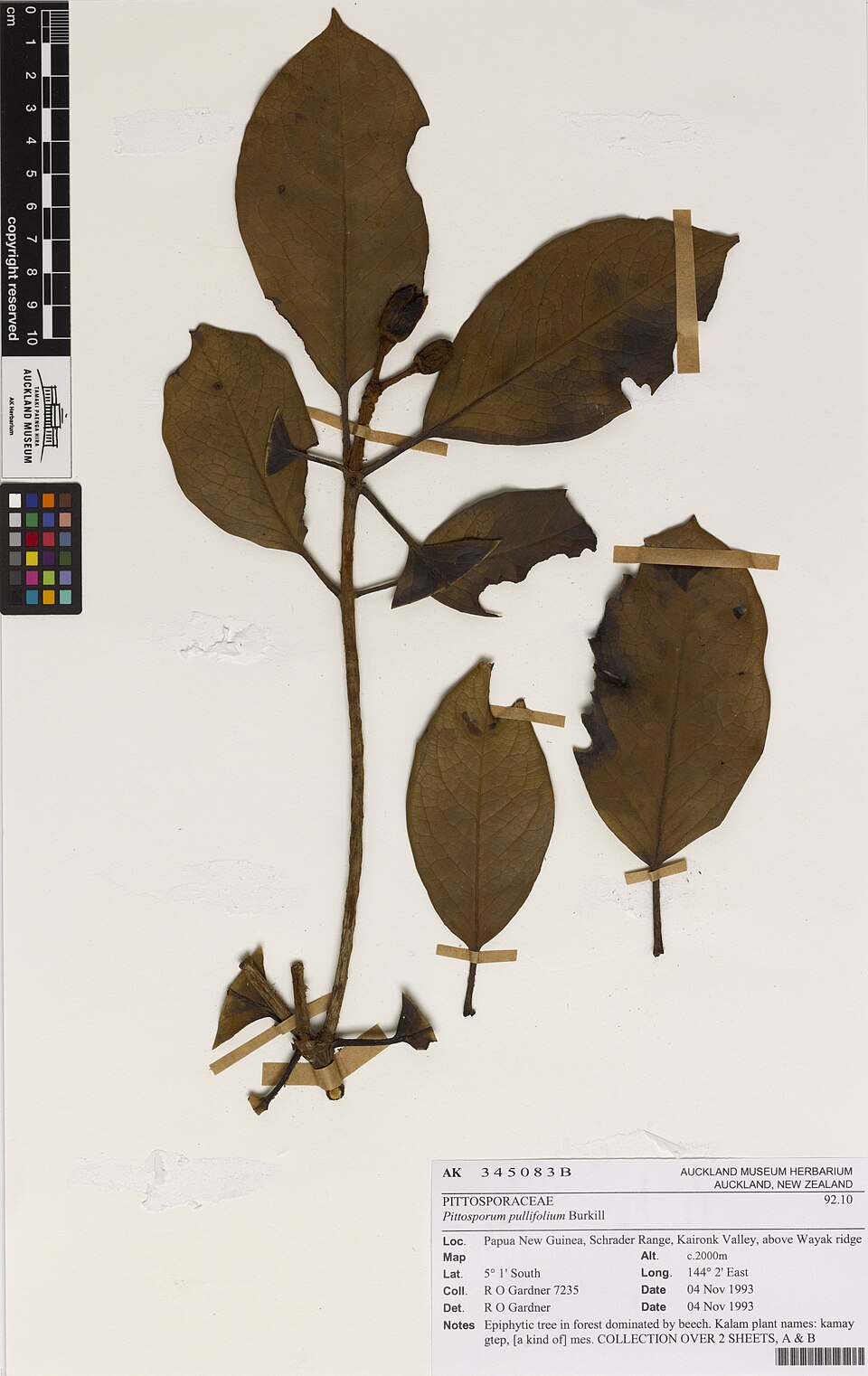
Pittosporum pullifolium
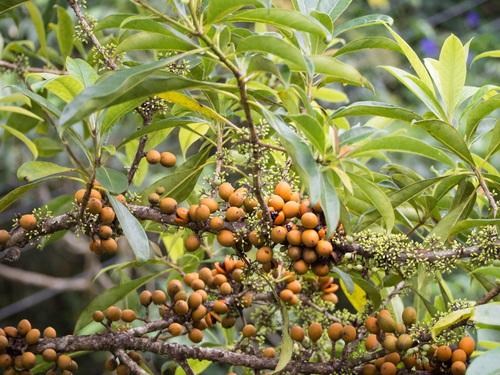
Pittosporum resiniferum
Resin cheesewood
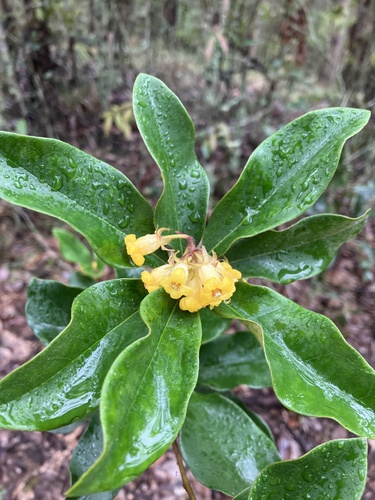
Pittosporum revolutum
Hairy pittosporum, Yellow Pittosporum, Rough-fruited Pittosporum, Mock orange
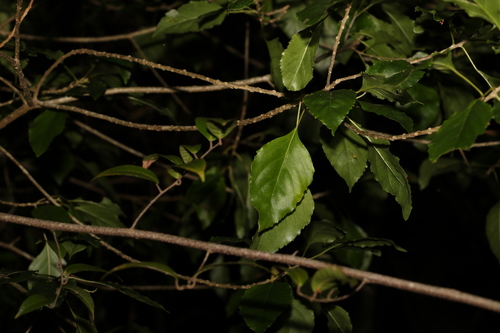
Pittosporum rhombifolium
Queensland pittosporum, Diamond leaf pittosporum
Pittosporum sinuatum
Pittosporum spinescens
Orange-thorn, Native orange, Wallaby apple, Large-fruited orange thorn