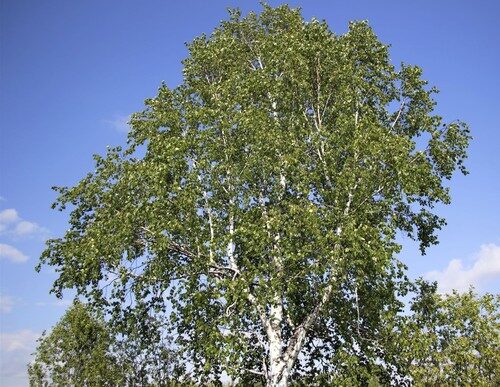
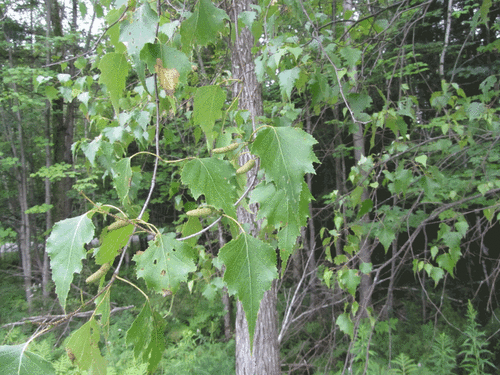
Betula nigra
L.
River Birch, Red Birch, Tropical birch
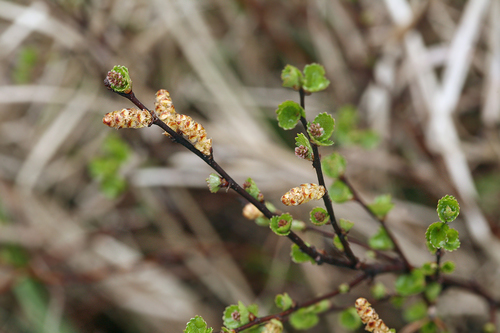
iNaturalist· cc-by-nc
(c) Richard Candler, some rights reserved (CC BY-NC), uploaded by Richard Candler
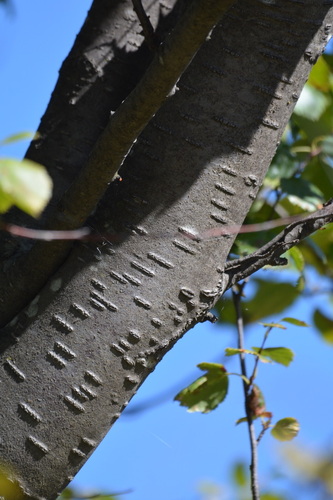
iNaturalist· cc-by-sa
(c) Plant Image Library, some rights reserved (CC BY-SA)
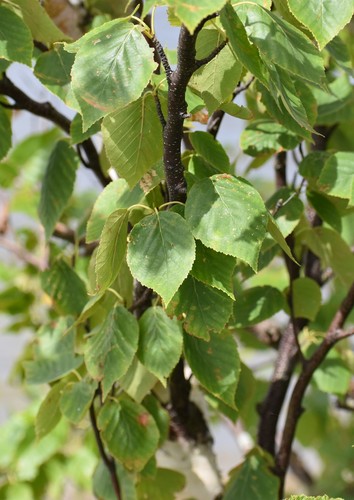
iNaturalist· cc-by
(c) Katja Schulz, some rights reserved (CC BY)
Summary
Source: WikipediaBetula nigra, the black birch, river birch or water birch, is a species of birch native to the Eastern United States from New Hampshire west to southern Minnesota, and south to northern Florida and west to Texas. It is one of the few heat-tolerant birches in a family of mostly cold-weather trees which do not thrive in USDA Zone 6 and up. B. nigra commonly occurs in floodplains and swamps.
Description
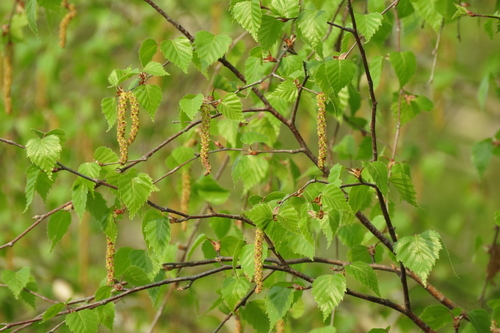
A deciduous tree. It grows 9-30 m high. It forks about 3-6 m above the ground to form a broad crown. The bark is dark and furrowed in older trees. The leaves are triangular with irregular teeth along the edge. They are 10 cm long. They taper at the base and are pointed to the tip. There are hairs on the veins underneath. The male and female flowers are on catkins on the same tree. Male catkins are 7.5 cm long and yellow-brown and hang down. Female catkins are green and upright. The fruit is a catkin which breaks up when ripe.
Edible Uses
Edible Parts: Sap Edible Uses: Sweetener Sap - raw or cooked. A sweet flavour. Harvested in early spring, before the leaves unfurl. The trunk is tapped by drilling a hole about 6mm wide and about 4cm deep. The sap flows best on warm sunny days following a hard frost. It makes a refreshing drink and can also be concentrated into a syrup or sugar. The sap can be fermented to make birch beer or vinegar. An old English recipe for the beer is as follows:- "To every Gallon of Birch-water put a quart of Honey, well stirr'd together; then boil it almost an hour with a few Cloves, and a little Limon-peel, keeping it well scumm'd. When it is sufficiently boil'd, and become cold, add to it three or four Spoonfuls of good Ale to make it work...and when the Test begins to settle, bottle it up . . . it is gentle, and very harmless in operation within the body, and exceedingly sharpens the Appetite, being drunk ante pastum.".
Traditional Uses
The sap contains sugar. It is used to make a drink. It can be boiled down to sugar. It is also fermented into birch beer.
This uses section is brief — help expand it
Medicinal Uses
Antiseborrheic Diuretic Dysentery Salve Stomachic Urinary A salve was made by boiling the buds until they were thick and pasty, sulphur was added and this was then applied externally to skin sores and ringworm. The leaves have been chewed, or used as an infusion, in the treatment of dysentery. An infusion of the bark has been used to treat stomach problems, 'milky' urine and difficult urination with discharge. The German Commission E Monographs, a therapeutic guide to herbal medicine, approve Betula species for infections of the urinary tract, kidney and bladder stones, rheumatism (see for critics of commission E).
Known Hazards
The aromatic and aliphatic hydrocarbons in birch tar are irritating to the skin. Do not use in patients with oedema or with poor kidney or heart functions
Distribution
It is a temperate plant. It grows naturally along river banks. It needs damp soils. It is frost resistant but damaged by drought. It suits hardiness zones 4-9. Arboretum Tasmania.
Where It Grows
Australia, North America*, Tasmania, USA,
Cultivation
Succeeds in a well-drained loamy soil in a sheltered position11, 43, 200]. Grows well in heavy clay soils. Likes its roots within reach of water. Dislikes wet soils according to another report. Shade tolerant. Hybridizes freely with other members of this genus. A good plant to grow near the compost heap, aiding the fermentation process. Trees are notably susceptible to honey fungus.
Propagation
Seed - best sown as soon as it is ripe in a light position in a cold frame. Only just cover the seed and place the pot in a sunny position. Spring sown seed should be surface sown in a sunny position in a cold frame. If the germination is poor, raising the temperature by covering the seed with glass can help. When they are large enough to handle, prick the seedlings out into individual pots and grow them on in a cold frame for at least their first winter. Plant them out into their permanent positions in late spring or early summer, after the last expected frosts. If you have sufficient seed, it can be sown in an outdoor seedbed, either as soon as it is ripe or in the early spring - do not cover the spring sown seed. Grow the plants on in the seedbed for 2 years before planting them out into their permanent positions in the winter.
Other Uses
Besom Soil stabilization Wood Young branches are used to make besoms, whisks etc. This species has an extensive root system and is sometimes planted for erosion control along the banks of streams. Wood - light, strong, close grained and hard, but it contains many knots because of the numerous branches along the trunk. It weighs 36lb per cubic foot. Of little use commercially, though it is sometimes used for furniture, turnery etc. Special Uses
Notes
There are about 60 Betula species. They grow in cool north temperate climates.
Synonyms
References (16)
- Bircher, A. G. & Bircher, W. H., 2000, Encyclopedia of Fruit Trees and Edible Flowering Plants in Egypt and the Subtropics. AUC Press. p 58
- Bodkin, F., 1991, Encyclopedia Botanica. Cornstalk publishing, p 145
- Coombes, A.J., 2000, Trees. Dorling Kindersley Handbooks. p 121
- Cundall, P., (ed.), 2004, Gardening Australia: flora: the gardener's bible. ABC Books. p 236
- Duke, J.A., 1992, Handbook of Edible Weeds. CRC Press. p 48
Show all 16 references Hide references
- Etherington, K., & Imwold, D., (Eds), 2001, Botanica's Trees & Shrubs. The illustrated A-Z of over 8500 trees and shrubs. Random House, Australia. p 130
- Facciola, S., 1998, Cornucopia 2: a Source Book of Edible Plants. Kampong Publications, p 49
- Hibbert, M., 2002, The Aussie Plant Finder 2002, Florilegium. p 43
- Little, E.L., 1980, National Audubon Society Field Guide to North American Trees. Alfred A. Knopf. p 366
- Lord, E.E., & Willis, J.H., 1999, Shrubs and Trees for Australian gardens. Lothian. p 48
- Ryan, S., 2008, Dicksonia. Rare Plants Manual. Hyland House. p 10
- Saunders, C.F., 1948, Edible and Useful Wild Plants. Dover. New York. p 165
- Slocum, P.D. & Robinson, P., 1999, Water Gardening. Water Lilies and Lotuses. Timber Press. p 111
- Sp. pl. 2:982. 1753
- Tozer, F., 2007, The Uses of Wild Plants. Green Man Publishing. p 47
- Young, J., (Ed.), 2001, Botanica's Pocket Trees and Shrubs. Random House. p 138