Flemingia grahamiana
Wight. & Arn.
Stain-pod
iNaturalist· cc0
no rights reserved, uploaded by Andrew Deacon
iNaturalist· cc0
no rights reserved, uploaded by Andrew Deacon
iNaturalist· cc-by
(c) i_c_riddell, some rights reserved (CC BY), uploaded by i_c_riddell
Summary
Source: WikipediaFlemingia grahamiana is a species of flowering plant in the family Fabaceae. Extracts of the plant are used in the dyeing of silk and cotton in parts of India, Africa, and the Middle East.
Description
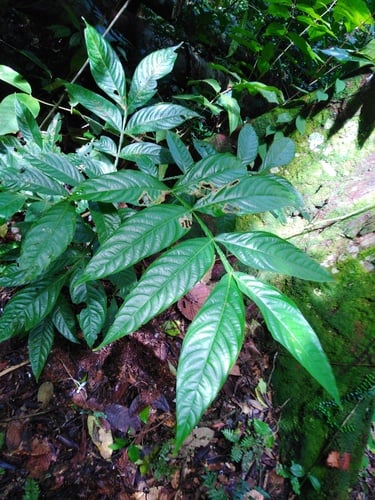
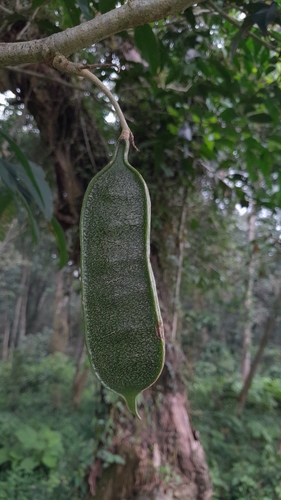
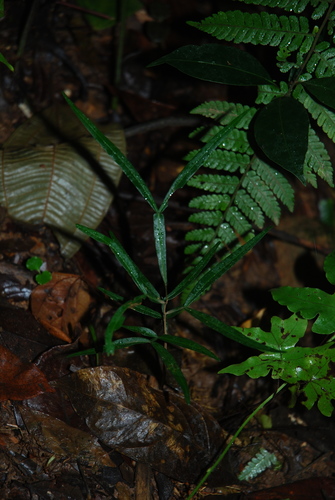
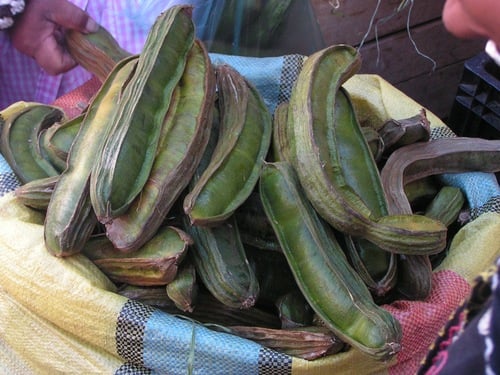
A herb or small shrub. It is erect and grows 1.8 m tall. It has deep roots that can form tubers. The leaves are alternate with 3 leaflets. The leaf stalk is 7 cm long. The leaflets are 2-15 cm long by 1-8 cm wide. The leaflet at the end is the largest. The flowers contain both sexes. The fruit is an inflated pod. It is 9-12 mm long by 6 mm wide. It contains 2 seeds. The seeds are round and 1.5 mm across. The fruit leaves stains when touched.
Edible Uses
The tubers and roots are edible.
Medicinal Uses
Flemingia grahamiana is used in various countries for ethnomedical purposes, in parts of India leaves are used as a purgative, while in parts of Malawi and Zimbabwe root extracts are used as a decoction to treat diarrhea and dysentery . Exudates from the pod is used in the dyeing of silk and sometimes cotton.
Distribution
A tropical plant. It grows in open savanna. It can be near water and rivers. It East Africa it grows to 2,100 m altitude. In Zimbabwe it grows between 480-1,800 m above sea level. In southern China it grows in forest between 900-1,600 m above sea level. In Yunnan.
Where It Grows
Africa, Asia, Benin, Cameroon, Central Africa, Central African Republic, CAR, China, Congo, East Africa, Ethiopia, Ghana, India, Indochina, Laos, Malawi, Malaysia, Middle East, Mozambique, Myanmar, Nigeria, Saudi Arabia, SE Asia, South Africa, Southern Africa, Togo, Uganda, Vietnam, West Africa, Yemen, Zambia, Zimbabwe,
Cultivation
Plants can be grown from seed. The plant can be cut back and will re-grow.
Propagation
Seed - it has a hard seedcoat and may benefit from scarification before sowing in order to speed up and improve germination. This can usually be done by pouring a small amount of nearly boiling water on the seeds (being careful not to cook them!) and then soaking them for 12 - 24 hours in warm water. By this time they should have imbibed moisture and swollen - if they have not, then carefully make a nick in the seedcoat (being careful not to damage the embryo) and soak for a further 12 hours before sowing.
Other Uses
Flemingia grahamiana is one of the principal sources of the Arab dye called ‘waras’, ‘wars’ or ‘warus’. Waras is a coarse purple or brilliant orange-brown powder, consisting of single (not grouped) hairs and dark gland globules rubbed from dry fruits. The powder is used in India, the Arab world and in Africa (e.g. in Uganda, Zimbabwe and Malawi), mainly for dyeing silk and cotton a golden-yellow, but also for other purposes such as dyeing bamboo for baskets and making coloured ink. It does not seem to be applied to wool. Waras is also used as a cosmetic by placing a small portion of the powder in the palm of the hand and moistening it with water; the hands are then rubbed together, producing a lather of a bright gamboge colour, which is applied as required. The fruit powder of Flemingia grahamiana contains a dark red to orange-brown resin, an orange-red crystalline substance and small quantities of a yellow crystalline substance. These are flavonoid colorants belonging to the group of chalcones: flemingins A, B and C, homoflemingin and 5-deoxyhomoflemingin. These principles resemble those of kamala (Mallotus philippinensis (Lam.) Muell.Arg.), which also are complex chalcones, but not identical. The dye of kamala is also produced by the glands on the fruits and in international trade waras and kamala are often traded together. In dye powder of waras, uncoloured long and simple hairs can be found, whereas in dye powder of kamala short uncoloured stellate hairs are found. To prepare the dye, the powder is dissolved in the dye bath with an equal weight of sodium carbonate. When the temperature of the bath reaches 40°c the yarns or textiles to be dyed are put into the bath and the whole is slowly heated to boiling point. To make the colour brighter, the fibre can be washed in slightly acidic water, e.g. made with lemon juice. Beautiful deep yellow or orange colours can be obtained, fast to light and acids, less so to alkaline substances. Those colours were used very frequently in combination with indigo blue in the renowned ikat textiles from Yemen. The plant has been recommended as a cover crop in DR Congo.
Notes
There are about 35 Flemingia species. It is a dye plant. It is also used in medicine.
Synonyms
Also Known As
Buandama, Kali-kalula, Mbutaya, Topmo Graham
References (6)
- Burkill, H. M., 1985, The useful plants of west tropical Africa, Vol. 3. Kew.
- Burkill, I.H., 1966, A Dictionary of the Economic Products of the Malay Peninsula. Ministry of Agriculture and Cooperatives, Kuala Lumpur, Malaysia. Vol 1 (A-H) p 1042
- Fowler, D. G., 2007, Zambian Plants: Their Vernacular Names and Uses. Kew. p 38, 81
- Jansen, P.C.M., 2005. Flemingia grahamiana Wight & Arn. [Internet] Record from Protabase. Jansen, P.C.M. & Cardon, D. (Editors). PROTA (Plant Resources of Tropical Africa), Wageningen, Netherlands. < http://database.prota.org/search.htm>. Accessed 16 October 2009.
- D. Oliver, Fl. trop. Afr. 2:231. 1871
Show all 6 references Hide references
- World Checklist of Useful Plant Species 2020. Royal Botanic Gardens, Kew