Acacia concurrens
Pedley
Black wattle
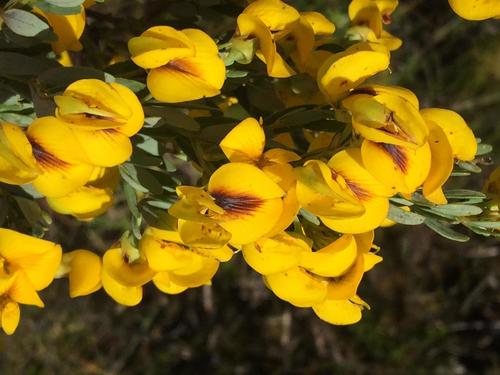
iNaturalist· cc-by
(c) Tatiana Gerus, some rights reserved (CC BY)
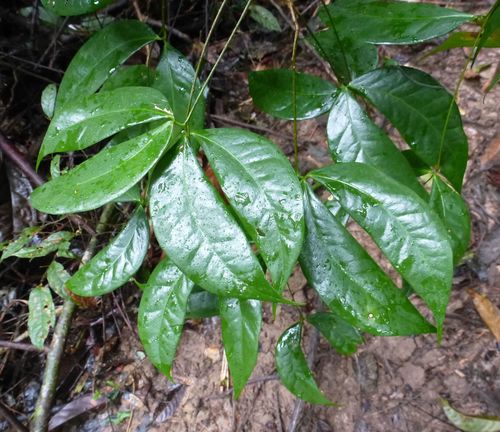
iNaturalist· cc-by
(c) Tim Albers, some rights reserved (CC BY), uploaded by Tim Albers
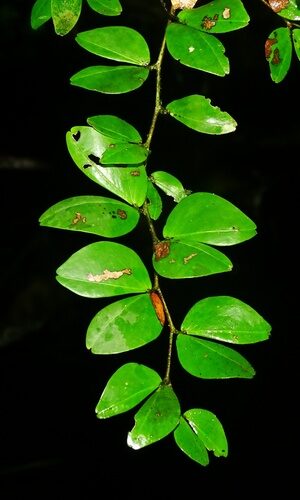
iNaturalist· cc-by-nc
(c) Pete Woodall, some rights reserved (CC BY-NC), uploaded by Pete Woodall
Summary
Source: WikipediaAcacia concurrens, commonly known as curracabah or black wattle, is a species of flowering plant in the family Fabaceae and is endemic to eastern Australia. It is a single-stemmed glabrous shrub or tree, with fissured bark, scurfy branchlets, very narrowly elliptic to narrowly elliptic, leathery phyllodes, spikes of pale yellow flowers and linear, semicircular, pods.
Description
A shrub or small tree. It grows 5 m tall. There are prickles along the stem. The leaves are twice divided and there are 8-18 pairs of pinnae. There are up to 50 pairs of pinnules on each pinnae. The flowers are yellow. They are in large clusters at the ends of branches. The pods are flattened.
Edible Uses
The seeds are parched, cleaned, and milled for consumption. The roots are also edible.
Traditional Uses
The seeds are parched, cleaned and milled.
This uses section is brief — help expand it
Distribution
It suits subtropical locations. It is a hardy plant and can grow in cooler places. It needs good drainage and full sunlight. It grows well in coastal areas.
Where It Grows
Australia*,
Cultivation
It is grown from seed. The seeds have a hard seed coat that needs to be broken.
Notes
There are about 1,350 Acacia species. Over 1,000 occur in Australia. Also as Mimosaceae.
Nutrition
| Part | Moisture | kJ | kcal | Protein | Vit A | Vit C | Iron | Zinc |
|---|---|---|---|---|---|---|---|---|
| Seed | 3.9 | 1935 | 463 | 23.3 | — | — | — | — |
| Roots | — | — | — | — | — | — | — | — |
Synonyms
Also Known As
Curracabah
References (9)
- A guide to some edible/useful (mostly) local species
- Cherikoff V. & Isaacs, J., The Bush Food Handbook. How to gather, grow, process and cook Australian Wild Foods. Ti Tree Press, Australia p 47
- Contr. Queensland Herb. 15:9. 1974
- Doran, J.C., & Turnbull, J.W. (Eds), 1997, Australian Trees and Shrubs: species for land rehabilitation and farm plantings in the tropics. ACIAR Monograph No 24. p 347
- Elliot, W.R., & Jones, D.L., 1982, Encyclopedia of Australian Plants suitable for cultivation. Vol 2. Lothian. p 33
Show all 9 references Hide references
- ILDIS Legumes of the World http:www;ildis.org/Legume/Web
- Lazarides, M. & Hince, B., 1993, Handbook of Economic Plants of Australia, CSIRO. p 2
- Ryan, M. (Ed.), 2003, Wild Plants of Greater Brisbane. Queensland Museum. p 117
- Williams, K.A.W., 1999, Native Plants of Queensland Volume 4. Keith A.W. Williams North Ipswich, Australia. p 10