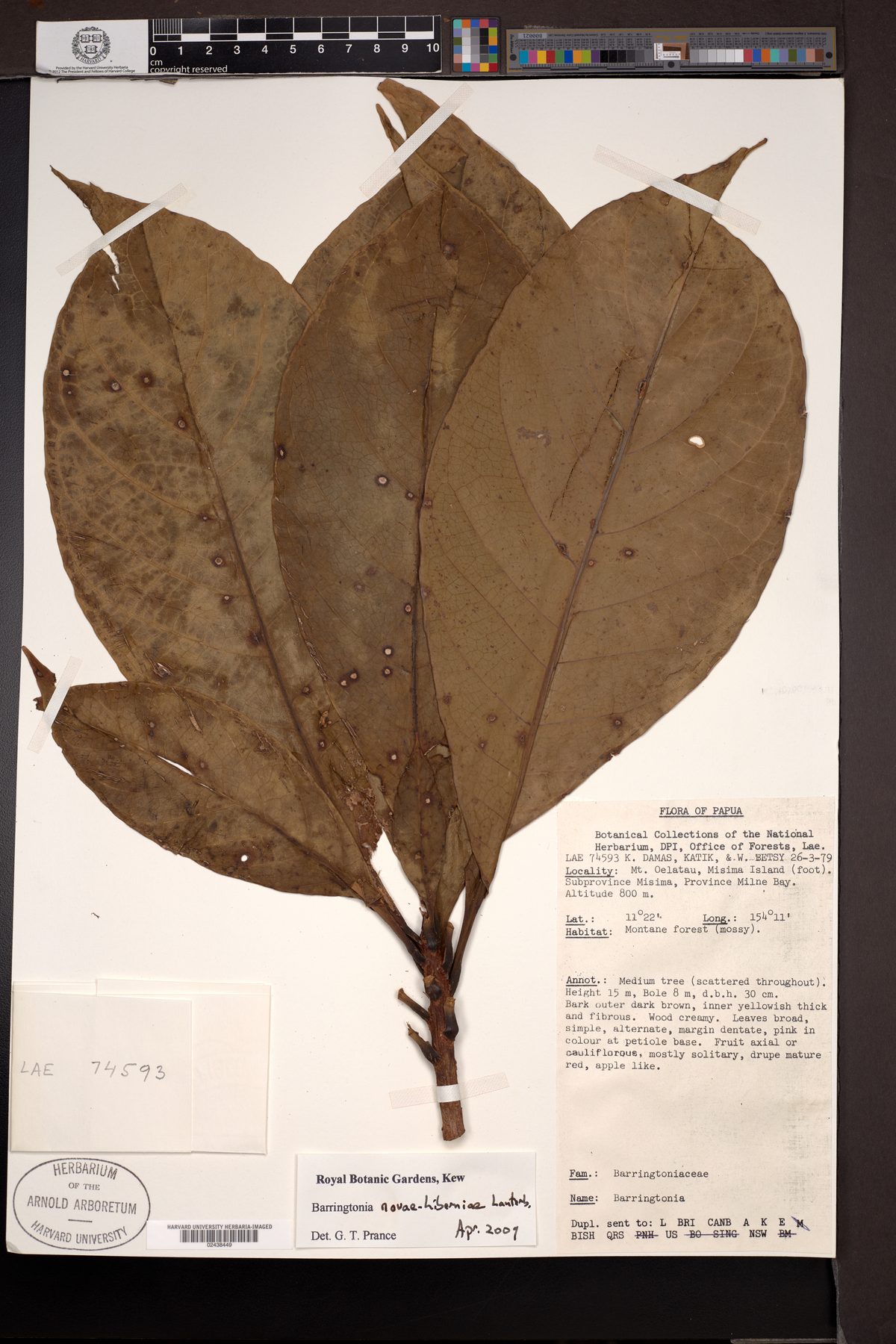
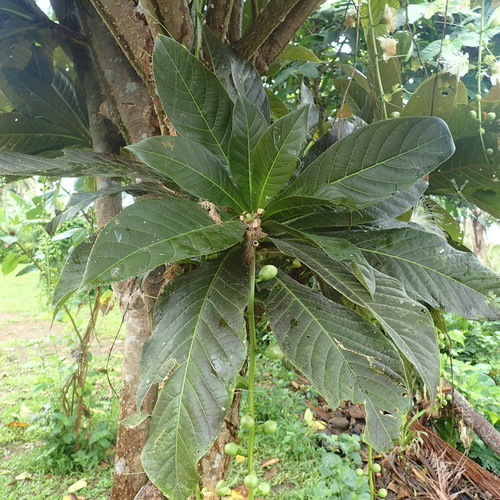
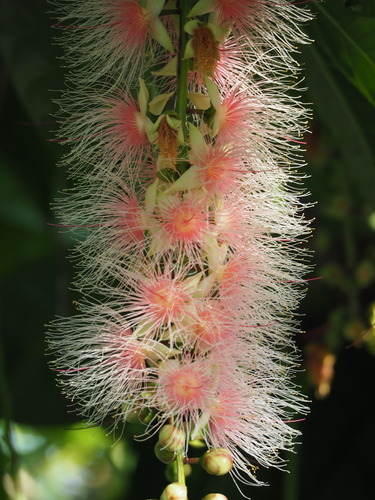
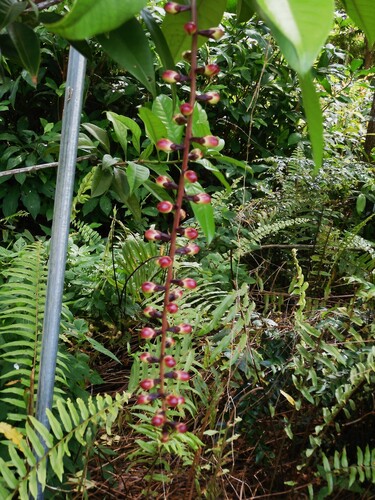
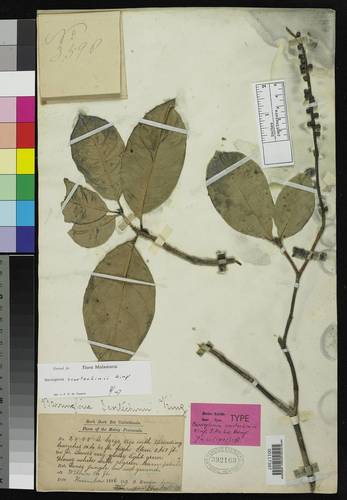
Barringtonia acutangula subsp. spicata
Blume
Putat nasi
gbif· cc-by
Royal Botanic Gardens, Kew
gbif· cc-by
Royal Botanic Gardens, Kew
gbif· cc-by-nc
President and Fellows of Harvard College
Summary
Source: WikipediaBarringtonia acutangula is a species of Barringtonia native to coastal wetlands in southern Asia and northern Australasia, from Afghanistan east to the Philippines, Queensland and the Northern Territory. Common names include freshwater mangrove, itchytree and mango-pine.
Description
A shrub or tree. It grows 3-18 m tall. The trunk is straight and branched near the base. The smaller branches are thick and crooked and angular. The leaves are alternate with short stalks. The leaves are oblong or sword shaped. They are 6-25 cm long by 2-10 cm wide. They have teeth around the edge. The flowers are pink and without stalks. They are in slender spikes.
Edible Uses
The young leaves are eaten, often prepared with fish.
Traditional Uses
The young leaves are eaten. They are often eaten with fish.
This uses section is brief — help expand it
Medicinal Uses
Research on this plant has reported a number of medicinal uses, including antitumor (seed extract), antibiotic, inhibition of growth of Helicobacter pylori, antinociceptive activity and antifungal activity. The 1889 book 'The Useful Native Plants of Australia' records that "In India an extract or juice is obtained from the leaves of this tree which, when mixed with oil, is used in native [sic.] practice for eruptions of the skin. The kernels powdered and prepared with sago and butter, are used in diarrhoea; mixed with milk they produce vomiting (Treasury of Botany). The root is bitter, and is said to be similar to Cinchona, but also cooling and aperient. (Drury)."
Distribution
A tropical plant. In Java it grows in the lowlands and to 400 m above sea level. It is often near water.
Where It Grows
Asia, Indochina, Indonesia, Laos, Malaysia, Myanmar, Philippines, SE Asia, Thailand, Vietnam,
Notes
There are about 40 Barringtonia species.
Synonyms
Also Known As
Jurai-jurai, Pokok gajah beranak
References (6)
- Bijdr. 1097. 1826 (As Barringtonia spicata)
- Bircher, A. G. & Bircher, W. H., 2000, Encyclopedia of Fruit Trees and Edible Flowering Plants in Egypt and the Subtropics. AUC Press. p 54 (As Barringtonia spicata)
- Burkill, I.H., 1966, A Dictionary of the Economic Products of the Malay Peninsula. Ministry of Agriculture and Cooperatives, Kuala Lumpur, Malaysia. Vol 1 (A-H) p 309 (As Barringtonia spicata)
- Martin, F.W. & Ruberte, R.M., 1979, Edible Leaves of the Tropics. Antillian College Press, Mayaguez, Puerto Rico. p 197 (As Barringtonia spicata)
- Ochse, J.J. et al, 1931, Vegetables of the Dutch East Indies. Asher reprint. p 358 (As Barringtonia spicata)
Show all 6 references Hide references
- Prance, G. T. & Jongkind, C. H., 2015, A Revision of African Lecythidaceae. Kew Bulletin. 70:1-68