Bertholletia excelsa
Humb. & Bonpl.
Brazil nut
iNaturalist· cc-by
(c) Leonardo Bergamini, some rights reserved (CC BY), uploaded by Leonardo Bergamini
iNaturalist· cc-by-nc
(c) Renata Xavier, some rights reserved (CC BY-NC), uploaded by Renata Xavier
iNaturalist· cc-by-nc
(c) srickey, some rights reserved (CC BY-NC), uploaded by srickey
Summary
Source: WikipediaBertholletia excelsa is a large evergreen tree reaching 40 m tall and 25 m wide at medium growth rate. Hardy to UK zone 10, frost tender in colder regions. It requires full sun and grows well in light sandy, medium loamy, or heavy clay soils with good drainage, though it tolerates poor nutrition and very acidic to very alkaline conditions. The plant prefers moist soil and attracts wildlife. It is self-fertile and pollinated by bees.
Description
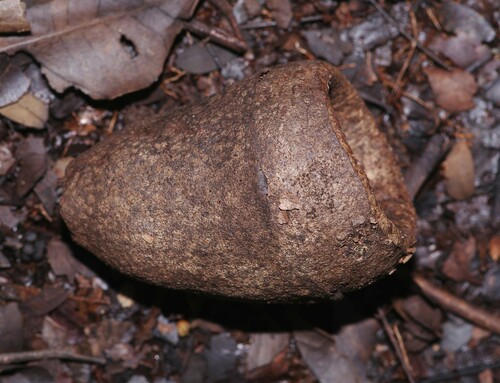
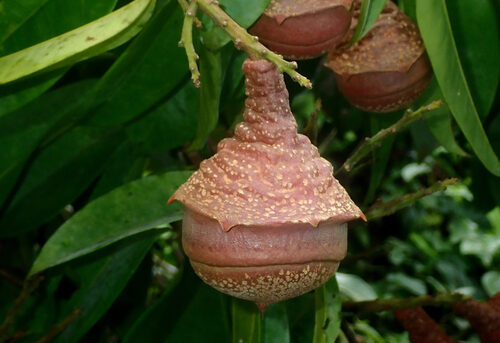
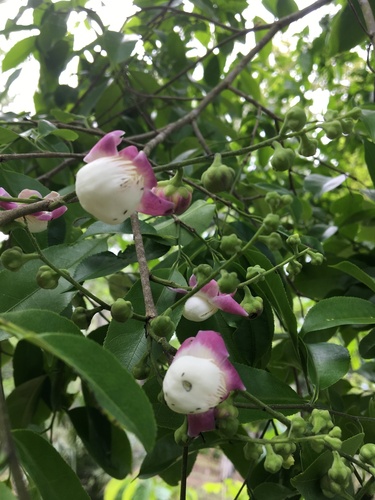
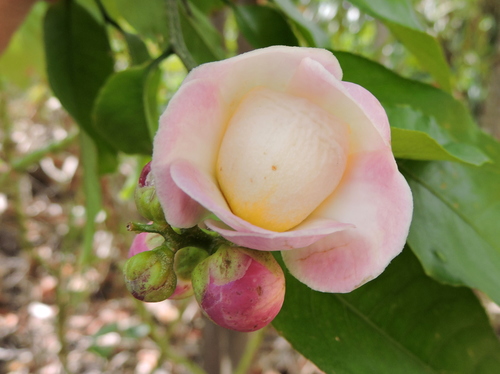
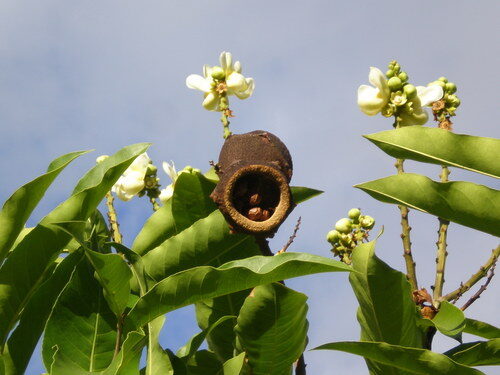
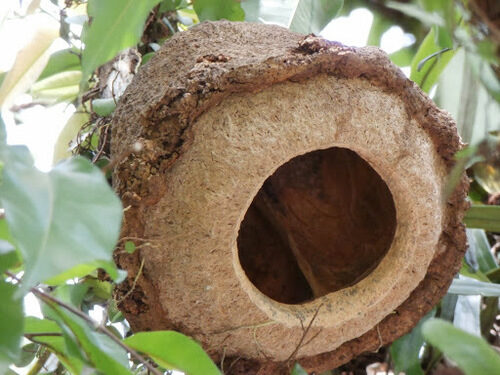
A very large tree growing up to 55-60 m high. The trunk can be 14 m around. The bark is rich red or grey and deeply cracked. Leaves are dark green and turn reddish brown as they die off. The leaf stalks are 5-6 cm long. The leaves are 25-35 cm long by 8-12 cm wide. The flowers occur in long loose flower stalks. The flowers are about 2.5 cm wide. The fruit is a large woody capsule or pod 10-15 cm across and 15-20 cm long. It is brown and has a rough surface. The fruit can weigh over 2.5 kg. It grows at the ends of the thick branches. It ripens then falls from the tree. A lid type structure on the fruit opens and lifts off at maturity. Each fruit pod can contain 12-25 nuts. Each nut has its own shell. The nut is three sided. They are 3.5-6 cm long. The creamy white kernel inside the nut is edible.
Edible Uses
Edible Parts: Oil Seed Edible Uses: Oil Edible portion: Nut, Oil, Flavouring. Seed - raw or cooked. A mild flavour, the nuts are a common item of food, eaten raw and also roasted, salted or used in ice cream etc. The nuts are very nutritious, containing roughly 66% fat or oil, 17% protein and 7% carbohydrate. The ripe fruit is a wooden capsule weighing up to 750g and containing 12 - 24 angular brown seed, each about 5cm long and 2.5cm wide. An oil is obtained from the seed. The fresh-pressed oil is pale yellow, almost odourless, with a pleasant nutty flavour. It is not unlike almond oil in composition. It can be used like olive oil. Nuts have a high level of selenium. They are also high in sulphur containing amino acids.
Traditional Uses
The nuts can be eaten raw or roasted. They are also salted and are used in ice cream. They are also sometimes grated with the stilt roots of Socratea palms and added to cassava flour. An oil can be extracted from the seeds.
Medicinal Uses
Skin The bark of the tree is used as a treatment for liver problems. The sweet oil from the seeds is applied to burns. A tea made from the fruit is used as a treatment for gastralgia. Nuts have a high level of selenium. They are also high in sulphur containing amino acids.
Known Hazards
Brazil nuts are susceptible to contamination by aflatoxins, produced by fungi, once they fall to the ground. Aflatoxins can cause liver damage, including possible cancer, if consumed. Aflatoxin levels have been found in Brazil nuts during inspections that were far higher than the limits set by the EU. However, mechanical sorting and drying was found to eliminate 98% of aflatoxins; a 2003 EU ban on importation was rescinded after new tolerance levels were set. Brazil nuts contain naturally high concentrations of selenium. Although selenium is an essential trace element, it is toxic if taken in excess. Exceeding the Tolerable Upper Intake Level of 400 micrograms per day can lead to selenosis. A standard serving measurement (28g or 1oz) of Brazil nuts frequently exceeds this limit, so consuming Brazil nuts daily is not recommended. The nuts may contain traces of radium, a radioactive element, with a kilogram of nuts containing an activity between 40 and 260 becquerels (1 and 7 nanocuries). This level of radium is small, although higher than in other common foods. According to Oak Ridge Associated Universities, elevated levels of radium in the soil do not directly cause the concentration of radium, but "the very extensive root system of the tree" can concentrate naturally occurring radioactive material, when present in the soil. Radium can be concentrated in nuts only if it is present in the soil. Brazil nuts also contain barium, a metal with a chemical behavior quite similar to radium. While barium can have toxic side effects when ingested (weakness, vomiting, diarrhea, etc.) the amount present in Brazil nuts is too small to have noticeable health effects.
Distribution
A tropical plant. It requires a hot, humid tropical lowland climates. It grows naturally in areas with an average temperature of 24-27°C. It needs a minimum annual temperature of 20-23°C and a maximum of 30-33°C. The rainfall is 1400-2800 mm per year. The annual average humidity is between 79-91%. It is damaged by drought and frost. It suits hardiness zone 12.
Where It Grows
Africa, Amazon, Asia, Australia, Bolivia, Brazil, Cameroon, Central Africa, Central America, China, Colombia, Costa Rica, Cuba, Ecuador, India, Ghana, French Guiana, Guianas, Guyana, Malaysia, Peru, SE Asia, Singapore, South America, Suriname, Trinidad, Venezuela, West Africa, West Indies,
Cultivation
The flowers are self sterile so a group of trees need to be planted near each other. Plants are grown from seed, cuttings or grafts. The seeds need to have the hard shell broken to help them to germinate. Seeds can only be stored for about 4-5 months. Because of the hard seed coat, seed may take 6-16 months to germinate. Treating seed by removing the seed coat and treating with phenyl mercuric acetate allows seeds to germinate in 3 months. Early germination can also be achieved by putting the nuts into sand a container with moist sand and storing it in a dry shady place for 6 months then removing the hard shell and planting the seeds.
Propagation
Seed - fresh seed germinates rapidly, often within 2 - 3 weeks, so long as a portion of the hard shell is cracked or carefully removed first in order to allow the entry of moisture. Otherwise seed can take 2 years to germinate. Seedlings probably need good light to grow away well. Seedling trees have borne a first crop at an age of 14 - 20 years. If the conditions are right, some of the seeds buried by rodents may germinate. Trees appear to depend on natural or artificial disturbance to reproduce. For example, they will be found in clearings in the forest created by humans, forest gaps created by tree fall, or sprouting from damaged mother roots. Trees take about 10 years to start reproducing; grafted material may begin to bear nuts within 4 years. Other than using a single clone, several selections are cloned and grafted onto stock to encourage cross-fertilization, which increases yield.
Other Uses
Containers Fibre Filter Fuel Furniture Lighting Oil Waterproofing Wood Other uses rating: Medium (3/5). Large Nut Tree, Public Open Spaces, Botanic Collections. Other Uses The hard woody 'fruit' that contains the seeds is used as cups or other receptacles. It is also made into bracelets or carved to make other ornaments. Empty fruit capsules are used to carry small, smoky fires in order to discourage black flies (Simulium spp.) from attacking people working in the field during the rainy season. Open capsules are sometimes used to collect latex from rubber trees. The oil obtained from the seed has been used as an illuminant. The oil has also sometimes been used in perfumery, paint and soap making, and as a lubricant for watches and clocks. The woody 'fruits' make an excellent fuel. The nut, which has an elevated oil content of 63-69%, burns with a candle-like flame when lit. The bark has been used in remote regions for fibre production. It is used for caulking ships. The heartwood is light brown to reddish; it is not clearly demarcated from the 3 - 5cm wide band of sapwood. The texture is medium, the grain straight or interlocked; lustre is medium. The wood is moderately heavy, hard and moderately durable being moderately resistant to fungi and termites but susceptible to dry wood borers. Seasoning is fairly fast with only a slight risk of checking or distortion; once dry it is moderately stable in service. It works well with normal tools; nailing and screwing are good; gluing is correct for internal purposes only. The durable wood is sought by boat builders, and is also used for purposes such as interior joinery, cabinet making, high class furniture, construction, flooring, heavy carpentry and sliced veneer. The felling of the trees is discouraged because they are more valuable as a nut crop, however the wood is well suited to all manner of structural work. The charcoal from Brazil nut shells is good at purifying water. Special Uses Carbon Farming Food Forest
Production
Trees grow very slowly. They begin producing nuts 8-10 years after planting. The fruit take over one year (14-15 months) to ripen. One tree can produce 300 or more pods per year. One fruit can weigh 2.2 kg. The nuts are harvested when the fruit fall to the ground.
Notes
There is only one Bertholettia species. Nuts have a high level of selenium. They are also high in sulphur containing amino acids. Selenium is helpful in preventing cancer. The charcoal from Brazil nut shells is good at purifying water.
Nutrition
| Part | Moisture | kJ | kcal | Protein | Vit A | Vit C | Iron | Zinc |
|---|---|---|---|---|---|---|---|---|
| Nuts | 8.5 | 2545 | 609 | 12 | 0 | — | 2.8 | 4.2 |
| Seed - oil | — | — | — | — | — | — | — | — |
Synonyms
Also Known As
Almendro, Castana del Brasil, Castana, Castanha-do-para, Castanheira, Castanheiro do Para, Chataigne du bresil, Coquito del Brasil, Niggertoe, Nuez del Brazil, Para nut, Paranoot, Tapa, Tapa risti, Tsixo
References (54)
- Abbiw, D.K., 1990, Useful Plants of Ghana. West African uses of wild and cultivated plants. Intermediate Technology Publications and the Royal Botanic Gardens, Kew. p 42
- Altschul, S.V.R., 1973, Drugs and Foods from Little-known Plants. Notes in Harvard University Herbaria. Harvard Univ. Press. Massachusetts. no. 3026
- Ambasta S.P. (Ed.), 2000, The Useful Plants of India. CSIR India. p 72
- Andrade, E. H. A. et al, 1999, Seed Composition of Amazonian Lecythidaceae Species: Part 3 in the Series ‘‘Studies of Edible Amazonian Plants’’. Journal of Food Composition and Analysis 12:37-51
- Barwick, M., 2004, Tropical and Subtropical Trees. A Worldwide Encyclopedic Guide. Thames and Hudson p 50
Show all 54 references Hide references
- Bianchini, F., Corbetta, F., and Pistoia, M., 1975, Fruits of the Earth. Cassell. p 194
- Bircher, A. G. & Bircher, W. H., 2000, Encyclopedia of Fruit Trees and Edible Flowering Plants in Egypt and the Subtropics. AUC Press. p 58 (Also as Bertholettia nobilis)
- Bodkin, F., 1991, Encyclopedia Botanica. Cornstalk publishing, p 143
- Brouk, B., 1975, Plants Consumed by Man. Academic Press, London. p 212
- Burkill, I.H., 1966, A Dictionary of the Economic Products of the Malay Peninsula. Ministry of Agriculture and Cooperatives, Kuala Lumpur, Malaysia. Vol 1 (A-H) p 322
- Chin, H.F., & Yong, H.S., 1996, Malaysian Fruits in Colour. Tropical press, Kuala Lumpur p 87
- Darley, J.J., 1993, Know and Enjoy Tropical Fruit. P & S Publishers. p 75
- Etkin, N.L. (Ed.), 1994, Eating on the Wild Side, Univ. of Arizona. p 122, 136
- Facciola, S., 1998, Cornucopia 2: a Source Book of Edible Plants. Kampong Publications, p 140
- FAO, 1995, Edible Nuts. Non Wood Forest Products 5.
- Flowerdew, B., 2000, Complete Fruit Book. Kyle Cathie Ltd., London. p 206
- Gouldstone, S., 1978, Australian and New Zealand Guide to food bearing plants. Books for Pleasure. p 44
- Grandtner, M. M. & Chevrette, J., 2013, Dictionary of Trees, Volume 2: South America: Nomenclature, Taxonomy and Ecology. Academic Press p 65
- Hedrick, U.P., 1919, (Ed.), Sturtevant's edible plants of the world. p 100
- Hermandez Bermejo, J.E., and Leon, J. (Eds.), 1994, Neglected Crops. 1492 from a different perspective. FAO Plant Production and Protection Series No 26. FAO, Rome. p 15
- Heywood, V.H., Brummitt, R.K., Culham, A., and Seberg, O. 2007, Flowering Plant Families of the World. Royal Botanical Gardens, Kew. p 183
- F. W. H. A. Humboldt & A. J. A. Bonpland, Pl. aequinoct. 1:122-127, t. 36. 1807
- Hu, Shiu-ying, 2005, Food Plants of China. The Chinese University Press. p 573
- Hunter, D., et al, 2019, The potential of neglected and underutilized species for improving diets and nutrition. Planta (2019) 250:709-729
- Kew Plants of the World Online
- Kiple, K.F. & Ornelas, K.C., (eds), 2000, The Cambridge World History of Food. CUP p 1737
- Lorenzi, H., 2002, Brazilian Trees. A Guide to the Identification and Cultivation of Brazilian Native Trees. Vol. 01 Nova Odessa, SP, Instituto Plantarum p 149
- Lorenzi, H., Bacher, L., Lacerda, M. & Sartori, S., 2006, Brazilian Fruits & Cultivated Exotics. Sao Paulo, Instituto Plantarum de Estuados da Flora Ltda. p 154
- Macmillan, H.F. (Revised Barlow, H.S., et al) 1991, Tropical Planting and Gardening. Sixth edition. Malayan Nature Society. Kuala Lumpur. p 271
- Martin, F. W., et al, 1987, Perennial Edible Fruits of the Tropics. USDA Handbook 642 p 32
- Menninger, E.A., 1977, Edible Nuts of the World. Horticultural Books. Florida p 34
- Milow, P., et al, 2013, Malaysian species of plants with edible fruits or seeds and their evaluation. International Journal of Fruit Science. 14:1, 1-27
- Mulherin, J., 1994, Spices and natural flavourings. Tiger Books, London. p 111
- O'Malley, D.M., et al, Genetics of Brazil nut (Bertholletia excelsa Humb. & Bonpl.: Lecythidaceae) Theor. Appl. Genetic. (1988) 76:929-932
- Paz, F. S., et al, 2021, Edible Fruit Plant Species in the Amazon Forest Rely Mostly on Bees and Beetles as Pollinators. Journal of Economic Entomology, XX(XX), 2021, 1–13
- Philips, O., 1992, The potential for harvesting fruits in tropical rainforests: new data from Amazonian Peru. Biodiversity and Conservation 2, 18-38
- Purseglove, J.W., 1968, Tropical Crops Dicotyledons, Longmans. p 637
- Roa, J. A. G. & Boada, D. S. G., 2018, Fundación para el Fortalecimiento de la Fruticultura y Plantas Alimenticias no Convencionales en Colombia.
- Schuler, S., (Ed.), 1977, Simon & Schuster's Guide to Trees. Simon & Schuster. No. 186
- Shanley, P. et al, (Eds), 2011, Fruit trees and useful plants in Amazonian life. Non-wood Forest Products No 20. FAO, CIFOR and PPI. p 49
- Small, E., 2009, Top 100 Food Plants. The world's most important culinary crops. NRC Research Press. p 131
- Tomchinsky, B., et al, 2021, Food Composition Data: Edible Plants from the Amazon. in M. C. M. Jacob, U. P. Albuquerque (eds.), Local Food Plants of Brazil, Ethnobiology, Springer p 276
- USDA, ARS, National Genetic Resources Program. Germplasm Resources Information Network - (GRIN). [Online Database] National Germplasm Resources Laboratory, Beltsville, Maryland. Available: www.ars-grin.gov/cgi-bin/npgs/html/econ.pl (10 April 2000)
- van Roosmalen, M.G.M., 1985, Fruits of the Guianan Flora. Utrecht Univ. & Wageningen Univ. p 162
- van Wyk, B., 2005, Food Plants of the World. An illustrated guide. Timber press. p 86
- Vasquez, R. and Gentry, A. H., 1989, Use and Misuse of Forest-harvested Fruits in the Iquitos Area. Conservation Biology 3(4): 350f
- Verheij, E. W. M. and Coronel, R.E., (Eds.), 1991, Plant Resources of South-East Asia. PROSEA No 2. Edible fruits and nuts. Pudoc Wageningen. p 320
- Villachica, H., (Ed.), 1996, Frutales Y hortalizas promisorios de la Amazonia. FAO, Lima. p 87
- Wickens, G.E., 1995, Edible Nuts. FAO Non-wood forest products. FAO, Rome. p 28, 139
- Williams, C.N., Chew, W.Y., and Rajartnam, J.A., 1989, Tree and Field Crops of the Wetter Regions of the Tropics. Longman, p 118
- World Checklist of Useful Plant Species 2020. Royal Botanic Gardens, Kew
- www.colecionandofrutas.org
- www.worldagroforestrycentre.org/treedb/
- Zambrana, P, et al, 2017, Traditional knowledge hiding in plain sight – twenty-first century ethnobotany of the Chácobo in Beni, Bolivia. Journal of Ethnobiology and Ethnomedicine (2017) 13:57