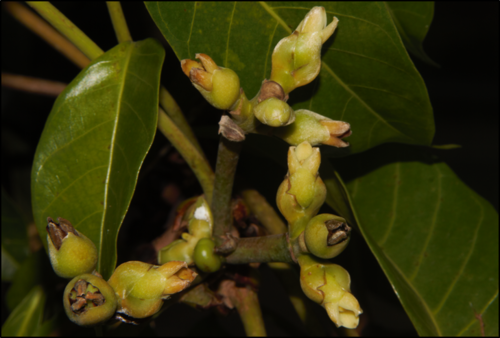
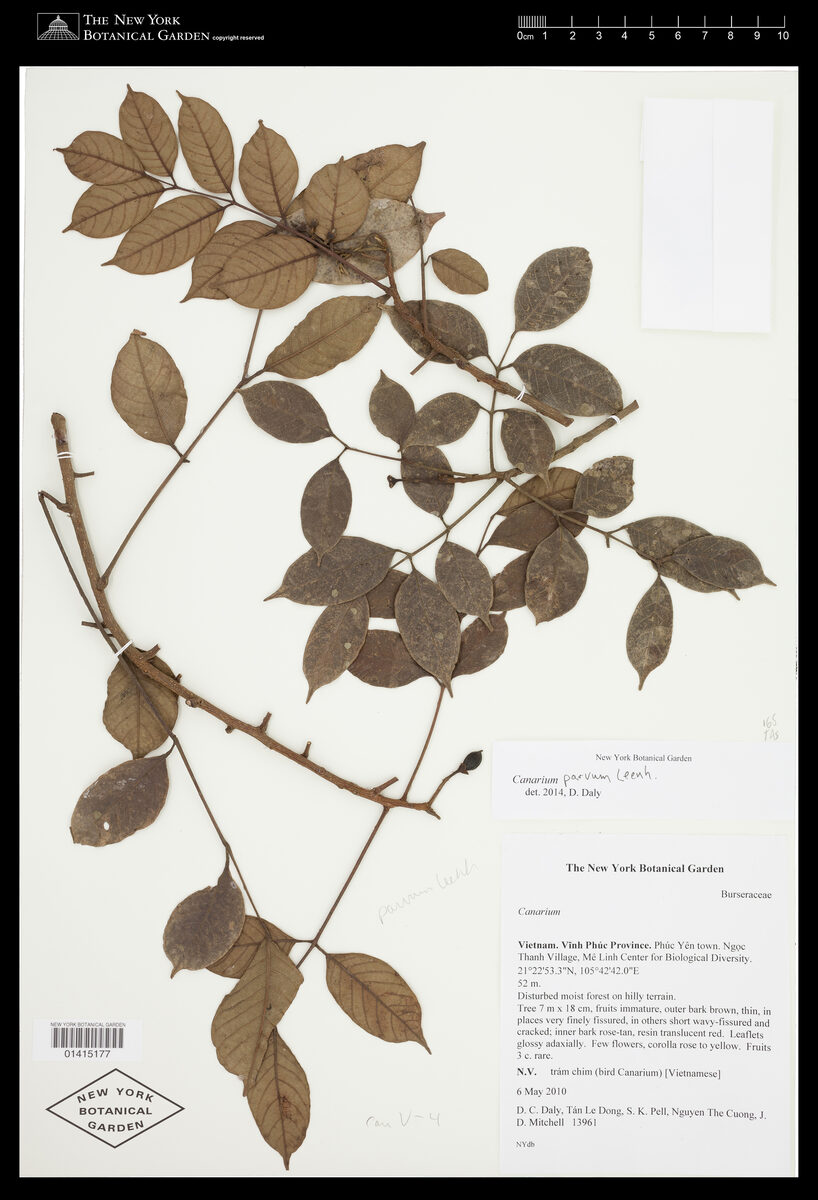
Canarium denticulatum
Blume
gbif· cc0
President and Fellows of Harvard College
gbif· cc0
President and Fellows of Harvard College
Summary
Source: WikipediaCanarium denticulatum is a tree in the family Burseraceae. The specific epithet denticulatum is from the Latin meaning 'small teeth', referring to the leaf margin.
Description
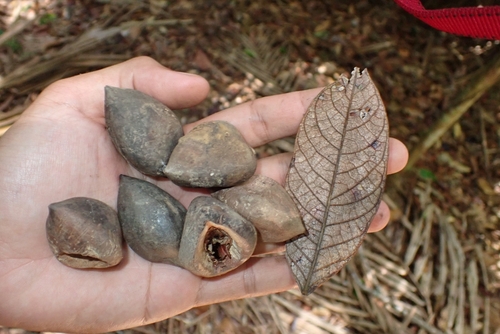
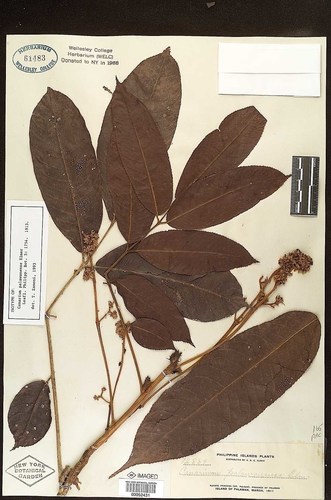
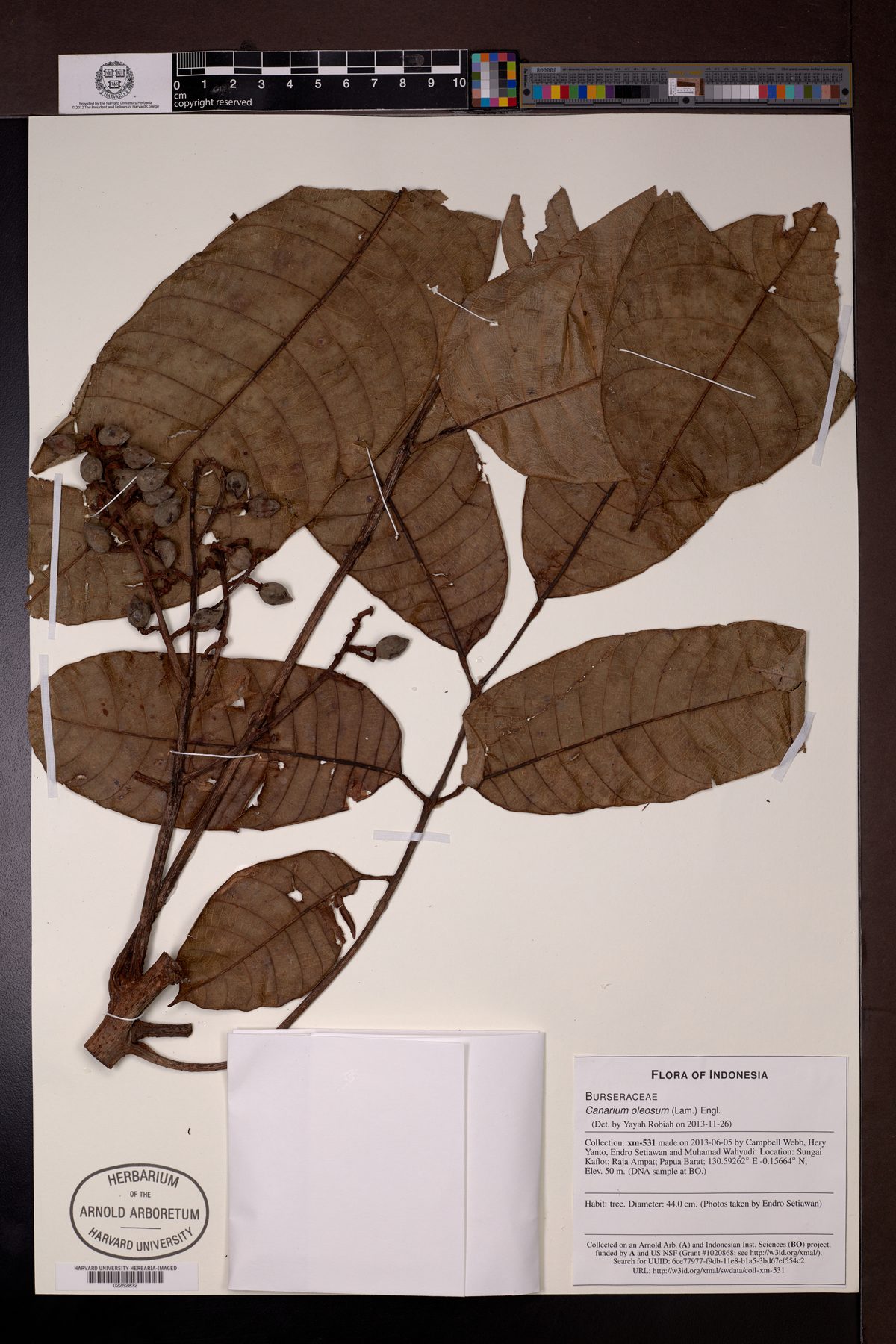
A tree. It grows 20-30 m high. The young branches are densely brown and hairy. The leaves are up to 50 cm long. The leaflets are 20-40 cm long. The leafy structures at the base of the leaf stalk (stipules) are deeply lobed and usually unequal sided. They are 1-2 cm by 0.8-1.3 cm. The flowers have a smell. Female flowers are 5-7 mm long. The fruit is oval and rounded at the ends. It is 1.3-2.5 cm long by 1-1.5 cm wide. The fleshy layer is thin. The wall of the stony shell is thick.
Edible Uses
The fruit, seeds, and nuts are eaten.
Distribution
A tropical plant. It grows from sea level up to 1,400 m along river banks.
Where It Grows
Andaman Islands, Asia, Indochina, Indonesia, Malaysia, Myanmar, Philippines, SE Asia, Thailand,
Cultivation
A dioecious species, both male and female forms need to be grown if fruit and seed are required.
Propagation
Seed - we have no specific information for this species but seeds of this genus generally have a hard seed coat and germinate erratically. Filing away some of the seed coat to allow moisture to enter more readily, without damaging the seed, will encourage a faster and more even germination.
Notes
There are 80-95 Canarium species.
Synonyms
Also Known As
Adal, Aijing, Alab-alab, Bangkulat, Jelapal gunung, Indalus, Kambayan, Kayamuk, Kedongdong, Kelamoh, Kenaren, Kuningam, Madamsat, Lembuakat, Pinayasan, Pininasan, Rave wulan, Sajeng, Selada, Talangsai, Unggit
References (10)
- Altschul, S.V.R., 1973, Drugs and Foods from Little-known Plants. Notes in Harvard University Herbaria. Harvard Univ. Press. Massachusetts. no. 1978
- Bircher, A. G. & Bircher, W. H., 2000, Encyclopedia of Fruit Trees and Edible Flowering Plants in Egypt and the Subtropics. AUC Press. p 79
- Burkill, I.H., 1966, A Dictionary of the Economic Products of the Malay Peninsula. Ministry of Agriculture and Cooperatives, Kuala Lumpur, Malaysia. Vol 1 (A-H) p 434
- Chai, P. P. K. (Ed), et al, 2000, A checklist of Flora, Fauna, Food and Medicinal Plants. Lanjak Entimau Wildlife Sanctuary, Sarawak. Forestry Malaysia & ITTO. p 166
- Milow, P., et al, 2013, Malaysian species of plants with edible fruits or seeds and their evaluation. International Journal of Fruit Science. 14:1, 1-27
Show all 10 references Hide references
- Ridley, 1922, Flora of the Malay Peninsula. 1 p 374
- Slik, F., www.asianplant.net
- Soepadmo, E. & Wong, K. M., (Eds.), 1995, Tree Flora of Sabah and Sarawak. Volume One. ITTO, Govt. Malaysia. p 53
- World Checklist of Useful Plant Species 2020. Royal Botanic Gardens, Kew
- www.pngplants.org