Canarium muelleri
F. M. Bailey
Queensland Elemi tree
wikimedia· cc0
No machine-readable author provided. Noles1984~commonswiki assumed (based on copyright claims). (via Wikimedia Commons)
Summary
Source: WikipediaCanarium muelleri, commonly named scrub turpentine or mangobark, is a species of Australian rainforest trees in the plant family Burseraceae. They are endemic to northeastern Queensland, widespread in the rainforests of the Wet Tropics region, and further south to the Conway Range area, near Proserpine, Queensland. Full grown trees may reach up to 30 m (100 ft) tall. They have pinnate (compound) leaves each composed of 3–9 leaflets, the combined length of the leaflets and the petiole totalling up to 30 cm (12 in). In Dec–Jan they grow fleshy, blue or black ripe fruits, 13–20 mm (0.5–0.8 in) long, eaten by rainforest birds including cassowaries and by fruit bats. Each fruit contains a hard–shelled seed. These trees formal description using this species name was published in 1890 by Frederick M. Bailey, Queensland colonial botanist from 1881 to 1915.
Description
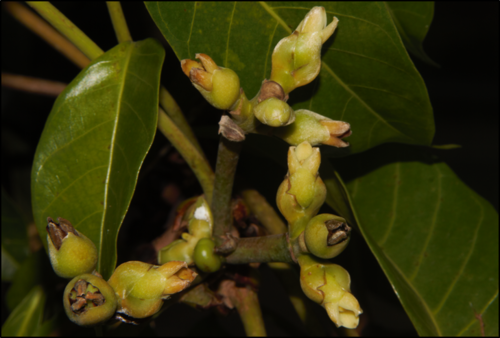
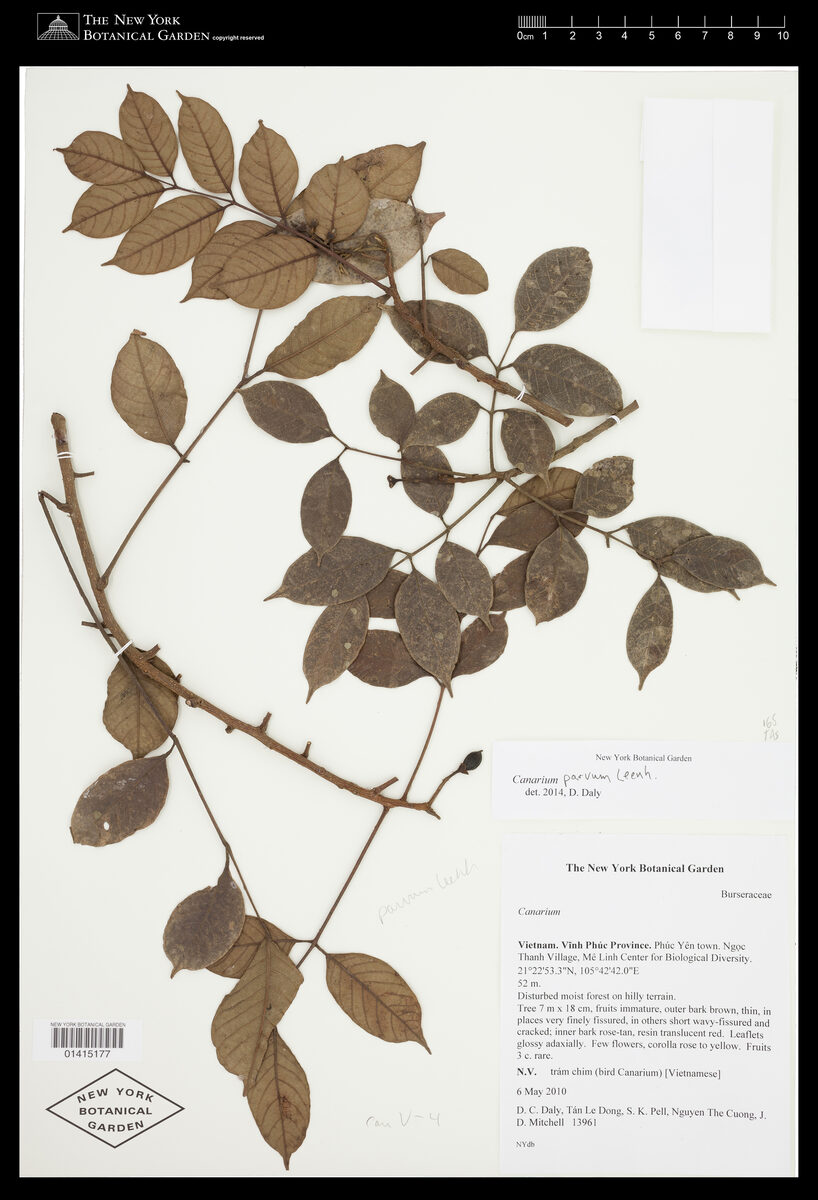
A medium sized tree. It grows 10-20 m high and spreads 3-8 m across. The young shoots have rusty red hairs. The leaves are divided into 5-7 leaflets. These are 4-7.5 cm long and sword shaped. The flower clusters are slender and grow in the axils of upper leaves. The flowers are greenish and about 0.3 cm across. The fruit are about 1.5 cm long.
Edible Uses
The kernel of the nut inside the fruit is eaten.
Traditional Uses
The kernel of the nut in the fruit is eaten.
This uses section is brief — help expand it
Medicinal Uses
Although the sap is reported to be poisonous when it enters the body by way of a cut, it is also said to be a very good healing agent for cuts, sores and chronic ulcers
Known Hazards
The sap is reported to be poisonous when it enters the body by way of a cut.
Distribution
A tropical plant. It grows in coastal rainforests in north-east Queensland in Australia. It grows from sea level to 800 m altitude. It needs well drained soil. It is damaged by frost or drought. It suits hardiness zones 10-12.
Where It Grows
Australia*,
Cultivation
Plants are grown from seed.
Propagation
Seed - we have no specific information for this species but seeds of this genus generally have a hard seed coat and germinate erratically. Filing away some of the seed coat to allow moisture to enter more readily, without damaging the seed, will encourage a faster and more even germination.
Other Uses
The wood is a useful, general purpose timber that is suitable for cabinet work and plywood.
Production
Trees grow quickly under good conditions.
Notes
There are 80-95 Canarium species.
Also Known As
Scrub Turpentine
References (13)
- Bodkin, F., 1991, Encyclopedia Botanica. Cornstalk publishing, p 210
- Cherikoff V. & Isaacs, J., The Bush Food Handbook. How to gather, grow, process and cook Australian Wild Foods. Ti Tree Press, Australia p 198
- Cooper, W. and Cooper, W., 2004, Fruits of the Australian Tropical Rainforest. Nokomis Editions, Victoria, Australia. p 96
- Cribb, A.B. & J.W., 1976, Wild Food in Australia, Fontana. p 103
- Elliot, W.R., & Jones, D.L., 1982, Encyclopedia of Australian Plants suitable for cultivation. Vol 2. Lothian. p 456
Show all 13 references Hide references
- Etherington, K., & Imwold, D., (Eds), 2001, Botanica's Trees & Shrubs. The illustrated A-Z of over 8500 trees and shrubs. Random House, Australia. p 179
- FAO, 1995, Edible Nuts. Non Wood Forest Products 5.
- Jackes, B.R., 2001, Plants of the Tropics. Rainforest to Heath. An Identification Guide. James Cook University. p 45
- Jones D, L, 1986, Ornamental Rainforest Plants in Australia, Reed Books, p 203
- Lazarides, M. & Hince, B., 1993, Handbook of Economic Plants of Australia, CSIRO. p 46
- Menninger, E.A., 1977, Edible Nuts of the World. Horticultural Books. Florida p 28
- Townsend, K., 1994, Across the Top. Gardening with Australian Plants in the tropics. Society for Growing Australian Plants, Townsville Branch Inc. p 118
- Wickens, G.E., 1995, Edible Nuts. FAO Non-wood forest products. FAO, Rome. p 111