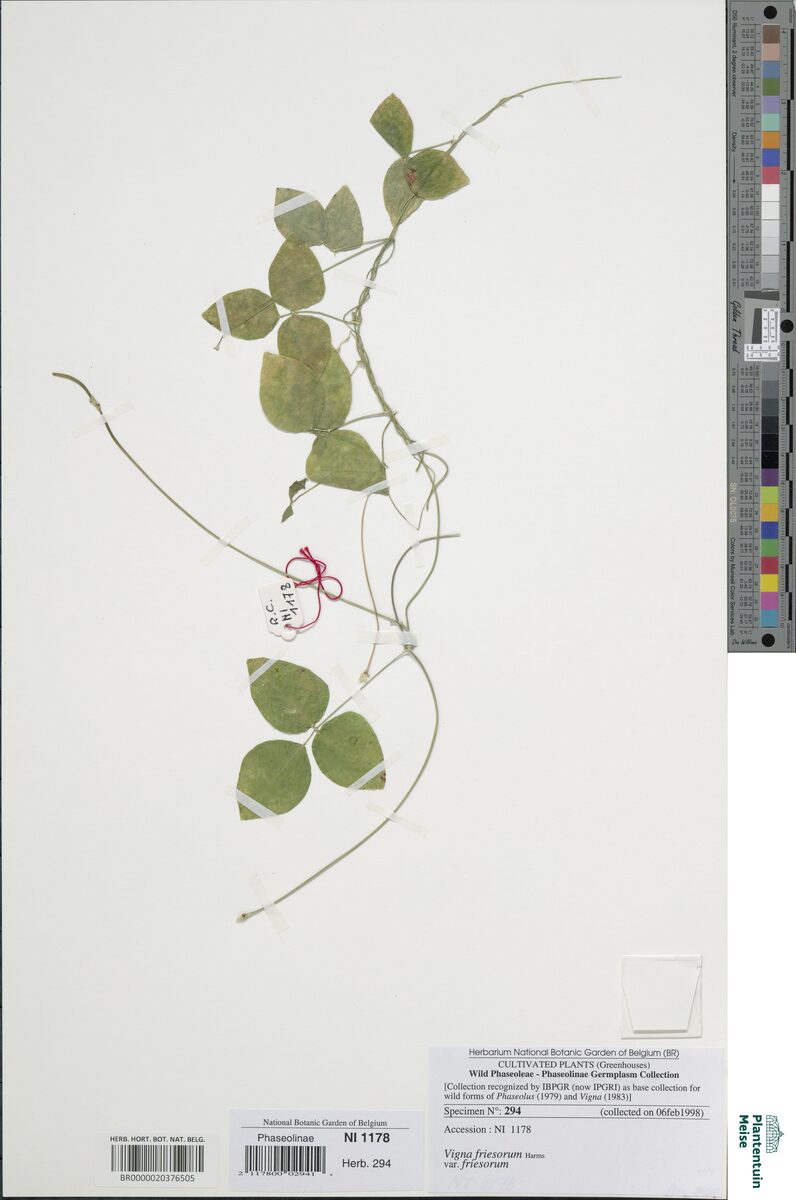
Wisteria villosa
Rehder
gbif· cc-by-nc
Louisiana State University, Shirley C. Tucker Herbarium (LSU-Vascular Plants)
gbif· cc0
Conveyor Belt
gbif· cc0
Conveyor Belt
Summary
A deciduous climbing vine. Flowers April to May with seeds ripening July to October. Hermaphroditic and insect-pollinated. Nitrogen-fixing. Grows in sandy, loamy, or clay soils with good drainage; prefers mildly acid to neutral pH. Requires full sun and moist soil.
Description
A deciduous climbing vine. Flowers April to May with seeds ripening July to October. Hermaphroditic and insect-pollinated. Nitrogen-fixing. Grows in sandy, loamy, or clay soils with good drainage; prefers mildly acid to neutral pH. Requires full sun and moist soil.
Edible Uses
The flowers are edible, though no further preparation details are recorded.
Medicinal Uses
None known.
Known Hazards
The seed of all members of this genus is poisonous.
Distribution
It is a temperate plant.
Where It Grows
Asia, China,
Cultivation
We have very little information on this species, though it is as hardy as W. sinensis and is quite possibly no more than a form of that species. The following notes are based on the general needs of the genus. Prefers a good loamy soil in a sunny south or south-west facing position, sheltered from cold winds and from early morning sun on frosty mornings. Plants can become chlorotic on alkaline soils. A soil that is too rich results in excessive foliage at the expense of flowering. Plants can take a few years to settle down after planting out. Too much shade or too rich a soil are normally the culprits, some form of root restriction can be beneficial. Any drastic pruning is best carried out in the spring, immediately after flowering. Plants are very tolerant of even the most drastic pruning and will re-grow even if cut right back to the base. Plants in this genus are notably susceptible to honey fungus. This species has a symbiotic relationship with certain soil bacteria, these bacteria form nodules on the roots and fix atmospheric nitrogen. Some of this nitrogen is utilized by the growing plant but some can also be used by other plants growing nearby. The plants also form a symbiotic relationship with a mycorrhizal fungus which makes more water, phosphorus and other minerals available to the plants.
Propagation
Seed has no dormancy requirements and can be sown as soon as it is ripe in a cold frame, germinating the following spring. Stored seed should be pre-soaked for 24 hours in warm water before sowing in a greenhouse in early spring. Seed can also be sown in an outdoor seedbed in late spring, with germination usually occurring the first spring, though it may sometimes be delayed by a further 12 months. Prick out seedlings into individual pots when large enough to handle and overwinter in a cold frame, planting out in late spring or early summer. Plants grown from seed are very slow and may take up to 20 years to flower. Basal cuttings of side-shoots can be taken in early to mid summer in a frame, once the new growth has hardened sufficiently. Each cutting should carry 2–3 leaves, and removing a shallow slice of bark from the bottom 15mm of the cutting helps expose extra cambium, encouraging callusing and better rooting. In a mist frame with bottom heat of 27–30°C, cuttings will root within 4 weeks and produce well-established plants by autumn. Layering in spring is also effective — lay a long shoot along the ground, cover with a shallow layer of soil, and it will produce roots at intervals along the stem. Once roots are well formed, the shoot can be divided into several plants, potted up, and kept in a lightly shaded position in a greenhouse until established before planting out.
Other Uses
The plant is a nitrogen fixer.
Notes
There are 10 Wisteria species.
Synonyms
References (1)
- Altschul, S.V.R., 1973, Drugs and Foods from Little-known Plants. Notes in Harvard University Herbaria. Harvard Univ. Press. Massachusetts. no. 1750