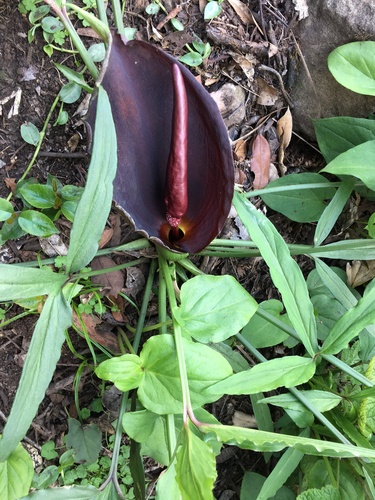
Montrichardia arborescens
(L.) Schott.
Chinchin banana
iNaturalist· cc-by-nc-nd
(c) bathyporeia, some rights reserved (CC BY-NC-ND)
iNaturalist· cc-by-nc
(c) Maggie Wagner, some rights reserved (CC BY-NC)
Summary
Source: WikipediaMontrichardia arborescens, the yautia madera, or moco-moco, is a tropical plant growing along river banks, swamps, or creeks. They consist of arrow shaped leaves that are food sources for some animal species. The plant produces inflorescences which then leave a fruit of Montrichardia arborescens which is edible and can be cooked. Its fruiting spadices produces large infructescences, which contain about 80 edible yellow fruit.
Description
It is a tree like aroid. It grows in wet places. The stems are pliable and covered with spines. It can grow 7 m tall. The stem is 5 cm across at the base. It is soft and spongy. The leaves are arrow head shaped. They are 40 cm long. The leaf stalk is about 32 cm long and sheaths the stem. The flowering stalk is like a lily and is a spike 11 cm long. It has a hood like bract around it. This can be 18 cm long. The flowers have a strong smell. They are white. The fruits have about 80 yellow fruit is a cluster. Each fruit is about 4 cm long. The fruit are edible.
Edible Uses
The fully ripe fruits and seeds are roasted or cooked and eaten. The starchy roots are also eaten.
Traditional Uses
The roasted fruit and seeds are eaten. The fruit need to be fully ripe. The seeds are cooked or roasted. The starchy roots are also eaten.
This uses section is brief — help expand it
Medicinal Uses
In Suriname, the milky juice of the stem is used in the treatment of deep external cuts. Its sap was first determined to be caustic and can cause dermatitis. It was later found that it can also be used against nose bleeds, sore eyes, and the sap can also be applied to ulcers in a poultice. Dried roots and leaves can also be taken to relieve hypertension and shoot juices for other shamanic practices.
Distribution
They are tropical plants. They grow in marshes. In Costa Rica it grows from sea level to about 100 m altitude. It can grow amongst mangroves and in estuaries. The temperature needs to be above 25°C.
Where It Grows
Argentina, Asia, Belize, Bolivia, Brazil, Central America*, Colombia, Costa Rica, Dominican Republic, Ecuador, French Guiana, Grenada, Guadeloupe, Guatemala, Guianas, Guyana, Honduras, Indonesia, Lesser Antilles, Nicaragua, Panama, Paraguay, Peru, Puerto Rico, SE Asia, Singapore, South America, Suriname, Trinidad-Tobago, Venezuela, West Indies*,
Cultivation
Plants can be grown from seed sown into waterlogged soil. They can also be grown from sections of the rhizome.
Production
There are about 80 seeds in each fruit stalk.
Notes
There are 2 Montrichardia species.
Also Known As
Aninha espinho, Arracacho, Boroboro, Chupaya, Fruta del diablo, Imuru, Malanga-gratter, Mokomoko, Montrikardia, Moucou-moucou, Mukumuku, Rabano, Yurika
References (14)
- Altschul, S.V.R., 1973, Drugs and Foods from Little-known Plants. Notes in Harvard University Herbaria. Harvard Univ. Press. Massachusetts. no. 120
- Arac. Betreff. 1:4. 1854
- Brown, D., 2000, Aroids. Plants of the Arum family. Timber Press. (Second edition) p 270, plate 51, 272,
- Coe, F.G., and Anderson, G.J., 1996, Ethnobotany of the Garifuna of Eastern Nicaragua. Economic Botany 50(1) pp 71-107
- Fouqué, A. 1972. Espèces fruitières d'Amérique tropicale. Institut français de recherches fruitierès outre-mer (ifac)
Show all 14 references Hide references
- Kermath, B. M., et al, 2014, Food Plants in the Americas: A survey of the domesticated, cultivated and wild plants used for Human food in North, Central and South America and the Caribbean. On line draft. p 546
- Maas, P.J. M., Non-Timber Forest Products of the North-West District of Guyana Part 2. The 85 most important NTFP species. p 168
- Martin, F. W., et al, 1987, Perennial Edible Fruits of the Tropics. USDA Handbook 642 p 82
- Roa, J. A. G. & Boada, D. S. G., 2018, Fundación para el Fortalecimiento de la Fruticultura y Plantas Alimenticias no Convencionales en Colombia.
- Romanowski, N., 2007, Edible Water Gardens. Hyland House. p 110
- Smith, N., Mori, S.A., et al, 2004, Flowering Plants of the Neotropics. Princeton. Plate 54 (Photo)
- Standley, P. & Steyermark, J., 1958, Flora of Guatemala. Fieldiana: Botany, Volume 24 part 1 p 335
- Sukarya, D. G., (Ed.) 2013, 3,500 Plant Species of the Botanic Gardens of Indonesia. LIPI p 1151 (As Montrichardia aculeatum)
- Zuchowski W., 2007, Tropical Plants of Costa Rica. A Zona Tropical Publication, Comstock Publishing. p 247