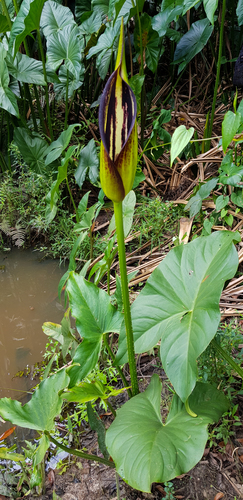
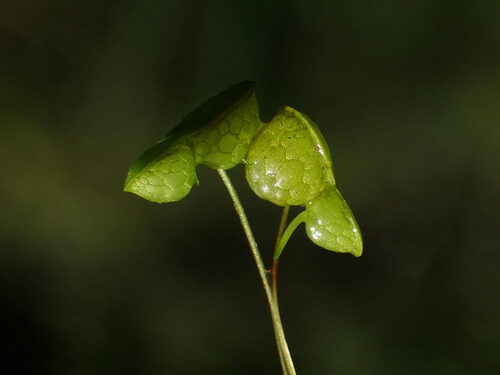
Arisaema jacquemontii
Blume
Jacquemont's cobra lily
iNaturalist· cc-by
(c) Siddarth Machado, some rights reserved (CC BY), uploaded by Siddarth Machado
iNaturalist· cc-by-nc
(c) Azan Khan, some rights reserved (CC BY-NC)
Summary
Source: WikipediaArisaema jacquemontii is a species of flowering plant from the family Araceae that can be found growing on rocky slopes and in the forests on the elevation of 2,400–4,000 metres (7,900–13,100 ft) in 'Afghanistan, East Asia and Himalayas. The species name refers to French botanist Victor Jacquemont.
Description
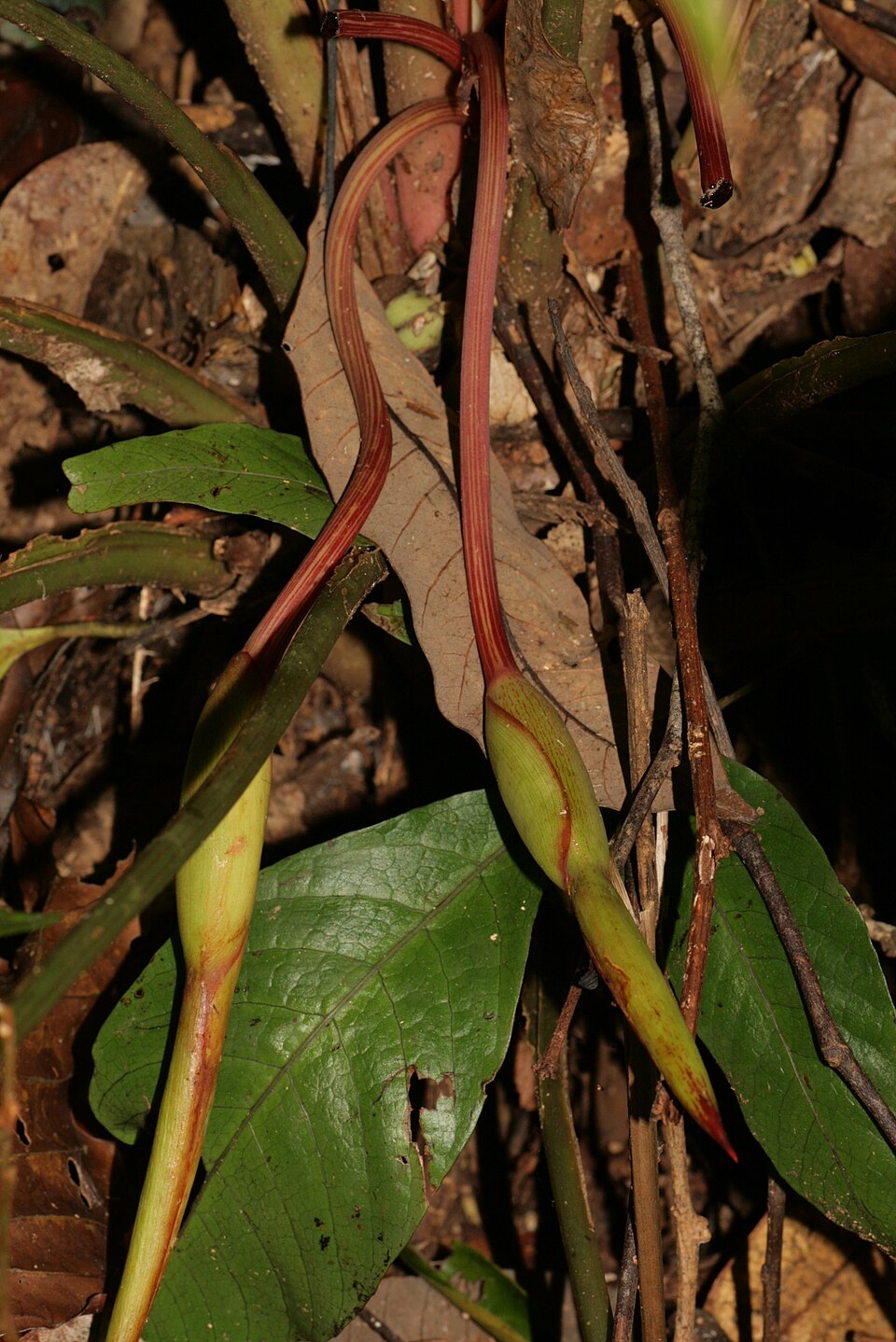
A herb. It grows to about 70 cm high. It forms tubers. There is usually one leaf divided into 5-9 lobes. These lobes are narrow and long. They have a long point. They are 5-15 cm long. The flower bract is green with white stripes. The tip is like a tail and curved upwards. It is 15 cm long. The fleshy flower stalk is 3.5-9 cm long. It is slightly curved.
Edible Uses
Edible Parts: Leaves Root Edible Uses: Root - cooked. Used in the same ways as potatoes. The tubers are 12 - 30mm in diameter. The root must be thoroughly cooked or dried before use, see the notes above on toxicity. Leaves - dried. The leaves are fermented before being eaten in Nepal. Some caution is advised, see the notes above on toxicity.
Traditional Uses
The young corms or rhizomes are cooked and eaten. They are eaten with salt or chilli or made into chutneys. The leaves are fermented and stored then eaten. Caution: The fresh plant is poisonous and needs processing.
Medicinal Uses
None known
Known Hazards
The plant contains calcium oxylate crystals. These cause an extremely unpleasant sensation similar to needles being stuck into the mouth and tongue if they are eaten but they are easily neutralized by thoroughly drying or cooking the plant or by steeping it in water.
Distribution
It grows in temperate and subtropical climates. It grows in coniferous forest, open grassy place in forest, rhododendron or junipers thickets, forest margins between 3000-4300 m altitude in China. It grows from 2700-4000 m altitude in Nepal. It is frost hardy.
Where It Grows
Afghanistan, Asia, Australia, Bangladesh, Bhutan, China, Himalayas, India, Nepal, Northeastern India, Pakistan, Sikkim, Tasmania, Tibet,
Cultivation
Prefers a cool moist peaty soil in the bog, woodland garden or a sheltered border in semi-shade. Prefers a loamy or peaty soil and will tolerate a sunny position if the soil is moist but not water-logged and the position is not too exposed. This is probably the hardiest of the Himalayan species and should succeed outdoors in a suitable position in many parts of the country. Only plant out full sized tubers and mulch them with organic matter in the winter. Plants need protection from slugs. Closely related to A. wardii. Most species in this genus are dioecious, but they are sometimes monoecious and can also change sex from year to year.
Propagation
Seed - best sown as soon as it is ripe in a shady position in a cold frame. Stored seed remains viable for at least a year and can be sown in spring in the greenhouse but it will probably require a period of cold stratification. Germination usually takes place in 1 - 6 months at 15°c. When large enough to handle, prick the seedlings out into individual pots and grow them on in light shade in the greenhouse for at least a coupe of years until the corms are more than 20mm in diameter. Plant out into their permanent positions whilst they are dormant. Division of tubers when the plant dies down in late summer.
Other Uses
None known Special Uses
Notes
There are about 150-170 Arisaema species.
Synonyms
Also Known As
Aaltano, Dwa ba, Hapatmakei, Hapetcheor, Khan Banjh, Sarpa komaka, Sarpako makai, Tuklom
References (16)
- Altschul, S.V.R., 1973, Drugs and Foods from Little-known Plants. Notes in Harvard University Herbaria. Harvard Univ. Press. Massachusetts. no. 153
- Bhattarai, S and Chaudary, R. P., 2009, Wild Edible Plants Used by the People of Manang District, Central Nepal. Ecology of Food and Nutrition, 48:1-20
- Boesi, A., 2014, Traditional knowledge of wild food plants in a few Tibetan communities. Journal of Ethnobiology and Ethnomedicine 10:75
- Brown, D., 2000, Aroids. Plants of the Arum family. Timber Press. (Second edition) p 315
- Dangol, D. R. et al, 2017, Wild Edible Plants in Nepal. Proceedings of 2nd National Workshop on CUAOGR, 2017.
Show all 16 references Hide references
- Flora of Pakistan.
- Gautam, R. S., et al, 2022, Ethnobotanical Review of Wild Edible Plants of Nepal. Journal of Natural History Museum Volume 32, 2021-22 p 104
- Ghimire, S. K., et al, 2008, Non-Timber Forest Products of Nepal Himalaya. WWF Nepal p 24
- Hibbert, M., 2002, The Aussie Plant Finder 2002, Florilegium. p 32
- Joshi, N., et al, 2007, Traditional neglected vegetables of Nepal: Their sustainable utilization for meeting human needs. Tropentag 2007. Conference on International Agricultural Research for Development.
- Li Heng, Araceae, Flora of China
- Manandhar, N.P., 2002, Plants and People of Nepal. Timber Press. Portland, Oregon. p 96
- Mir, M. Y., 2014, Documentation and ethnobotanical survey of wild edible plants used by the tribals of Kupwara, J & K, India. International Journal of Herbal Medicine. 2(4): 11-18
- Plants for a Future database, The Field, Penpol, Lostwithiel, Cornwall, PL22 0NG, UK. http://www.scs.leeds.ac.uk/pfaf/
- Rawat, G.S., & Pangtey, Y.P.S., 1987, A Contribution to the Ethnobotany of Alpine Regions of Kumaon. J. Econ. Tax. Bot. Vol. 11 No. 1 pp 139-147
- Ryan, S., 2008, Dicksonia. Rare Plants Manual. Hyland House. p 121