Arisaema costatum
(Wall.) Mart.
iNaturalist· cc-by
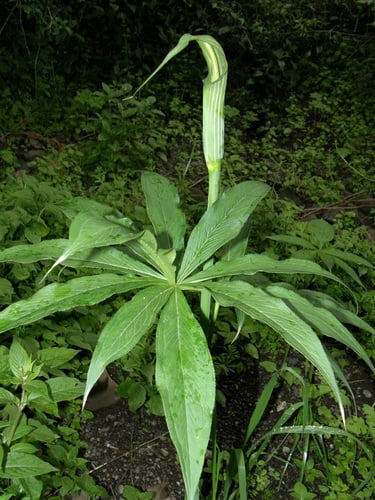
(c) Sagnik Dutta Roy, some rights reserved (CC BY), uploaded by Sagnik Dutta Roy
iNaturalist· cc-by
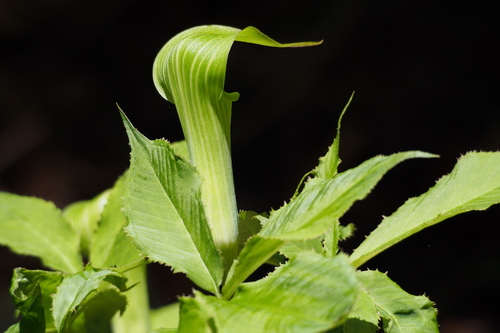
(c) Sagnik Dutta Roy, some rights reserved (CC BY), uploaded by Sagnik Dutta Roy
iNaturalist· cc-by
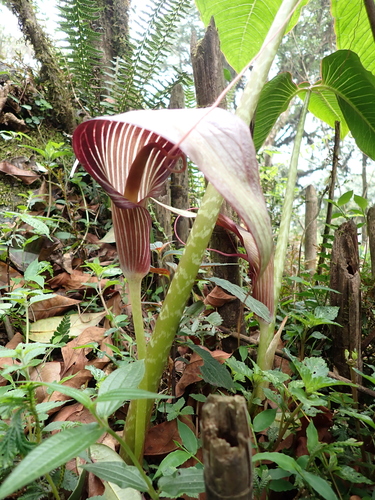
(c) Sagnik Dutta Roy, some rights reserved (CC BY), uploaded by Sagnik Dutta Roy
Summary
Source: WikipediaHerbaceous perennial growing 60cm tall by 40cm wide. Monoecious with both sexes on same plant, though not self-fertile; pollinated by flies. Flowers June to July. Hardy to UK zone 7. Prefers light sandy or medium loamy, well-drained soils with mildly acid to alkaline pH. Tolerates full to partial shade and requires moist soil.
Description
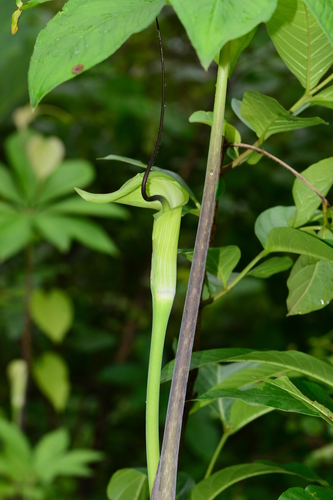
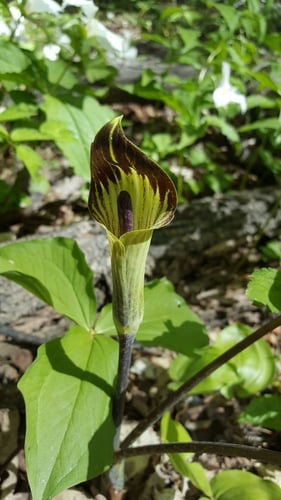
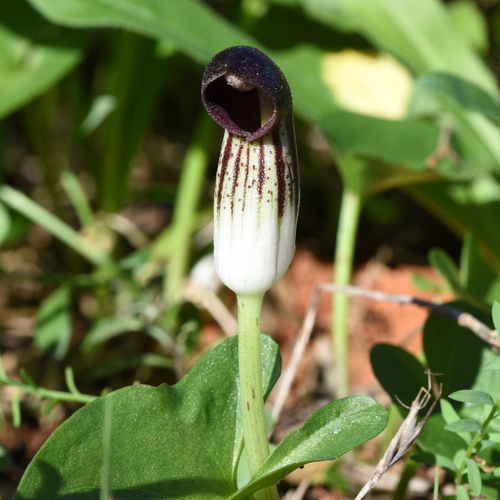
A tuber plant which keeps growing from year to year. It is 35-50 cm high. The tuber is round and falettened and 3-5 cm across. There is one leaf which is divided into 3 leaflets. The leaflets are oval and 40 cm long. They have a red edge. The bract around the flower is deeply hooded. It is dark red with white stripes. It is 10-15 cm long with a long pointed tip. The flower stalk is narrow and light red. It trails to 45 cm long.
Edible Uses
Edible Parts: Root Edible Uses: Root - cooked. It is boiled, dried and then ground into a powder. The tuber is 3 - 5cm in diameter. Some caution is advised, see the notes above on toxicity.
Traditional Uses
The dried leaves are boiled and cooked as a vegetable. The young shoots are used to make curries. The corm is eaten after repeated boiling. Caution: It is toxic unless it is properly processed.
Medicinal Uses
None known
Distribution
It is a temperate plant. It grows in grasslands in forest area between 2300-2400 m in China. It is frost hardy.
Where It Grows
Asia, China, Himalayas, India, Myanmar, Nepal, SE Asia, Tibet,
Propagation
Seed - best sown as soon as it is ripe in a shady position in a cold frame. Stored seed remains viable for at least a year and can be sown in spring in the greenhouse but it will probably require a period of cold stratification. Germination usually takes place in 1 - 6 months at 15°c. When large enough to handle, prick the seedlings out into individual pots and grow them on in light shade in the greenhouse for at least a coupe of years until the corms are more than 20mm in diameter. Plant out into their permanent positions whilst they are dormant. Division of tubers when the plant dies down in late summer.
Other Uses
None known Special Uses
Notes
There are about 150-170 Arisaema species.
Synonyms
Also Known As
Asek kaki, Dhakayo, Glatli, Jangali makai, Sarpa makai, Thwa, Tobyo
References (6)
- Brown, D., 2000, Aroids. Plants of the Arum family. Timber Press. (Second edition) p 314
- Ghimire, S. K., et al, 2008, Non-Timber Forest Products of Nepal Himalaya. WWF Nepal p 23
- Hedrick, U.P., 1919, (Ed.), Sturtevant's edible plants of the world. p 72
- Khakurel, D., et al, 2021, Foods from the wild: Local knowledge, use pattern and distribution in Western Nepal. PLOS ONE.
- Plants for a Future database, The Field, Penpol, Lostwithiel, Cornwall, PL22 0NG, UK. http://www.scs.leeds.ac.uk/pfaf/
Show all 6 references Hide references
- Uprety, Y., et al, 2016, Traditional use and management of NTFPs in Kangchenjunga Landscape: implications for conservation and livelihoods. Journal of Ethnobiology and Ethnomedicine (2016) 12:19