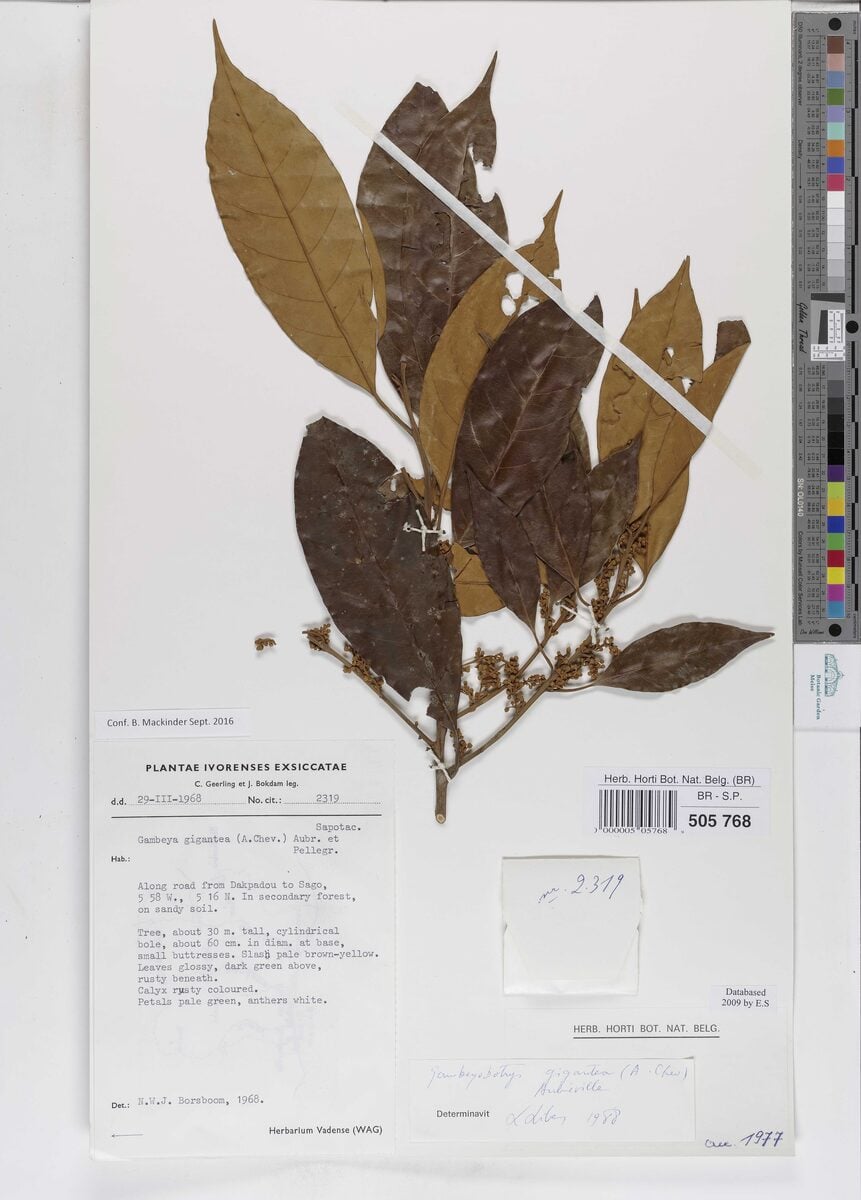
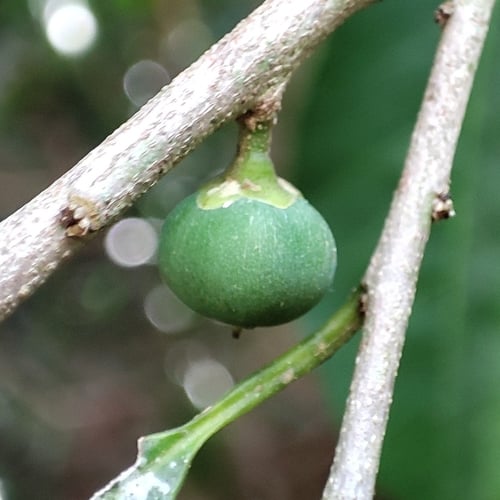
Manilkara salzmannii
(A. de Candolle) Lam.,
Massaranduba, Black massaranduba, Macaranduba-pre-ta
iNaturalist· cc-by-nc
(c) riancarlos, some rights reserved (CC BY-NC)
iNaturalist· cc-by-nc
(c) riancarlos, some rights reserved (CC BY-NC)
iNaturalist· cc-by-nc
(c) riancarlos, some rights reserved (CC BY-NC)
Description
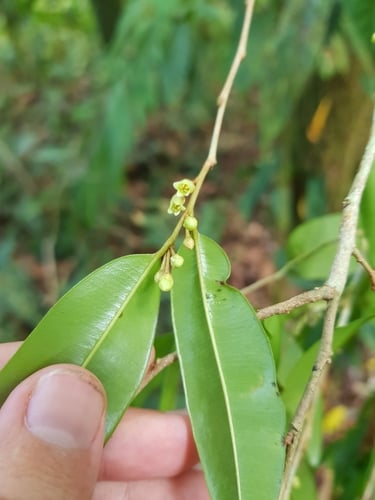
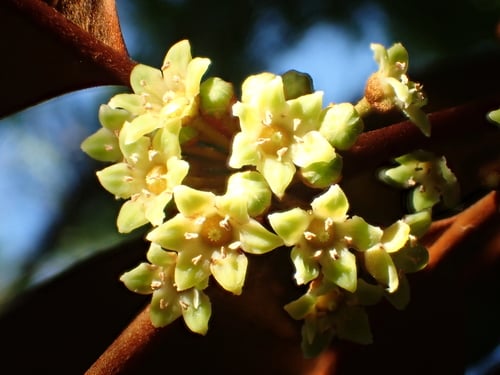
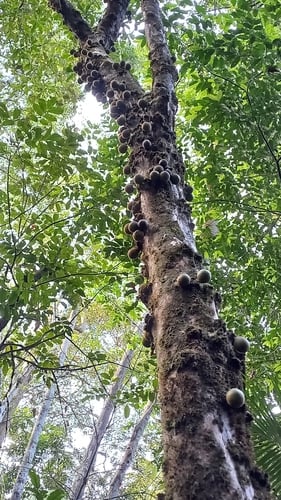
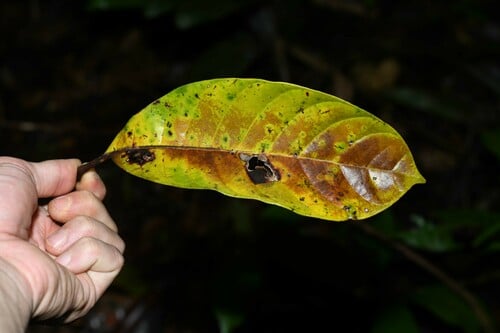
A small to large tree. They are often 10 m high. They can be 30 m high in lowland rainforest. The bark is cracked. The young branches are pale grey. They are hairy are first but become smooth. The leaves are 4-13 cm long by 2-5.7 cm wide. They are often fattened and sword shaped. There are 10-16 pairs of veins. The leaf stalk is 0.5-2.1 cm long. It has a channel along it. The flowers occur as 3-10 in a tuft of branches arising from the one place. The flower stalk is 0.7-1.5 cm long. The flowers are white or cream and can have a scent. The fruit is 2-2.5 cm long by 1.7-2.5 cm wide. It is oval or round. It becomes reddish-orange to purple-black at maturity. There are 1 or 2 seeds. The seeds are 1.3-1.5 cm long by 0.8-0.9 cm wide and flattened. The seed coat is hard and smooth. The fruit is edible.
Edible Uses
Fruit - raw. A berry containing 1- 2 hard seeds enclosed in a sweet, succulent pulp. The fruit is up to 3cm in diameter. The latex from the bark is edible.
Traditional Uses
The fruit are eaten fresh.
This uses section is brief — help expand it
Distribution
A tropical plant. Sea level to 200 m. It grows in the coastal region in Brazil. It grows in mangrove, sandy and rocky shores.
Where It Grows
Brazil*, South America,
Cultivation
Plants are grown from seed. Ripe fruit are harvested and put into plastic bags to soften. The seeds are removed. Fresh seed are planted. They germinate in 4-60 days.
Propagation
Seed - best sown as soon as it is ripe. Sow in a well-drained seedbed in a sunny position. Germination usually takes place in 6 - 9 weeks, though germination rates are usually low.
Other Uses
A latex is obtained from the bark. The wood is very heavy, of medium texture and straight grained. It has excellent mechanical properties and great natural durability, even when exposed. It is used for external work in general, railway ties, poles, fence posts, construction etc.
Production
Plants grow at a moderate rate.
Notes
There are about 75 Manilkara species.
References (6)
- Fouqué, A., 1972, Espèces fruitières d'Amérique tropicale. Institut français de recherches fruitierès outre-mer (ifac)
- Grandtner, M. M. & Chevrette, J., 2013, Dictionary of Trees, Volume 2: South America: Nomenclature, Taxonomy and Ecology. Academic Press p 379
- Kermath, B. M., et al, 2014, Food Plants in the Americas: A survey of the domesticated, cultivated and wild plants used for Human food in North, Central and South America and the Caribbean. On line draft. p 520
- Lorenzi, H., 2002, Brazilian Trees. A Guide to the Identification and Cultivation of Brazilian Native Trees. Vol. 02 Nova Odessa, SP, Instituto Plantarum p 332
- Lorenzi, H., Bacher, L., Lacerda, M. & Sartori, S., 2006, Brazilian Fruits & Cultivated Exotics. Sao Paulo, Instituto Plantarum de Estuados da Flora Ltda. p 296
Show all 6 references Hide references
- Pennington, T.D., 1990, Sapotaceae in Flora Neotropica Monograph 52. New York Botanical Gardens. p 55