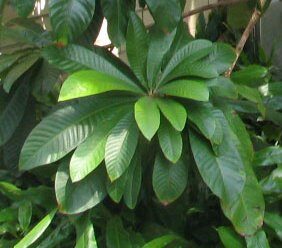
Chrysophyllum gorungosanum
Engl.
Brown-berry fluted milkwood
iNaturalist· cc-by-nc
(c) andreaudzungwa, some rights reserved (CC BY-NC)
iNaturalist· cc-by-nc
(c) andreaudzungwa, some rights reserved (CC BY-NC)
iNaturalist· cc-by-nc
(c) andreaudzungwa, some rights reserved (CC BY-NC)
Description
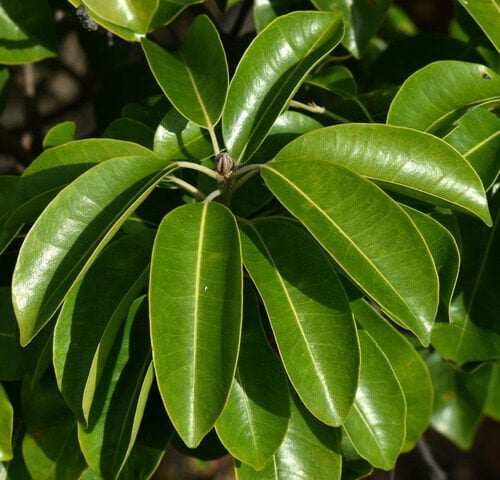
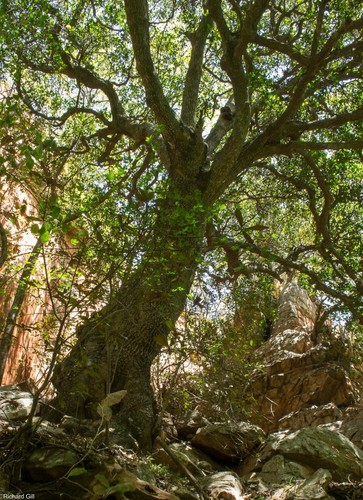
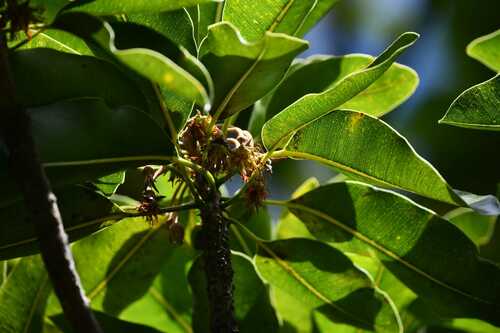
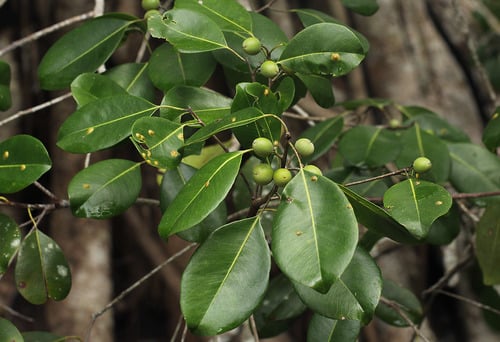
A tall evergreen tree. It grows 30-40 m tall. It has a straight slender trunk which branches after about 16 m. It has a small spreading crown. The trunk is fluted. Young parts of the tree are covered with golden-brown fairs. The bark is light grey. It has cracks along its length. The leaves are narrow and oblong. They are stiff and 7-15 cm long. They narrow towards the leaf stalk. The leaf stalk is 2.5 cm long. The upper surface of the leaves is dark green and shiny. The lower surface is covered with brown to silver hairs. The midrib and veins are prominent under the leaf. There are 10-17 pairs of side veins clearly curved towards the leaf tip. The flowers are yellow and very small. They are in short stalked clusters beside the leaves. The fruit is oval and 4 cm long. It has dense brown hairs which rub off in patches. There are 3-5 flat seeds inside the fleshy fruit.
Edible Uses
The oval fruits are eaten fresh or processed into jam.
Traditional Uses
The fruit is eaten. They are also used for jam.
This uses section is brief — help expand it
Distribution
A tropical plant. It grows in lower mountain forest in Uganda. It occurs in evergreen forest.
Where It Grows
Africa, Angola, Burundi, Cameroon, Central Africa, Congo, East Africa, Kenya, Malawi, Mozambique, Rwanda, Southern Africa, Tanzania, Uganda, Zimbabwe,
Cultivation
Plants are grown from seed. They can be sown direct or in pots then transplanted. For seed the fruit are collected after falling to the ground then crushed and the seed extracted. Seed can be stored in a cool place. Shade should be provided for young plants.
Other Uses
A white latex exudes from incisions in the bark. The wood is pinkish brown, straight-grained, medium texture, liable to split in the log and to warp on seasoning. It is used for timber, grain mortars, beehives, veneer and plywood.
Notes
There are about 80-150 Chrysophyllum species. They are mostly in tropical America. There are 44 species in tropical America.
Synonyms
Also Known As
Chifila, Mucasi, Muchanje, Muchanza, Mufu, Umutooyi
References (10)
- Ferns, Useful Tropical Plants
- Fox, F. W. & Young, M. E. N., 1982, Food from the Veld. Delta Books. p 339
- Katende, A.B., Birnie, A & Tengnas B., 1995, Useful Trees and Shrubs for Uganda. Identification, Propagation and Management for Agricultural and Pastoral Communities. Technical handbook No 10. Regional Soil Conservation Unit, Nairobi, Kenya. p 180
- Lemmens, R.H.M.J., 2007. Chrysophyllum africanum A.DC. [Internet] Record from Protabase. Louppe, D., Oteng-Amoako, A.A. & Brink, M. (Editors). PROTA (Plant Resources of Tropical Africa), Wageningen, Netherlands. < http://database.prota.org/search.htm>. Accessed 14 October 2009.
- Monogr. afrik. Pflanzen-Fam. 8:44. 1904
Show all 10 references Hide references
- Palgrave, K.C., 1996, Trees of Southern Africa. Struik Publishers. p 725
- White, F., Dowsett-Lemaire, F. and Chapman, J. D., 2001, Evergreen Forest Flora of Malawi. Kew. p 538
- Williamson, J., 2005, Useful Plants of Malawi. 3rd. Edition. Mdadzi Book Trust. p 64
- World Checklist of Useful Plant Species 2020. Royal Botanic Gardens, Kew (As Gambeya gorungosana)
- www.zimbabweflora.co.zw 2011